


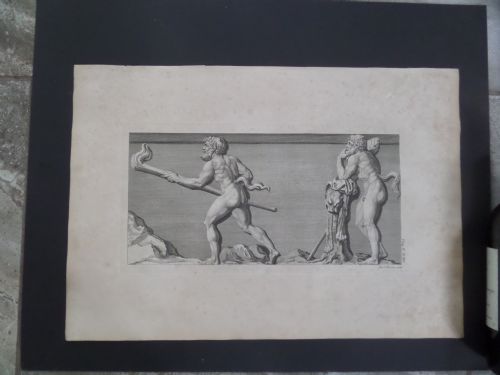
Greek Mythology Engraving
These greek mythology engraving works bring neoclassical deities and architectural studies from the eighteenth century and early twentieth century straight to your walls.
Greek Mythology Engraving
A greek mythology engraving captures classical deities, mythological figures, and architectural antiquities from Athens on paper using ink. You will most frequently meet eighteenth-century plates and early twentieth-century neoclassical illustrations on this page.
The subjects range from depictions of Eros, Aphrodite, and satyrs to personified wind gods such as Zephyros, Euros, Apeliotes, Kaikas, and Boreas. These works often originate from ambitious archaeological and art historical surveys of the period.
Framed prints and fine art prints appear alongside loose sheets, frequently mounted behind glass within wood, metal, gilded wood, or giltwood frames. Each piece offers a direct window into neoclassical taste and antiquarian scholarship.
Materials and technique
These works rely on ink applied to paper through manual printing techniques, capturing fine lines for both figural subjects and architectural detail. Master engravers and etchers produced plates that recorded classical sculpture, ruins, and mythical narratives.
Completed prints are housed in frames constructed from wood, metal, gilded wood, or giltwood, often protected behind glass to preserve the paper from atmospheric damage.
Wind gods from the Tower of the Winds in Athens appear frequently, ensuring your walls are perpetually surveyed by ancient meteorological deities.
Judging quality and execution
The distinction in quality rests upon the crispness of the ink impression and the depth of the engraved line. Plates pulled early in the printing run preserve the sharpest architectural details and the most subtle facial expressions of the gods.
Framing and mounting materials also set examples apart, with period giltwood and gilded wood surrounds offering a more sympathetic historical context for eighteenth-century sheets than modern mouldings.
John Flaxman·James Basire·Edward Rooker
The Greek Mythology Engraving Glossary
- Engraving
- A printmaking technique where an artist cuts lines directly into a metal plate with a sharp tool called a burin. The resulting incisions hold the ink for transfer to paper under pressure.
- Etching
- A method where acid bites lines into a metal plate through a protective ground. This process allows for freer, more fluid lines than traditional engraving.
- Neoclassical
- A style spanning the eighteenth and early twentieth centuries that revived the classical forms, motifs, and proportions of ancient Greece and Rome. It dominates the architectural and mythological subjects seen here.
- Antiquities
- Ancient relics and architectural remains, particularly those from Greece and Rome. Eighteenth-century publications often documented these sites through detailed engraved plates.
Greek Mythology Engraving: Frequently Asked Questions
What is a greek mythology engraving?
A greek mythology engraving is an inked paper print depicting classical deities, mythical scenes, or ancient architecture. These works date primarily from the eighteenth and early twentieth centuries.
They reflect the period's deep fascination with classical antiquity, archaeology, and neoclassical art, often serving as plates in bound architectural surveys before being separately framed.
How were these prints originally used?
Many of these engravings served as illustrations within monumental published volumes documenting Athenian antiquities and Homeric epics. Educated collectors bound them into folios or displayed them framed during the grand tour era.
Over time, individual plates were separated from their original volumes to be mounted and framed as standalone works of fine art graphic prints.
How do I care for framed paper prints?
Keep paper prints away from direct sunlight and high humidity to prevent the ink from fading and the paper from yellowing. Acid-free backing materials help preserve the sheet over decades of display.
Ensure that the glass does not touch the surface of the paper directly, allowing a small air gap to prevent moisture condensation and adherence.
How can I tell eighteenth century prints apart?
Eighteenth-century impressions typically display heavier, laid paper with distinct watermarks and plate marks pressed firmly into the sheet margins. The typography and publishing inscriptions along the lower edge often reveal the exact survey or volume of origin.
Twentieth-century neoclassical illustrations tend to use smoother wove paper stock and exhibit cleaner, more uniform mechanical impressions without the distinct plate sinkage of earlier hand-pulled copperplate engravings.