
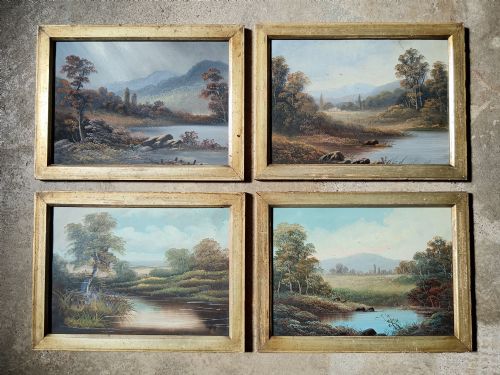


Gouache Landscape Art
Gouache landscape art offers dense, matte pigment views of countryside and city, prized for rich colour and crisp detail.
Gouache Landscape Art
Gouache landscape art encompasses works executed in opaque watercolour on paper, capturing topographical views, picturesque ruins and foreign travels across multiple centuries. Buyers encounter framed paintings dating from the eighteenth century through the mid-twentieth century, reflecting diverse regional aesthetics from British countryside scenes to Mediterranean vistas.
The selection ranges from intimate nineteenth-century Grand Tour souvenirs of Naples to early twentieth-century depictions of Dartmoor and Exmoor. Mid-century examples introduce modernist abstractions and cubist interpretations of French landscapes, demonstrating the enduring versatility of the medium across different artistic movements.
Materials and technique
Artists create these works using heavy opaque gouache, frequently combined with watercolour, pastel or ink upon paper supports. This water-soluble medium permits both delicate washes and thick, light-reflecting impasto applications that yield saturated colour values.
Preservation typically involves framing behind glass within wooden surrounds, sometimes incorporating gilded or gilt wood mouldings to protect the paper substrate from atmospheric degradation and environmental moisture.
Artists occasionally deployed heavy opaque gouache to capture the steely moonlight reflecting off Venetian gondolas after dark.
Judging quality
Quality rests upon the surety of the draughtsmanship, the vibrancy of the retained pigment and the atmospheric depth achieved within the composition. Masterful handling of opaque layers creates luminous light effects and spatial perspective that distinguish superior works from standard topographical records.
The integrity of the original paper support and the sympathetic pairing with period frames also determine the standing of a piece. Works demonstrating clear provenance, artist attribution and stable pigment condition represent the pinnacle of the genre.
Joseph Knight·Gaston Cornil·AJ Thornton·Milton Drinkwater·Reginald Mills
The Gouache Landscape Art Glossary
- Gouache
- An opaque watercolour medium composed of ground pigments bound in water-soluble plant gum, often mixed with a white filler to increase opacity. This formulation allows artists to paint light colours over dark backgrounds.
- Grand Tour
- A traditional trip of Europe undertaken by upper-class European young men of sufficient means during the eighteenth and nineteenth centuries. Souvenirs from these journeys frequently included topographical gouache paintings.
- Impasto
- The process of laying paint thickly on a surface so that it stands out from the plane. In gouache works, heavier pigment application creates tangible texture.
- Provenance
- The chronology of the ownership, custody or location of a historical object. Clear documentation confirms authenticity and historical context.
Gouache Landscape Art: Frequently Asked Questions
How do I care for gouache paintings?
Keep works behind glass away from direct sunlight to prevent the organic pigments from fading over time. Maintain stable indoor humidity levels to protect the delicate paper support from warping or foxing.
Ensure frames are securely sealed at the back to deter dust and insect ingress. Professional framing using acid-free materials safeguards the longevity of antique paper works.
What is the difference between gouache and watercolour?
Watercolour is transparent, relying on the white of the paper to reflect light back through the pigment washes. Gouache includes added white chalk or pigment, making the paint opaque and light-absorbent.
This opacity allows artists to paint light tones over dark washes, achieving a matte, velvety finish distinct from traditional transparent watercolour.
How can I date an antique landscape?
Examine the framing methods, paper characteristics and stylistic markers indicative of periods like the Victorian era or mid-century modernism. Signatures, inscriptions and labels on the reverse often provide direct chronological clues.
Costume details in figures or architectural elements depicted within the landscape also help narrow down the decade of creation.
Where were Grand Tour gouaches made?
Grand Tour gouaches were predominantly produced in artistic hubs across Italy, notably Naples and Venice, to cater to travelling collectors. Local studios specialised in rapid, highly decorative views of Mount Vesuvius or the Grand Canal.
These pieces were typically acquired as sets and brought back to Britain or France as mementoes of foreign travel.