




Gothic Brass Book Trough
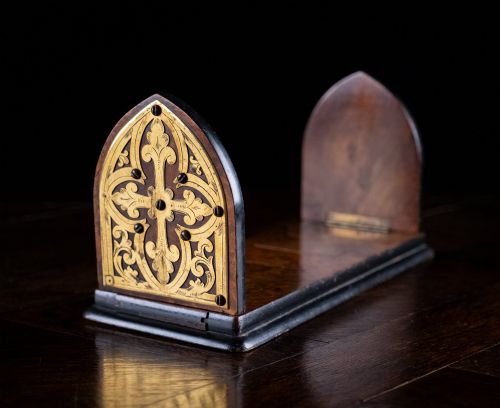
These gothic brass book trough examples are Victorian extending book rests and slides built to keep heavy volumes upright on the desk.
Gothic Brass Book Trough
When you search for a gothic brass book trough, you find Victorian extending book rests, slides, and desk accessories designed to hold household libraries. These pieces belong firmly to the nineteenth century, spanning decades from eighteen sixty to eighteen ninety.
The format typically involves a wooden base fitted with expanding mechanisms and metal mounts. Walnut, mahogany, coromandel, and burr walnut form the primary wooden bodies, while brass provides the structural mounts and gothic architectural framework.
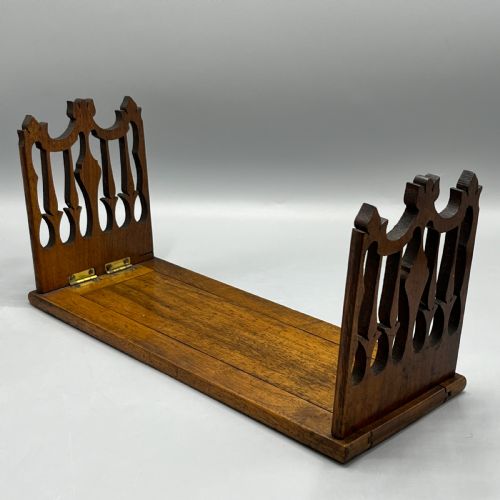
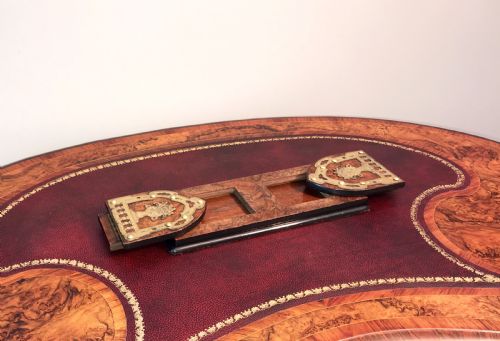
Makers adapted these library accessories to sit upon desks or tables with folding or sliding actions. The prevalent form on this page is the extending book slide, which expands to accommodate varying numbers of volumes.
How they were made
Craftsmen shaped dense hardwoods like walnut, mahogany, and ebony to form the heavy bases of each book slide. They integrated brass mounts, often cast and pierced in gothic revival patterns, to reinforce the joints and frame the ends.
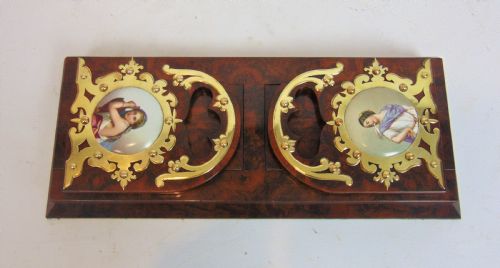
Makers embellished select examples with applied decorative details such as painted porcelain plaques, bone, and inset agate stones. Patent mechanisms, including those by Betjemann, allowed the wooden platforms to slide smoothly on hidden tracks.
Gothic Brass Book Trough Retail Price Guide 2026
Typical asking prices for gothic brass book trough among the pieces listed under this phrase on Sellingantiques today, from the lower quarter to the upper quarter. They describe what is for sale here now, not the wider market.
Every listed piece dates from the Victorian period of the nineteenth century, combining brass with woods like walnut, mahogany, and coromandel.
What varies in quality
Quality rests upon the selection of timbers and the crispness of the brass mounts. Finely figured burr walnut and dense coromandel indicate higher tier production than plain mahogany.
The inclusion of hand-painted porcelain plaques or inset agate distinguishes standard library accessories from superior ornamental pieces. Engineering precision in the extending action also marks the distinction between ordinary utility items and exceptional workshop output.
Betjemanns
The Gothic Brass Book Trough Glossary
- Book slide
- A desk accessory with an extending mechanism designed to hold a row of books upright. It expands or contracts to fit the collection.
- Gothic revival
- An architectural and decorative style popular during the Victorian era. It utilises medieval pointed arches, trefoils, and heavy brass tracery.
- Coromandel
- A dense, heavy timber imported from Asia, valued for its dark brown colour and dramatic contrasting grain. It appears on high-status Victorian desk wares.
- Burr walnut
- Wood taken from the warted growth of a walnut tree, yielding intricate swirling grain patterns. Cabinet makers prized it for decorative veneers.
- Betjemanns patent
- A mechanical expanding action for book slides developed by the Betjemann firm. It allows the ends to move outward smoothly while keeping the base stable.
Gothic Brass Book Trough: Frequently Asked Questions
What periods do these pieces date from?
The listed items originate entirely from the Victorian era, spanning the nineteenth century.
Specific dates within the titles point to production around eighteen sixty, eighteen seventy, and eighteen ninety.
What materials make up the frames?
The structural bodies consist of hardwoods including walnut, burr walnut, mahogany, ebony, and coromandel.
Cast brass forms the mounts, hinges, and architectural gothic framing elements attached to the wood.
What decorative elements appear on the ends?
Many book slides feature pierced brass work in gothic revival patterns to ornament the upright ends.
Selected examples incorporate fine painted porcelain plaques, bone details, or inset agate stones into the wooden body.
Where were these accessories used?
Victorian households placed these book holders on library desks, study tables, and parlour surfaces.
They kept reference books, poetry collections, and daily reading volumes orderly and within reach.