
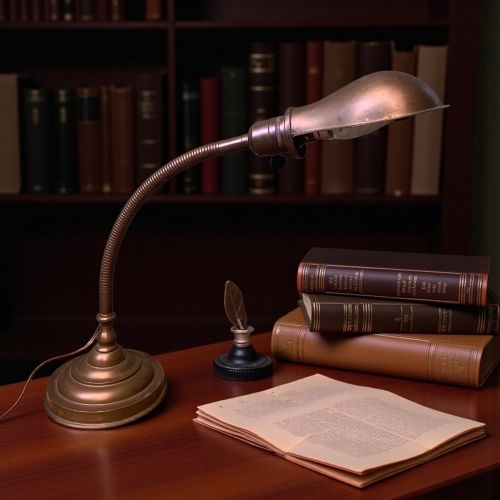


Gooseneck Task Lighting
Gooseneck task lighting brings adjustable illumination to a desk, combining heavy cast iron or brass bases with flexible arms.
Gooseneck Task Lighting
Gooseneck task lighting covers adjustable desk and table lamps designed to focus light precisely where needed. These pieces emerge primarily from the Edwardian era through the nineteen-thirties, spanning styles from Art Nouveau and Art Deco to French Industrial.
The material palette centres on brass, bronze, cast iron, and metal, occasionally paired with fabric, etched glass, cranberry glass, or porcelain shades. Desk lamps and reading lamps dominate the selection, featuring swan neck or flexible stems that bend and pivot.
Materials and Construction
Makers utilised durable metals such as brass, bronze, and cast iron to build sturdy foundations and articulated arms that withstand daily repositioning. Flexible tubing and swan neck designs allow the arm to curve smoothly while maintaining its position.
Shades are fashioned from glass, etched glass, porcelain, fabric, or matching metal, secured to direct the beam efficiently. Wiring configurations often incorporate fabric flex to connect the adjustable head to the power source.
The listings show desk lamps spanning the Edwardian era, nineteen-thirties, and nineteen-hundreds, constructed from brass, bronze, and cast iron.
Evaluating Construction
Quality rests in the substantial weight of the cast iron or brass base, ensuring the lamp remains stable when the arm extends. The articulation mechanism must hold its tension firmly without sagging over time.
Finishes display varying degrees of patination, and original shades in glass, porcelain, or metal elevate the integrity of the piece. Precision in the metalwork distinguishes standard commercial production from finer workshop execution.
Hawkins
The Gooseneck Task Lighting Glossary
- Swan neck
- A curved metal arm that bends like a bird's neck to adjust the height and angle of the light source.
- Cranberry glass
- A rich pinkish-red glass created by adding gold chloride to the molten batch, often utilised for decorative lamp shades.
- Fabric flex
- Flexible electrical wire wrapped in woven fabric, commonly seen on period lighting reconstructions.
- Art Deco
- A design style from the nineteen-thirties characterised by geometric symmetry and streamlined forms.
- Notary lamp
- A traditional desk lamp style designed for reading documents, featuring an adjustable arm and focused directional shade.
Gooseneck Task Lighting: Frequently Asked Questions
What is gooseneck task lighting?
Gooseneck task lighting refers to adjustable desk lamps designed with flexible or curved metal arms that direct illumination onto a specific workspace.
These pieces typically date from the Edwardian period through the mid-twentieth century and utilise heavy metal bases for stability.
How do I date a brass desk lamp?
Dating relies on stylistic clues such as Art Nouveau floral motifs, Art Deco geometric lines, or Edwardian brass construction methods. Material choices like porcelain shades or fabric flex also point to specific manufacturing decades.
Examining the casting quality and switches provides further context for the period of production.
Are these lamps safe to use today?
Many period lamps are rewired to meet modern electrical standards while retaining their original brass, bronze, or cast iron components.
It is advisable to check the wiring status and consult a professional electrician if rewiring is required before daily use.
Can I replace a broken glass shade?
Replacing a shade requires matching the fitter size and style of the original glass, porcelain, or metal component.
Finding period-appropriate replacements preserves the intended aesthetic of Edwardian and Art Deco reading lamps.