




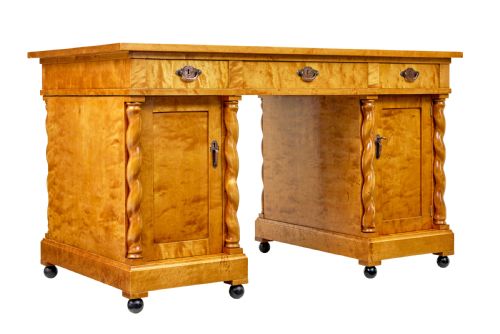


Golden Wood Writing Table
These golden wood writing table examples bring pale figured timbers and purposeful nineteenth-century proportions to a study.
Golden Wood Writing Table
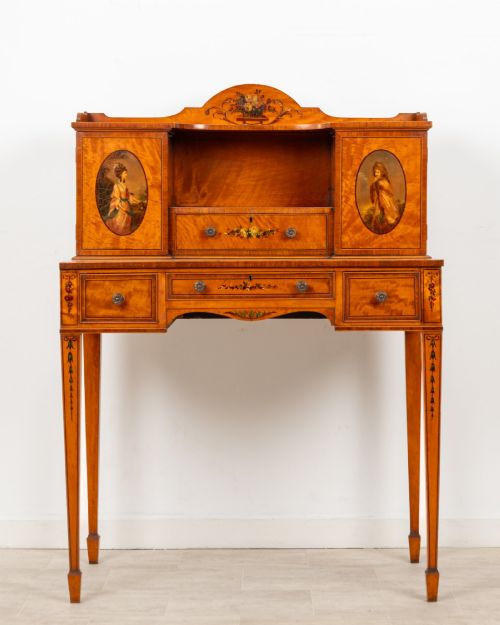
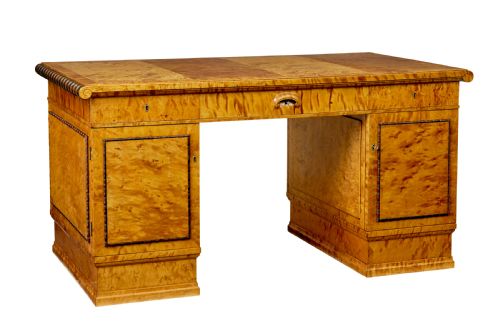
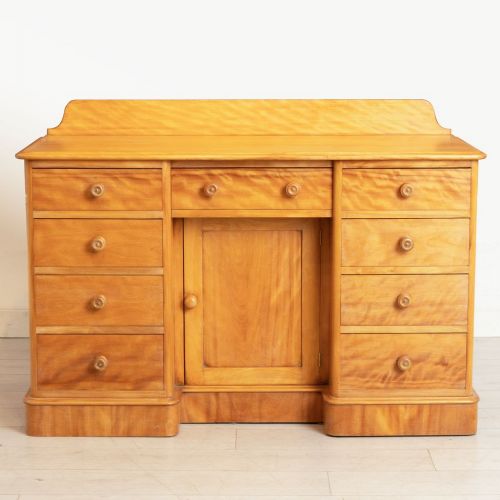
A golden wood writing table serves as a functional workspace, typically taking the form of a freestanding pedestal desk, a kneehole desk, or a compact ladies writing table. The selection spans the eighteenth, nineteenth, and early twentieth centuries, with Victorian satin birch and Edwardian satinwood items appearing most frequently.
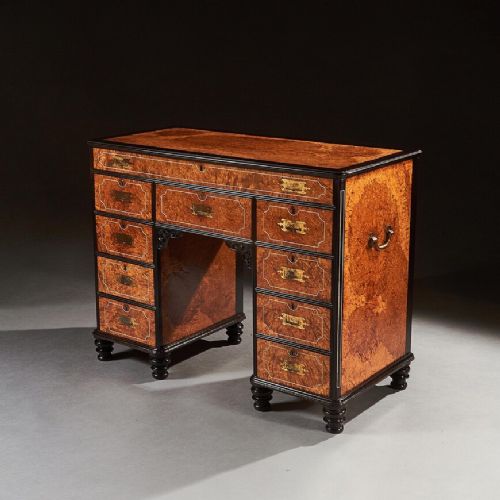
Examples stretch across varied regional traditions and revivals, encompassing Biedermeier burr birch, French Louis XV revival pieces, and Chinese export furniture. Buyers encounter everything from serpentine hall tables to fitted Carlton House desks designed for correspondence.
The form adapts to multiple domestic settings, functioning as a library table or a sofa table alongside its primary role for writing. These pieces rely on light-toned timbers like satinwood and birch to brighten a room while retaining substantial utility.
How they were made
Cabinetmakers utilised pale figured veneers such as satinwood, satin birch, and burr birch applied to sturdy secondary woods like pine. Surface decoration frequently involved contrasting banding in tulipwood, floral hand-painting, and intricate marquetry inlay.
Structural hardware typically incorporates cast brass handles and key escutcheons, occasionally complemented by gilt ormolu mounts. Writing surfaces were traditionally inset with panels of tooled leather to provide a durable writing plane.
Golden Wood Writing Table Retail Price Guide 2026
Typical asking prices for golden wood writing table among the pieces listed under this phrase on Sellingantiques today, from the lower quarter to the upper quarter. They describe what is for sale here now, not the wider market.
Stylistic influences represented in the selection range from Georgian and Victorian to Art Deco and Biedermeier.
What varies in quality
The distinction between tiers rests upon the choice of timber veneer and the precision of its grain matching across the surfaces. Superior examples display carefully selected burr or figured wood that wraps harmoniously around drawers and borders.
Execution of detail defines the upper range, seen in crisp carving, fine floral hand-painting, and precise inlay work. The integration of original brass hardware and well-fitted internal stationery compartments further elevates a piece above standard utility furniture.
The Golden Wood Writing Table Glossary
- Satinwood
- A dense, lustrous timber native to tropical regions, prized for its golden sheen and smooth texture. It became a defining material for refined neoclassical and Edwardian furniture.
- Satin Birch
- A pale northern wood exhibiting a shimmering, chatoyant grain figure. Cabinetmakers utilised it extensively during the Victorian era as a lighter alternative to dark hardwoods.
- Pedestal Desk
- A freestanding desk comprising two supporting banks of drawers beneath a rectangular top. This form offers generous storage while allowing the piece to sit centrally in a room.
- Carlton House Desk
- A Davenport-style writing desk featuring an elevated superstructure of small drawers and pigeonholes arranged in a horseshoe curve. It originated in the late eighteenth century for meticulous correspondence.
- Campaign Desk
- A modular or collapsible writing desk engineered for easy transport by military officers. These items often feature recessed brass handles and corner brackets for protection during travel.
Golden Wood Writing Table: Frequently Asked Questions
How do I care for a satinwood surface?
Keep these golden wood writing table surfaces away from direct sunlight and excessive heat to prevent the pale timber and delicate veneers from fading or drying out.
Apply a traditional beeswax polish sparingly and buff with a soft cloth to maintain the natural lustre without building up heavy chemical residues.
Are these desks suitable for daily computer work?
Many nineteenth-century pedestal and kneehole variations offer adequate knee clearance and surface area to accommodate a modern laptop alongside standard desk accessories.
Consider the internal drawer dimensions carefully if you intend to store modern electronics, as older configurations were designed strictly for paperwork and stationery.
What is the difference between a writing table and a library table?
A writing table generally incorporates drawers integrated into the frieze specifically intended for paper storage and writing implements, often paired with an inset leather top.
Library tables are typically larger freestanding pieces meant for sorting books and manuscripts, sometimes featuring drawers on both sides for shared access in a communal study.
How do I identify a Biedermeier piece?
Biedermeier furniture prioritises clean architectural lines and minimalist restraint, allowing the natural golden figure of burr birch or cherry timber to serve as the primary decoration.
Ornate carving is largely absent, replaced by smooth, unblemished surfaces and subtle geometric banding that highlight the warmth of the wood.