
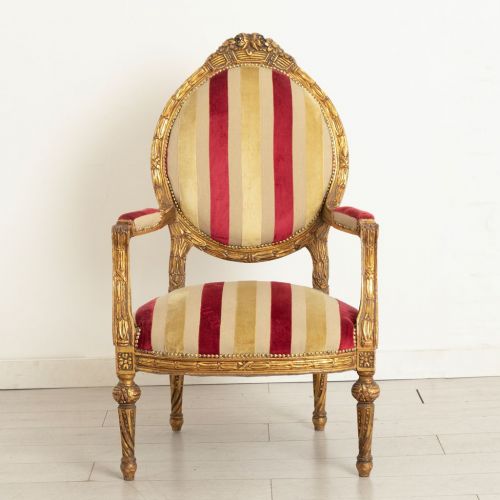


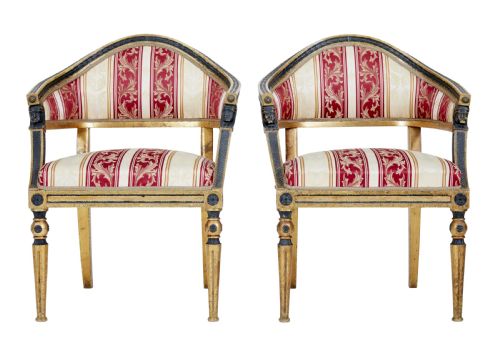


Gold Striped Armchair
A gold striped armchair brings classical proportion and woven texture into a room, offering immediate visual structure through gilded frames and striped textiles.
Gold Striped Armchair
A gold striped armchair represents a distinct intersection of gilded woodwork and patterned textile design, drawing on centuries of European seating traditions. When searching for a gold striped armchair, buyers encounter pieces spanning the 18th century through to the 19th and early 20th centuries. These seating forms encompass French Louis XVI style fauteuils, Swedish Empire models, and Victorian interpretations.
The prevailing form on this page is the open armchair or fauteuil, alongside salon chairs and desk chairs. Origins range across French, Swedish, Italian, and Portuguese workshops, reflecting diverse regional adaptations of classical styles. The overarching unifying element remains the combination of a giltwood or mahogany frame with patterned fabric.
Period variations show distinct stylistic lineages, from Queen Anne style chairs to French Louis XV revival pieces and Regency designs. Buyers select these chairs to anchor a room with architectural woodwork and contrasting textile patterns. Each specimen captures the decorative priorities of its respective decade, whether 1890, 1900, or 1920.
How they were made
Construction relies upon traditional timber framing, utilising materials such as mahogany and giltwood to form the structural skeleton of the seat. Carved showwood details demonstrate hand-chiselled ornamentation, particularly on Swedish and Italian giltwood examples.
Upholstery techniques incorporate textiles, velvet, and woven tapestry fabric stretched over supportive internal webbing and stuffing. Brass fittings and inlay work occasionally supplement the primary timber structures, as seen in specific Regency and Victorian desk and tub chairs.
Portuguese elbow chairs from 1890 occasionally display carving so exuberant it seems the wood itself decided to throw a party.
What varies in quality
Quality resides in the crispness of the wood carving and the depth of the gilding applied to the frame. Hand-carved giltwood elements display sculptural confidence that distinguishes master workshops from standard production.
The selection and execution of the textile upholstery dictate the secondary tier of refinement. Original or period-appropriate woven tapestry fabric and velvet demonstrate a commitment to material integrity that elevates the entire object.
The Gold Striped Armchair Glossary
- Giltwood
- Timber that has been coated with a thin layer of gold leaf or gold paint. This finish creates a reflective surface characteristic of formal European seating.
- Showwood
- Polished or carved wooden framing left visible around the upholstered portions of a chair. It highlights the craftsmanship of the structural skeleton.
- Sabre leg
- A concave sweeping leg that tapers toward the foot, commonly found on Regency furniture. This profile provides both structural stability and visual lightness.
- Tub chair
- An armchair featuring a continuous curved back and arms forming a single enclosure. This form offers a distinct enclosing silhouette compared to open fauteuils.
Gold Striped Armchair: Frequently Asked Questions
What is a gold striped armchair?
A gold striped armchair is a seating piece featuring a gilded or timber frame paired with striped fabric upholstery. These chairs draw on historical European design traditions from the 18th, 19th, and early 20th centuries.
They combine architectural woodwork with patterned textiles, serving as both functional seating and decorative centrepieces within traditional and eclectic interiors.
Where were these armchairs made?
These armchairs originate from various European centres, with French, Swedish, Italian, and Portuguese workshops heavily represented in historical production. Each region imparted local stylistic preferences onto standard classical forms.
Regional variations appear in the carving styles of the giltwood frames and the silhouette of the chair backs and legs.
How do I identify the period?
Period identification relies upon examining stylistic markers such as Louis XVI, Regency, or Queen Anne design idioms. Structural clues like sabre legs or carved showwood also indicate specific eras of manufacture.
Materials such as mahogany or specific giltwood applications help narrow down the decade of production between the 18th and early 20th centuries.
How should I live with one?
Living with a giltwood and upholstered chair involves placing it in low-traffic areas to preserve delicate textile surfaces and gilded finishes. Regular gentle dusting protects the carved woodwork from accumulation.
Pairing the chair with complementary interior tones allows the gold frame and striped textile pattern to function as a focal point without overwhelming the room.