



![Pen and Ink Sketch - Female Nudes by William Edward Frost [1810-1877]](https://www.sellingantiques.co.uk/photosnew/dealer_kendallhouse/dealer_kendallhouse_full_1758970795762-8493507346.jpg)


Gold Mounted Watercolour Painting
These gold mounted watercolour painting pieces offer delicate works on paper framed and set off with gilt work.

Gold Mounted Watercolour Painting
A gold mounted watercolour painting brings together delicate pigment work on paper and the refined shine of gilt frames or gold leaf accents. These works range from the Georgian period through the Victorian era and into the early twentieth century.
Buyers will encounter framed portraits, landscapes, and architectural views spanning multiple centuries. The selection includes individual sheets alongside pairs and grouped sets from British and European schools.
Materials and construction
Artists painted primarily with watercolours on paper, occasionally adding pen and ink or embroidery details. Works are protected under glass and housed within wooden frames finished in gold leaf or giltwood.
The framing method directly incorporates gold elements to highlight the painted surface within. Mounting techniques from various periods utilise wood, glass, and paper components to preserve the delicate pigment.
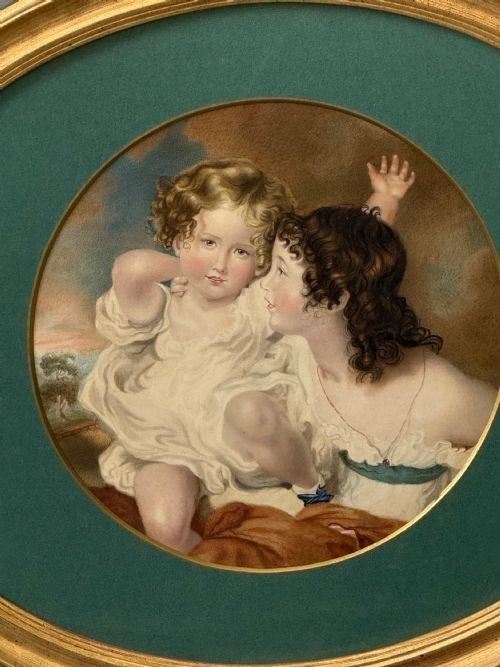
Among the landscapes and portraits, several pieces record quiet moments of children at play and birds perched in plum blossom.
Distinctions in quality
Quality rests upon the precision of the brushwork and the harmony between the painting and its gold mount. Stronger pieces display confident handling of watercolour pigments and well-preserved paper supports.
The character of the gilt frame and the condition of the glass contribute significantly to the overall presence of the piece. Works by recorded artists or distinct regional schools show greater artistic ambition.
William Wood·Robert Winchester Fraser·Harry Bright·William Edward Frost·George Stanfield Walters·James H Hulse·John McDougal·Snaffles·Robert Kemp·Karl Feiertag·Belisario Gioja·Alfred Rimmer·William Crouch·Margaret Thompson·T Fairfax
The Gold Mounted Watercolour Painting Glossary
- Watercolour
- A paint consisting of a solution of colour in water, applied to paper surfaces. This medium allows for transparent washes and delicate tonal gradations.
- Giltwood
- Wood carved and covered with a thin layer of gold leaf or gold paint. This material provides the traditional gleaming border for framed paper works.
- Portrait miniature
- A small, highly detailed portrait painting, often executed on paper or vellum. These intimate works frequently feature gold mountings or specialised frames.
- Eyot
- A small island, particularly one in a river. This subject appears in nineteenth-century watercolour landscapes.
- Gouache
- An opaque watercolour paint sometimes used alongside standard transparent watercolours. It provides denser highlights on the painted surface.
Gold Mounted Watercolour Painting: Frequently Asked Questions
How should I hang a gold mounted watercolour painting?
Keep watercolours away from direct sunlight to prevent the pigments and paper from fading over time. Stable indoor humidity protects both the paper support and the gilt wooden frame.
Position the artwork at eye level where the fine details of the watercolour and the catch of light on the gold mount can be appreciated.
What periods do these paintings come from?
The selection spans from the eighteenth century through the Victorian period and into the mid-twentieth century. Georgian and Victorian examples sit alongside early twentieth-century illustrations and landscapes.
Each period brings distinct framing styles and mounting techniques that reflect the taste of its time.
Are these watercolours always framed under glass?
Glass is standard for works on paper to protect the delicate watercolour medium from dust, moisture, and physical damage. The glass sits between the viewer and the painted surface.
Original glass is frequently retained in antique pieces, contributing to the historical integrity of the framing.
How do I identify a portrait miniature?
Portrait miniatures are notably small paintings executed with fine detail, often depicting specific individuals. They frequently feature specialised gold mountings or protective cases.
These pieces require close viewing to appreciate the precision of the artist's brushwork on a reduced scale.