


Gold Mary Medal
A gold mary medal is a devotional pendant carrying centuries of French craftsmanship, worn as both a personal talisman and a fine jewellery piece.
Gold Mary Medal
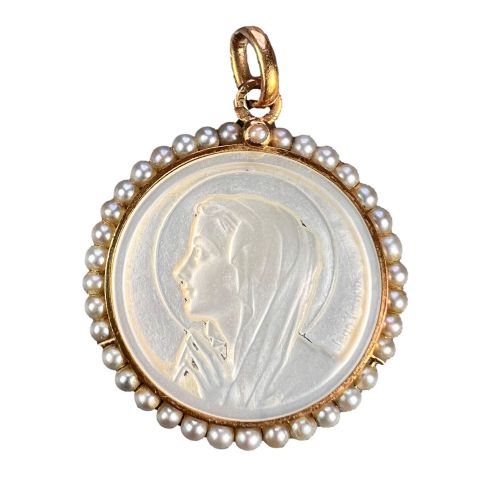
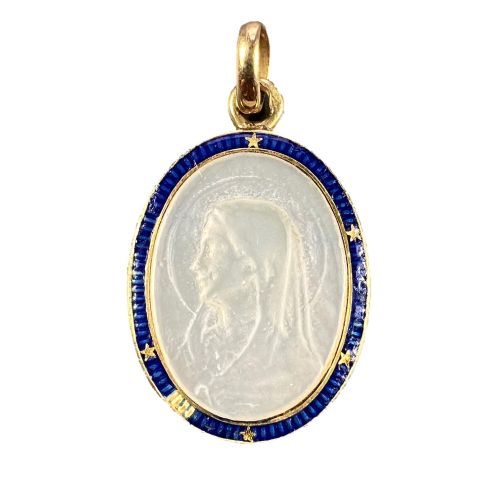
A gold mary medal encompasses devotional pendants and charms dedicated to the Virgin Mary, frequently discovered in French antique variations dating from the late nineteenth century through to the mid-twentieth century. Collectors encounter these pieces primarily as oval or circular medals fashioned in yellow, rose, or white gold, often depicting the Madonna and Child or Notre Dame. The listings show a strong presence of Art Nouveau and religious devotional designs originating from French workshops.
Most examples function as pendant necklaces or charms, integrating imagery such as the Miraculous Medal or the Sacred Heart. The items span multiple decades, maintaining a distinct focus on French religious jewellery from the nineteen-tens and nineteen-twenties. Buyers searching this category frequently evaluate pieces that double as wearable art and spiritual artefacts.
Materials and Techniques
Goldsmiths utilised eighteen-carat yellow, rose, and white gold as the primary metal foundation for these devotional medals, shaping them through casting, piercing, and hand-engraving. The resulting structures often incorporate delicate frames or floral motifs designed to highlight the central devotional portrait.
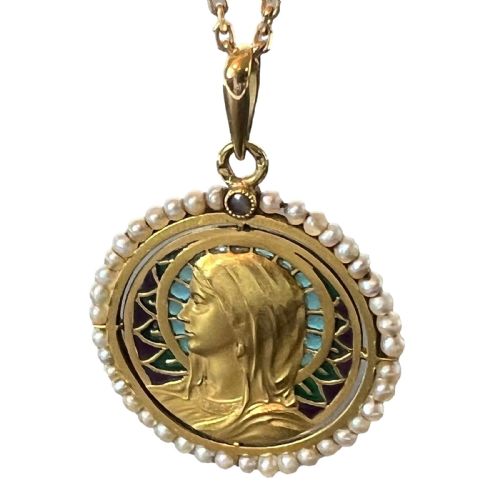
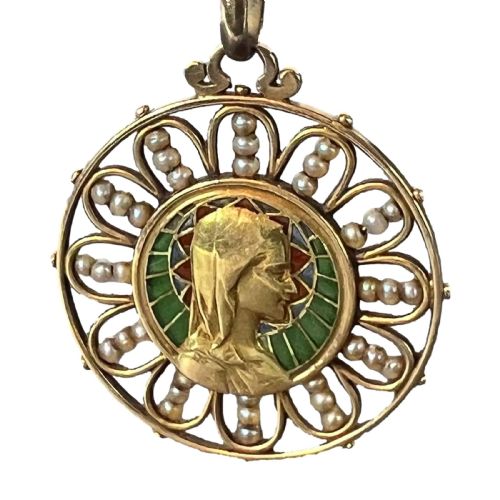
Craftsmen integrated translucent plique-a-jour enamel and opaque enamel to add vibrant colour to the gold surfaces, resembling miniature stained-glass windows. Artisans additionally set seed pearls and mother of pearl into the metalwork, creating luminous borders and contrasting backgrounds for the religious figures.
The documented periods span from eighteen-ninety through the nineteen-fifties, capturing multiple decades of religious jewellery design.
Factors of Quality
The preservation of delicate plique-a-jour enamel and the secure setting of seed pearls determine the structural integrity of the pendant. Pieces retaining undamaged translucent enamel and original mounting show superior craftsmanship and careful historical handling.
Emile Monier·Emile Dropsy·Augis·Becker·Sellier
The Gold Mary Medal Glossary
- Plique-a-jour
- An enamelling technique where translucent enamel is fired in open cells without a backing, allowing light to shine through the coloured glass like a miniature window. This method requires exceptional skill to prevent the delicate glass film from cracking during cooling.
- Miraculous Medal
- A specific devotional pendant design originating from a nineteenth-century apparition, featuring standard iconography of the Virgin Mary standing upon a globe. These pieces hold specific religious symbolism distinct from standard Madonna portraits.
- Seed Pearl
- Tiny, naturally small pearls utilised by jewellers to edge or accent devotional frames. They are typically drilled and threaded or pegged onto gold settings.
- Madone
- The French term for depictions of the Madonna and Child, frequently inscribed on religious medals from French workshops. These form the central motif of many devotional pendants.
- Charm
- A small decorative pendant suspended from a bracelet or necklace, often sharing the miniature scale and loop attachment of these religious medals.
Gold Mary Medal: Frequently Asked Questions
What periods do these gold medals date from?
The available pieces originate primarily from the late nineteenth century through the mid-twentieth century, with a concentration of items produced around nineteen-ten.
French workshops active during the Art Nouveau and Art Deco periods created the majority of these devotional jewels.
Are these medals made of solid gold?
The items are fashioned from eighteen-carat yellow, rose, or white gold, representing the standard purity for fine French jewellery of the era.
Makers frequently stamped the metal with standard French control marks denoting this gold content.
How were plique-a-jour enamelled medals worn?
Owners typically suspended them from gold chains as pendant necklaces, allowing light to pass directly through the translucent enamel panels.
Some examples also functioned as charms attached to traditional link bracelets.
How do I identify a signed medal?
Makers and sculptors often stamped their surnames into the lower edge of the metal ground near the figures.
Names such as Dropsy or Monier appear directly on the surface as maker marks.