



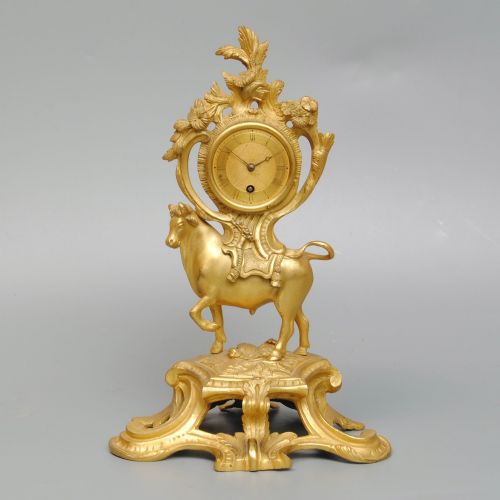


Gold Mantelpiece Clock
A gold mantelpiece clock brings nineteenth-century drawing rooms alive with the gleam of ormolu, marble, and porcelain.

How they were made
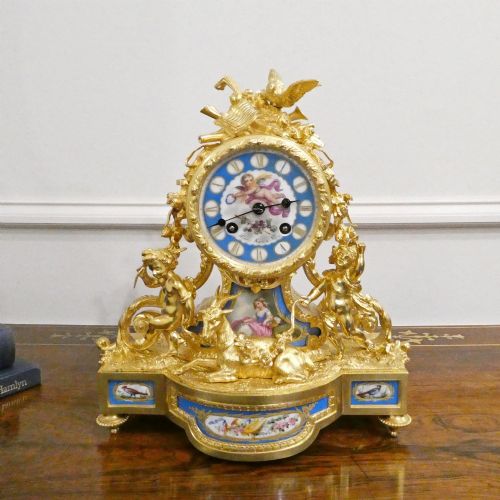
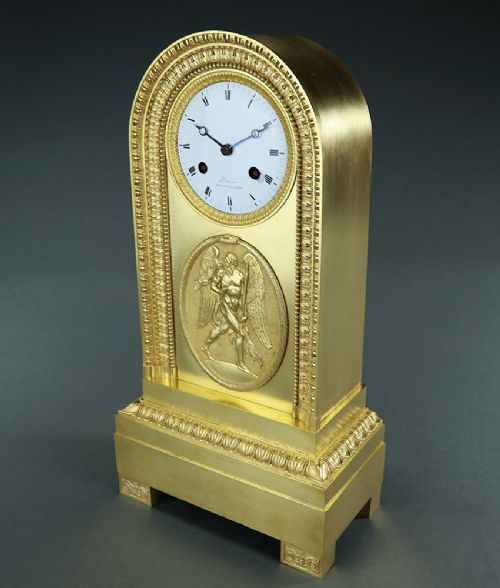
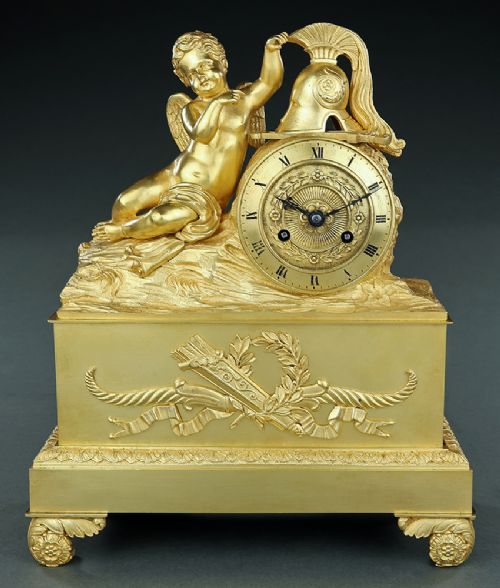
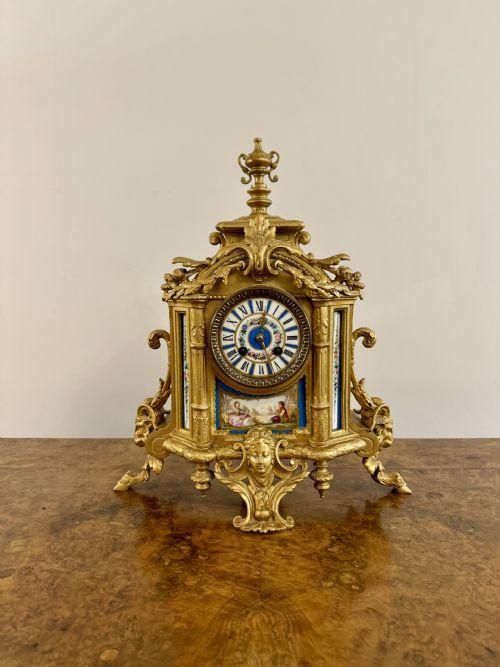
Casings rely heavily on fire-gilded ormolu, solid brass, and gilt bronze, often combined with panels of hand-painted porcelain or white enamel dials. Makers married cast metalwork with glass enclosures and marble bases to create substantial decorative objects.
Movements were engineered for accuracy, utilising eight-day striking mechanisms and intricate escapements housed within sturdy brass and bronze frameworks. Surface ornamentation ranges from engine-turned masks to elaborate cast cherubs and floral motifs.
What varies in quality
Quality rests in the crispness of the bronze casting and the depth of the gilding, where sharp, hand-chased details outshine soft, flat surfaces. The integration of high-grade materials like Sevres porcelain plaques and clear cut crystal elevates a piece significantly.
Provenance and mechanical complexity further divide standard production from exceptional examples, particularly when signed by known horologists or housed in architectural portico cases.
Listings feature nineteen-century periods extensively, spanning Victorian, Georgian, and Regency eras alongside French Empire and Art Deco designs.
Henry Marc·Henry Dasson·Viner London·Japy Freres·Breguet·Grey of Edinburgh·Howell James and Co·Leroy and Fils
The Gold Mantelpiece Clock Glossary
- Ormolu
- Gilt bronze produced by applying a mixture of gold and mercury to a bronze object. This historic fire-gilding technique creates a deep, durable golden finish.
- Garniture
- A set of decorative objects designed to be displayed together on a mantelpiece. These typically consist of a central clock flanked by matching candelabras or urns.
- Portico Clock
- A clock featuring a architectural case supported by four columns. This neoclassical design often incorporates a swinging pendulum suspended between the pillars.
- Carriage Clock
- A small, portable spring-driven timepiece equipped with a carrying handle. They frequently feature glass panels that reveal the internal escapement.
- Drum Head Clock
- A timepiece characterised by a circular clock face housing perched atop a decorative base. The drum shape sits prominently within the surrounding metalwork.
Gold Mantelpiece Clock: Frequently Asked Questions
How do I wind a gold mantelpiece clock?
Most mechanical versions use a key inserted into the dial to tension the springs every eight days. Care must be taken not to overwind the mechanism.
Striking clocks should be allowed to complete their sequence without forcing the hands backwards during adjustment.
Where should I place a clock garniture?
These sets demand a sturdy, level surface such as a living room mantelpiece or a large sideboard. The central clock sits flanked by its matching side pieces to create a balanced display.
Direct sunlight and damp environments should be avoided to protect the delicate gilt surfaces and porcelain panels.
How do I identify a French nineteenth-century clock?
Examination of the internal movement and cast bronze casework usually reveals characteristic foundry stamps or signature engraving. Stylistic cues draw heavily from Louis XVI, Empire, and Rococo revivals.
Enamel dials and fire-gilded ormolu finishes provide further confirmation of continental origin.
What is an eight day striking clock?
An eight day movement requires winding approximately once a week rather than daily. The striking mechanism sounds the hours and sometimes the halves on a bell or gong.
This practical development became standard in better quality nineteenth-century timepieces.