


Gold Leaf Eagle Carving
A gold leaf eagle carving brings striking neoclassical presence to a room, channelling Regency and Georgian grandeur through gilded wood and mirrors.
Gold Leaf Eagle Carving
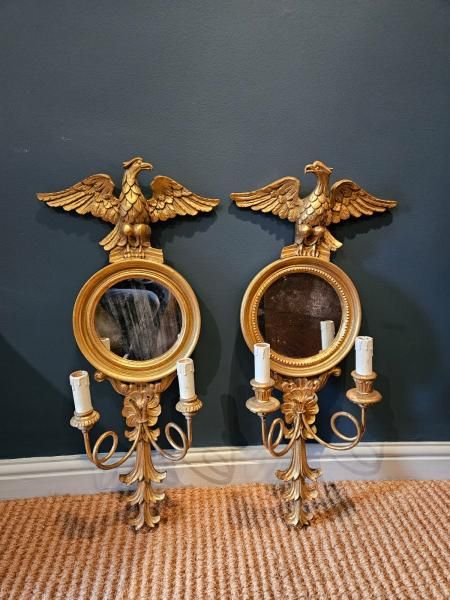
Gold leaf eagle carving encompasses grand decorative mirrors, wall sconces, and sculptural wall pieces originating from periods such as the Georgian, Regency, and Victorian eras. These items typically feature bold avian motifs integrated into circular convex mirrors, pier glasses, and girandoles, reflecting the dramatic tastes of the early nineteenth century.
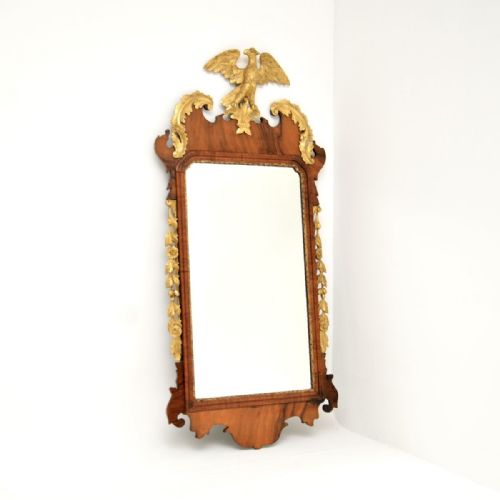
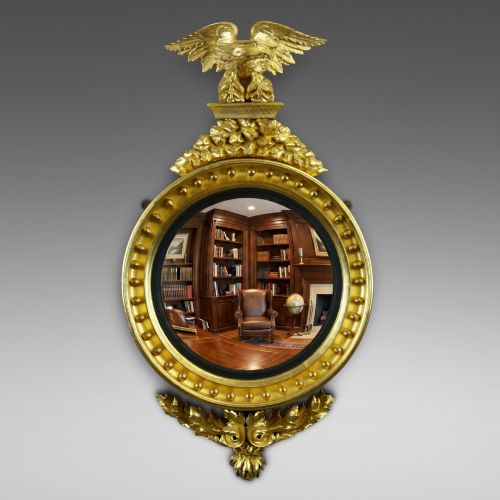
The versions most commonly met on this page are Regency convex mirrors surmounted by carved eagles, alongside Georgian parcel gilt wall mirrors and occasional twentieth-century revival interpretations. Makers of these works drew heavily upon classical idioms, utilising the eagle as a symbol of power and majesty above circular or rectangular glass plates.
How they were made
Craftsmen built these carvings using timber substrates such as mahogany, ebonised wood, or general hardwoods, upon which they applied layers of gesso to create fine relief details. The resulting carved surfaces, particularly the wings and heads of the eagles, received meticulous coatings of gold leaf or giltwood finishes to achieve a brilliant metallic lustre.
Convex mirror plates and wall sconce fittings were then set within these ornate frames, sometimes accompanied by candle arms or intricate fretwork borders. The interaction between the gilded gesso and the curved glass required specialist framing techniques typical of Regency and Georgian workshops.
Convex mirrors were once nicknamed butler's mirrors because their wide-angle view supposedly allowed servants to monitor the entire dining table at a glance.
What varies in quality
The distinction between the top of the range and simpler pieces lies in the crispness of the carving and the depth of the gilding. Superior examples display powerfully rendered feathers on the eagle, harmonious proportions across the frame, and authentic period gesso rather than later synthetic replacements.
Scale and presence also dictate quality, with large overmantel mirrors and massive Napoleonic gilt eagles demonstrating greater ambition in design. The survival of the original gilding surface, without heavy overpainting, preserves the integrity and visual impact of the piece.
The Gold Leaf Eagle Carving Glossary
- Giltwood
- Wood that has been coated with gold leaf or gold paint for a decorative metallic finish. This surface treatment defines the appearance of nearly all pieces listed here.
- Convex mirror
- A circular mirror with a bulging spherical glass plate that reflects a wide, curved view of the room. These are frequently surmounted by carved eagles in Regency designs.
- Gesso
- A plaster-like mixture applied to wood frames to provide a smooth base for carving and gilding. Skilled artisans modelled intricate floral and avian motifs directly into this layer.
- Girandole
- A branched wall mirror or sconce designed to hold candles. The reflective glass amplifies the candlelight within the interior space.
- Parcel gilt
- Woodwork that is partially gilded, leaving sections of the underlying natural wood, such as mahogany or ebonised surfaces, exposed for contrast.
Gold Leaf Eagle Carving: Frequently Asked Questions
How were eagle mirrors used?
Eagle mirrors and sconces were hung centrally on principal reception room walls as focal points. The carved eagle atop the frame added vertical height and neoclassical dignity.
They were also placed above mantelpieces to bounce natural light from windows back into the room during darker afternoons.
How do I date a giltwood mirror?
Dating relies on examining the construction methods of the wooden frame, the composition of the gesso, and the characteristics of the mirror plate. Earlier Georgian and Regency frames show distinct joinery and hand-carved depth.
Later Edwardian and twentieth-century revivals often utilise machine-cut elements or different backing materials while copying older styles.
How do I clean gilded surfaces?
Gilded surfaces require extremely gentle dusting with a soft, dry brush to avoid disturbing the delicate gold leaf. Moisture and chemical cleaners must be strictly avoided.
Professional conservation is recommended for any significant buildup of grime or areas where the gesso is unstable.