


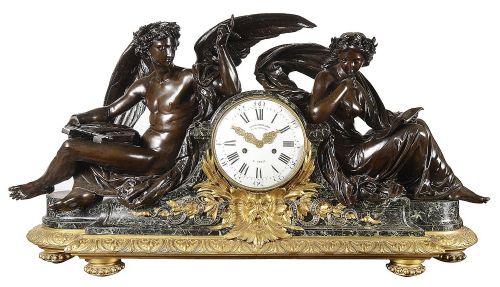


French Empire Mantel Sculpture
These french empire mantel sculpture pieces bring grand classical presence and patinated bronze figures to a chimneypiece.
French Empire Mantel Sculpture
When you search for french empire mantel sculpture, you encounter substantial works dominated by figural clocks, garniture sets, and standalone bronzes rooted in the nineteenth century. These objects draw on French Empire, Neoclassical, and Napoleon III styles to celebrate military leaders, classical literature, and allegorical subjects. The pieces most commonly met on this page combine cast bronze and ormolu with marble bases, housing mechanical clock movements or standing as independent sculptural figures.
The material vocabulary of these works relies heavily on patinated bronze, gilt ormolu, and contrasting marble plinths, often accented with enamel dials or silver plating. Makers utilised these combinations to create high-contrast pieces where dark figural bronzes stand forward against bright gilded mounts. The forms range from simple equestrian bronzes of Napoleon to elaborate architectural clock garnitures featuring eagles and literary figures.
How they were made
The construction of a french empire mantel sculpture involves lost-wax or sand casting in bronze, followed by meticulous chasing to sharpen the fine details of hair, drapery, and armour. Artisans applied mercury gilding or ormolu techniques to impart a rich golden lustre to selected bronze elements, creating a striking contrast with dark patinated surfaces and white or black marble bases.
Listings feature nineteenth century works spanning the Regency and Napoleon III periods, utilising bronze, ormolu, and marble.
What varies in quality
The integration of materials also defines the grade of the piece, particularly in how securely the bronze figures anchor to their marble plinths and how finely the ormolu mounts are fitted to the primary structure. Harmonious proportions between the sculptural subject, the marble base, and the dial layout separate standard production from ambitious workshop commissions.
Charpentier Paris·Victor Paillard Paris·Deniere and Cailleaux·Japy Freres
The French Empire Mantel Sculpture Glossary
- Ormolu
- Gilded bronze produced through a mercury amalgamation process that leaves a durable, deep golden finish. This technique was widely utilised on decorative mounts across the nineteenth century.
- Garniture
- A set of matching ornamental objects consisting of a central clock flanked by side pieces such as urns or candelabra. These sets created a balanced decorative scheme on a mantelpiece.
- Patina
- The surface sheen and coloration developed on bronze over decades through handling, oxidation, and natural wear. A stable patina preserves the underlying metal while showing evidence of age.
- Plinth
- The heavy base block, frequently fashioned from marble, that supports the main bronze sculpture or clock housing. It provides both visual grounding and structural stability.
- Chasing
- The manual post-casting process of refining and texturing bronze surfaces with small punches and chisels. Fine chasing distinguishes high-grade workshop output from rough commercial castings.
French Empire Mantel Sculpture: Frequently Asked Questions
What is a clock garniture?
A clock garniture comprises a central mantel clock accompanied by matching side ornaments, such as vases or sculptural figures, designed to sit together on a fireplace.
These matching sets were arranged to create a symmetrical display across a salon mantelpiece during the nineteenth century.
How do I identify Napoleon III pieces?
Napoleon III pieces generally date from the mid-nineteenth century and incorporate eclectic revivals of earlier French styles, particularly Neoclassical and Empire motifs.
They frequently feature dark patinated bronze figures mounted on rich marble plinths, celebrating historical rulers and classical themes.
What materials make up these sculptures?
These works are constructed primarily from cast bronze, gilt ormolu, and various types of marble, occasionally incorporating enamel dials and silver plating.
Artisans combined these contrasting substances to achieve a rich visual texture between polished metal and solid stone.
Where should I place a mantel sculpture?
Mantel sculptures and clock sets are designed for prominent display on a fireplace mantel or a heavy sideboard where their weight and height can be supported.
Their substantial marble bases and detailed bronzes require a stable surface with adequate clearance for viewing from multiple angles.