
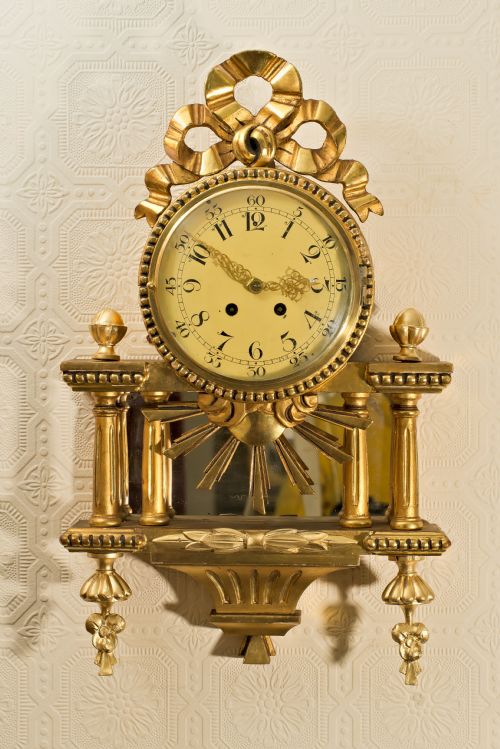


Gold Gilt Cartel Clock
A gold gilt cartel clock brings a sculptural wall piece into a room, shaped by French and English hands across three centuries.
Gold Gilt Cartel Clock
A gold gilt cartel clock is a wall-mounted timekeeper designed to sit directly on a panel or plaster surface rather than resting upon a mantel or bracket. These decorative instruments span the eighteenth, nineteenth, and early twentieth centuries, drawing on French and English workshop traditions.
The versions most commonly met on this page are French examples from the nineteenth century, adopting Louis XVI and Rococo revival styles in cast metal. Buyers also encounter earlier English and Swedish interpretations in carved and gilt wood, alongside smaller numbers from the Edwardian period.
Makers ranged from individual London clockmakers to continental bronze founders, each housing circular dial faces within asymmetrical or classical architectural wall cases. The resulting objects combine mechanical timekeeping with ornate sculptural metalwork or gilded timber.
Materials and construction
Makers shaped cases from carved timber, cast bronze, and brass, applying gold leaf or liquid ormolu to create the characteristic golden surface. Ormolu involves mercury gilding on bronze, while giltwood relies on thin sheets of gold leaf laid over a prepared gesso and timber base.
Enamel provided the material for white dial faces, carrying painted Roman or Arabic numerals behind protective glass covers. Mirror glass and eglomise panels occasionally appeared within the lower portions of Swedish and continental wall cases to catch the light.
Listings span the eighteenth to the early twentieth century, incorporating French, English, and Swedish workshops working in giltwood, ormolu, and bronze.
Distinctions in craftsmanship
The distinction between ordinary production and superior work lies in the crispness of the cast bronze or the depth of the wood carving. Hand-chased mounts show sharp detail in foliage and scrollwork, whereas weaker castings appear soft and uniform under magnification.
Movement quality separates workshop standards, with signed brass movements offering better gear cutting and more reliable timekeeping than unmarked replacements. Original gilding intact across complex surfaces holds greater integrity than later refinishing.
WETTERSTRANDS·Perivale of England·WILLIAM WEBSTER - LONDON
The Gold Gilt Cartel Clock Glossary
- Cartel clock
- A wall clock housed in an ornate frame made of gilt bronze, brass, or carved wood. These pieces were designed in France and England to hang directly on interior walls.
- Ormolu
- Finely ground gold amalgam applied to a bronze base through heat-gilding techniques. This process produces a rich golden finish characteristic of eighteenth and nineteenth-century French metalwork.
- Giltwood
- Timber carved and coated with gold leaf over a gesso ground. It appears frequently in Swedish and English wall clocks.
- Eglomise
- Cold painting and gilding on the reverse side of glass panels. This technique adds decorative borders and dark reflective panels to Swedish wall clocks.
- Rococo revival
- A nineteenth-century design movement mimicking the asymmetrical scrolls, C-curves, and naturalistic foliage of the mid-eighteenth century French court.
Gold Gilt Cartel Clock: Frequently Asked Questions
How do I hang a cartel clock?
These wall clocks require secure wall fixings capable of supporting the combined weight of the metal or wooden case and the internal brass movement. Wall mounting brackets or reinforced screws engage with suspension brackets built into the rear of the case.
Level placement ensures the pendulum swings evenly and the movement keeps accurate time. Consulting a professional horologist helps secure heavy bronze or giltwood models safely.
Where were cartel clocks placed?
Period interiors featured these wall clocks in principal reception rooms, salons, and formal parlours where guests gathered. Their elevated position allowed visible timekeeping and displayed the owner's taste in metalwork and carving.
Placing them away from direct sunlight and damp exterior walls protects the delicate gilding and paper or enamel dials.
How do I wind an antique clock?
Winding involves inserting a matching key into the winding holes on the enamel dial face to tension the internal springs or lift the driving weights. Turning the key requires a steady, measured motion until resistance indicates the mainspring is fully wound.
Care prevents damage to the delicate teeth of the brass wheels within the movement. Regular servicing by a clockmaker keeps the gear train functioning smoothly.
How do I tell Louis XVI from Rococo?
Louis XVI style cases rely on symmetry, straight architectural lines, classical urns, swags, and geometric proportions. They reflect an eighteenth-century return to neoclassical order and restraint.
Rococo cases embrace asymmetry, C-scrolls, cascading foliage, and fluid organic forms. This earlier eighteenth-century aesthetic returned in nineteenth-century revival pieces with exaggerated sculptural exuberance.