

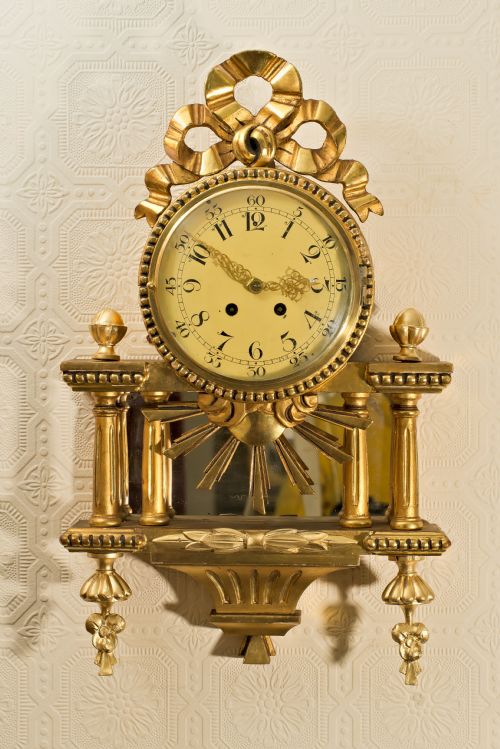


Antique Cartel Wall Clock
An antique cartel wall clock brings sculptural metalwork and precise movement directly to the wall, offering a striking focal point for a period interior.
Antique Cartel Wall Clock
An antique cartel wall clock is a wall-mounted timepiece housed within an ornate, unified frame rather than a traditional wooden case. The pieces found here span from the eighteenth century through to the early twentieth century, taking in Georgian, Victorian, and Edwardian eras.
French workshops dominate the selection, bringing elaborate Rococo and Louis XVI neoclassical styles to the wall. Buyers encounter everything from restrained Swedish giltwood designs to large, heavily cast ormolu and bronze creations featuring scrolling foliage and asymmetric asymmetry.
The dial is typically protected behind curved glass, framed by enamel chapters and driven by intricate brass movements. These clocks were originally designed for the principal rooms of grand houses, serving to display both wealth and horological skill.
Materials and construction
Makers shaped cases from cast bronze, gilt metal, and ormolu, often fire-gilding the metal surfaces to achieve a lasting golden sheen. Carved giltwood and ebonised wood also form significant variants, providing lighter or more austere alternatives to heavy metal castings.
Dials rely on white enamel chapters with painted numerals, protected by glazed bezels. Movements are constructed from brass and steel gear trains, designed to run for days or weeks on a single wind.
Listings feature eighteenth and nineteenth-century pieces alongside early twentieth-century examples, spanning brass, bronze, giltwood, and enamel.
Judging the work
Quality rests upon the crispness of the cast bronze and the depth of the gilding. Finer pieces display sharply chiselled acanthus leaves and scrolls rather than soft, blurred edges.
The integrity of the movement and the presence of signed dial plates separate standard production from exceptional horology. Original matching components indicate a higher tier of craftsmanship.
HENRI MARC OF PARIS·WETTERSTRANDS·Perivale of England·WILLIAM WEBSTER·Henri Riondet·Vincenti·Japy Freres·Samuel Marti·Maison Bagues
The Antique Cartel Wall Clock Glossary
- Cartel clock
- A wall-mounted clock with an ornamental frame made of metal, wood, or gilt bronze. These clocks sit directly against the wall without a supporting bracket or pedestal.
- Ormolu
- Finely chopped leaf gold applied to a copper or bronze base using a mercury amalgam process. This technique creates a rich, matte golden surface characteristic of fine French pieces.
- Enamel
- A glassy substance fused to a metal dial through firing to create a smooth, white surface for painted numerals. It provides a durable finish that resists tarnishing over centuries.
- Louis XVI style
- A neoclassical design vocabulary marked by symmetry, straight lines, and classical motifs such as urns and ribbons. It contrasts with the earlier, more exuberant curves of the Rococo period.
- Eglomise
- The technique of gilding and painting on the reverse side of glass to create a mirror-like or decorative panel. It frequently appears in Swedish and continental clock panels.
Antique Cartel Wall Clock: Frequently Asked Questions
How do you hang a cartel clock safely?
These clocks are heavy and require secure fixing directly into a solid wall stud or masonry using appropriate wall anchors. The weight of cast bronze or giltwood demands a robust screw and bracket system rather than a simple picture hook.
Ensure the clock hangs completely plumb so the pendulum swings evenly and the movement maintains accurate time. Levelling the case prevents the escapement from stalling.
Are these clocks difficult to maintain?
Mechanical movements require professional cleaning and lubrication every few years to prevent wear on the brass pivots and gear teeth. Regular winding keeps the tension balanced across the mainspring.
Dust the gilded and carved surfaces gently with a soft brush to avoid scratching the delicate metal finishes. Avoid using liquid polishes on gilt bronze or ormolu.
How can you tell a Rococo piece from a Neoclassical one?
Rococo pieces feature asymmetric designs, C-scrolls, and naturalistic motifs like foliage and asymmetrical shells. The overall impression is dynamic and fluid.
Neoclassical pieces embrace symmetry, straight columns, urns, and geometric precision inspired by ancient Greece and Rome. The silhouette becomes much more restrained and architectural.
Did these clocks always hang in living rooms?
Historically, cartel clocks were status symbols placed in principal reception rooms, parlours, and formal halls where guests would admire them. Their dual function as art and timekeeper made them central to interior decoration.
Bedchambers and libraries also housed them, though usually in smaller, less ornate formats compared to the grand salon versions.