


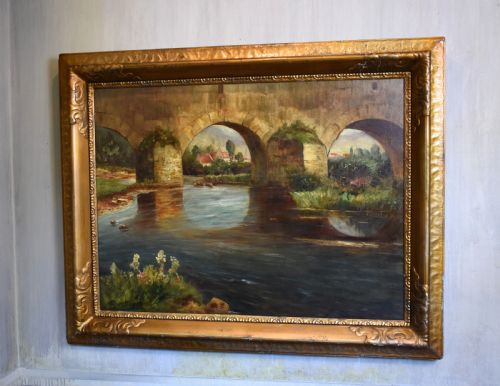


Gold Framed Architectural Print
These gold framed architectural print pieces capture classical facades and historical interiors through enduring ink, wash and engraving.
Gold Framed Architectural Print
A gold framed architectural print brings classical scenes, archaeological discoveries and historical buildings into domestic rooms. These works span the eighteenth and nineteenth centuries, capturing everything from Italian antiquities to British country houses.
Buyers meet varied formats on this page, ranging from large neoclassical coloured scenes to detailed monochrome engravings and lithographs. Many pieces preserve the grand tour spirit, recording foreign travels and ancient monuments through ink, paper and watercolour.
The framing defines the presentation, employing gilt wood and gold leaf to elevate the paper or canvas within. Such pieces suit studies, libraries and hallways where traditional wall art anchors the room.
Materials and methods
Makers utilised high quality paper, ink and watercolour to render precise architectural details and subtle tonal washes. Engravings and lithographs required skilled plate work, transferring intricate designs from copper or stone onto the sheet.
Wood provided the structural foundation for the surrounds, shaped into mouldings and finished with gold leaf or gilt wood. Glass protected the fragile paper surfaces from dust and atmospheric moisture over successive centuries.
One eighteenth century engraving records Raphael's Vatican loggie frescoes, bringing papal architecture straight to the domestic wall.
Distinctions in quality
The fineness of the line work and the depth of the ink or watercolour determine the visual success of the piece. Stronger examples display crisp architectural rendering and careful hand colouring that enhances the structural composition.
The quality of the gilding on the wood frame sets the better specimens apart from simpler counterparts. Original gilt wood surrounds with intact leaf show superior craftsmanship compared to later replacements.
David Roberts RA·Ottaviani·Francesco Piranesi·Franz Reder-Broili·Francis Dodd RA RSW
The Gold Framed Architectural Print Glossary
- Engraving
- A printmaking technique where an artist cuts lines into a metal plate to hold ink. This method produces sharp, precise lines ideal for architectural draughtsmanship.
- Lithograph
- A planographic printing process based on the repulsion of oil and water. It allowed artists to reproduce tonal drawings and coloured scenes with great fidelity.
- Gilt wood
- Wood coated with a thin layer of gold leaf or metallic powder. It provides a bright, reflective border that complements classical imagery.
- Neoclassical
- A style inspired by the classical art and architecture of ancient Greece and Rome. It prioritises symmetry, proportion and monumental forms.
- Monochrome
- A work executed in a single colour or shades of one colour. In these pieces, it usually refers to ink and wash drawings.
Gold Framed Architectural Print: Frequently Asked Questions
How do I care for an old architectural print?
Keep the piece away from direct sunlight to prevent the paper and any watercolour pigments from fading over time. Maintain stable room temperatures to protect both the wooden frame and the paper substrate from humidity damage.
Check that the backing board and glass remain secure to keep dust and insects away from the historic surface. Handle the heavy frame with care when moving the artwork to a new position on the wall.
Are these prints original period works?
The listings comprise authentic eighteenth and nineteenth century engravings, lithographs and watercolours created during the periods they represent. Each piece reflects the printing and drawing techniques of its specific decade.
Examine the paper texture, ink saturation and framing materials to understand the age of the object. Archival papers and period gilt wood frames confirm the historical nature of the artwork.
How should I hang a heavy gilt framed print?
Use robust wall fixings suited to the weight of the wood and glass construction, anchoring directly into wall studs where possible. Distribute the weight evenly using two sturdy hooks rather than a single central point.
Position the artwork at eye level to appreciate the fine architectural details within the scene. Ensure the wall surface is dry and structurally sound before mounting the piece.
What subjects appear in these architectural prints?
Common subjects include ancient Roman statues, Italian ruins, British country houses and continental street scenes. These reflect the educational travels and classical interests of past collectors.
Detailed elevations and perspective views record historical buildings that have since altered or vanished. The imagery offers a window into nineteenth century taste and archaeological discovery.