
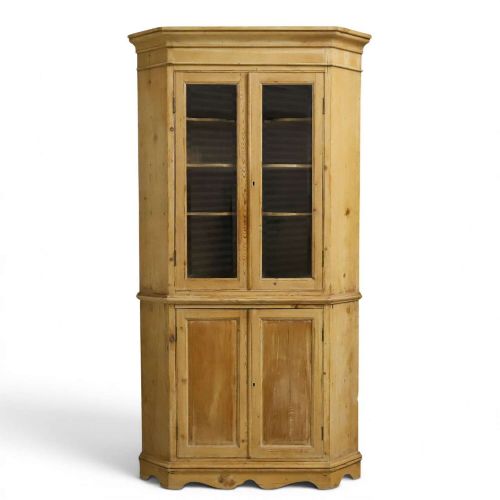
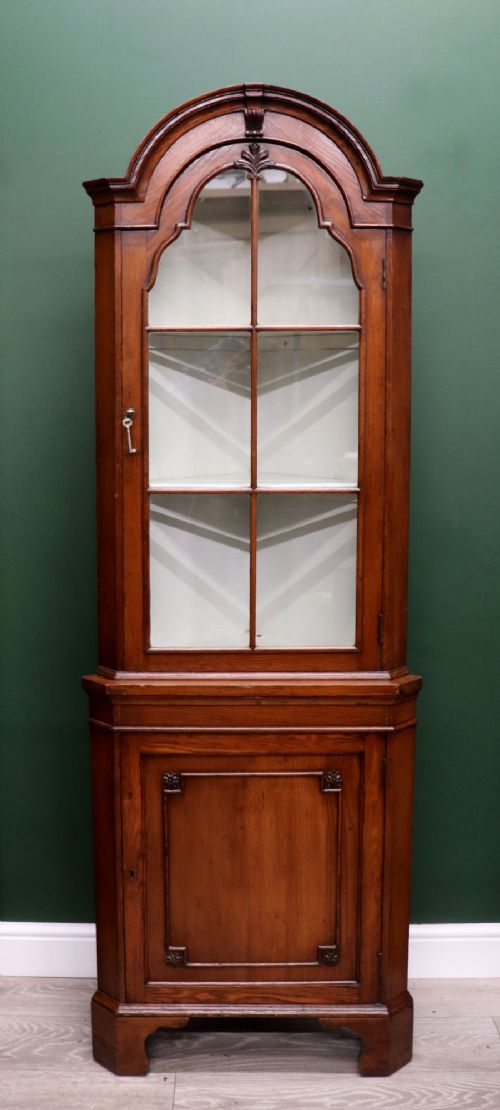
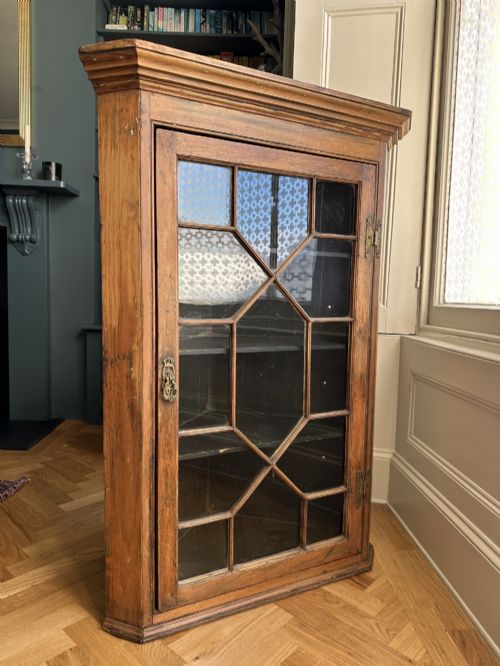


Glazed Door Corner Cabinet
These glazed door corner cabinets put awkward room angles to work, displaying collections behind clear glass while keeping the room looking tidy.
Glazed Door Corner Cabinet
A glazed door corner cabinet makes use of empty room junctions, transforming dead space into a focal point for storage and display. These pieces range from tall floor-standing cupboards to smaller wall-hung or two-part designs.
The evidence shows examples spanning from the Georgian period through the Victorian era and Edwardian times, up to the 1930s. Mahogany, oak, pine, and walnut are the primary woods found across these eras.
You will encounter regional country pieces alongside refined revival styles such as Sheraton Revival and Georgian Revival. Some examples feature bowed glass doors while others rely on astragal glazing bars to divide the panes.
Materials and Construction
Cabinet makers relied on solid and veneered timbers, utilising mahogany, oak, walnut, pine, and satinwood to build the carcases. Brass hardware, including hinges and key escutcheons, provides functional and decorative detail.
Glass panes are fitted into doors either as a single curved sheet of bowed glass or segmented by wooden glazing bars. Interiors often feature painted finishes or wooden shelving tailored to display ceramics and glassware.
Edwardian and Georgian periods dominate the stylistic origins found in the listings.
Evaluating Craftsmanship
Quality rests in the selection of timber figures, such as flame mahogany or burr walnut veneers, matched against solid secondary woods. The refinement of the glazing bars and the precision of the door joints separate standard utility pieces from finer urban cabinet work.
Proportion and scale dictate how a cabinet sits in a room, with slender cornices and well-balanced two-part forms commanding greater attention than heavier, plain structures.
The Glazed Door Corner Cabinet Glossary
- Astragal
- A moulding profile used to divide glass panes within a door. These thin wooden bars form geometric patterns across the window.
- Bow front
- A convex curved cabinet front that projects outward. This shape requires specialised glass and precise woodworking.
- Two-part form
- A piece constructed in two separate sections, usually a upper display cabinet resting on a lower cupboard base. This makes transport and placement easier.
- Sheraton Revival
- A late nineteenth or early twentieth-century design movement inspired by the lightness and neoclassical ornamentation of George Sheraton. These pieces often incorporate delicate inlays.
- Escutcheon
- A protective plate surrounding a keyhole. Brass is the most common metal used for these fittings on antique furniture.
Glazed Door Corner Cabinet: Frequently Asked Questions
How do I choose the right size?
Measure the wall span from the corner outwards on both sides, as corner cabinets take up more linear wall space than expected. Consider whether you need a floor-standing unit or a two-part form.
Ceiling height also matters, particularly with taller Edwardian and Georgian examples that feature elaborate cornices.
Are these cabinets secure for valuable items?
Most antique cabinets retain their original working locks and brass keys, offering basic security for stored collections. The glass panes are traditional and thin compared to modern safety glass.
Positioning the cabinet away from heavy traffic areas protects both the glass and the contents from accidental knocks.
How should I care for the wood?
Maintain timber surfaces with a traditional beeswax polish applied sparingly and buffed with a soft cloth. Avoid placing these pieces in direct sunlight to prevent the mahogany, walnut, or oak from fading.
Keep them away from modern heat sources to stop the solid wood and veneers from drying out or splitting.
What is the difference between country and revival styles?
Country pieces, such as Welsh oak or pine cupboards, prioritize sturdy utility and simple construction over decorative flourish. They suit relaxed interiors and often feature painted interiors.
Revival pieces emulate earlier Georgian elegance, incorporating refined mahogany veneers, satinwood stringing, and delicate astragal glazing.