
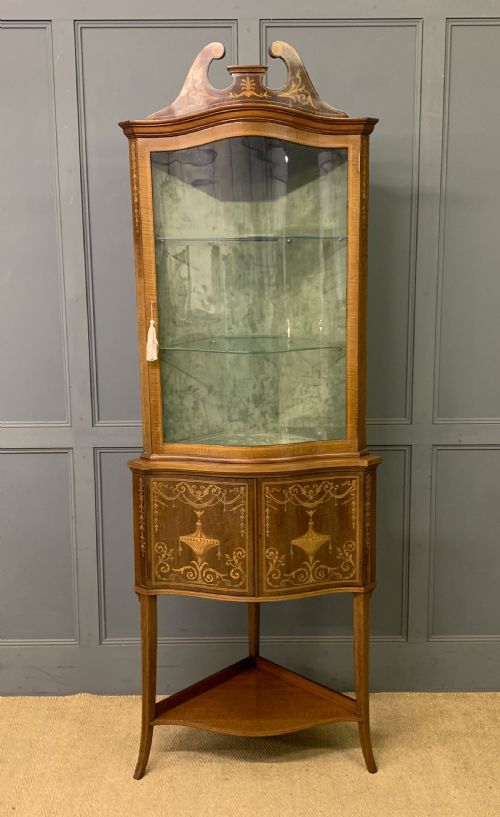
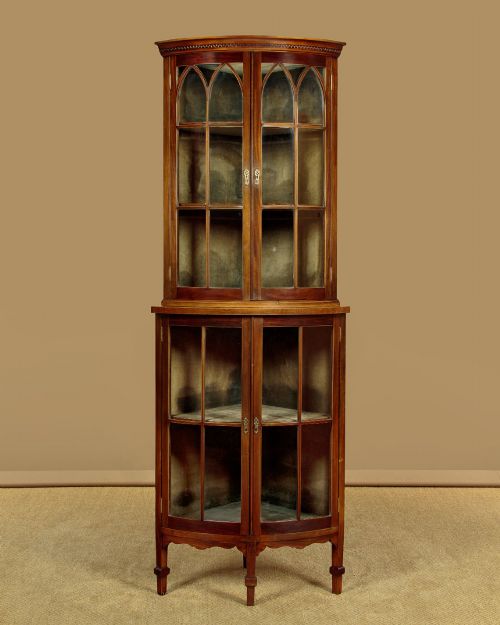


Glass Fronted Corner Cabinet
A glass fronted corner cabinet solves the perennial problem of awkward room angles by turning unused wall space into a display showcase for treasured possessions.

Glass Fronted Corner Cabinet
A glass fronted corner cabinet is designed to fit snugly into the 90-degree angle of a room, making efficient use of dead space while offering visibility for contents through a glazed door. The selection includes tall standing double-height cupboards as well as more compact single pieces.
Makers and craftsmen applied various regional English styles, ranging from straightforward country house vernacular pieces to elaborate marquetry-inlaid creations. These forms evolved over centuries, shifting from dark eighteenth-century proportions to lighter Edwardian Revival interpretations.
Materials and construction methods
Cabinet makers relied heavily on solid hardwoods such as mahogany, oak, and walnut for the structural carcass and framing. Veneers like flame mahogany and burr walnut were often laid over secondary timbers to create striking patterned surfaces on the doors and front panels.
Glazing techniques involved holding individual panes of glass within timber bars or curved wooden frames, particularly on bow front and serpentine models. Brass hardware such as hinges, escutcheons, and keyplates provided functional and decorative accents against the dark wood.
Listings feature mahogany, walnut, oak, and ebonised wood spanning the Edwardian era back to the eighteenth century.
Distinguishing grades of craftsmanship
Superior quality is found in the selection of timber figures, where matched veneers or fine marquetry inlays demonstrate the cabinet maker's precision. Plain surfaces differ markedly from pieces featuring detailed stringing, brass mounts, or intricately shaped serpentine fronts.
Structural integrity depends on the original joinery of the triangular carcass and how well the heavy glazed door hangs on its hinges. Cabinets that retain their original glass panes, backboards, and brasswork command greater appreciation among collectors.
Edwards And Roberts
The Glass Fronted Corner Cabinet Glossary
- Bow front
- A convex curved front facade that projects outward, common in later Georgian and Edwardian designs. This shape softens the hard lines of a room corner.
- Marquetry
- Decorative veneer patterns formed by fitting together small pieces of wood, shell, or ivory into wood panels. It creates pictorial or geometric designs on the cabinet doors.
- Serpentine
- A gently undulating front edge with a convex centre flanked by concave curves, or vice versa. This sophisticated shaping requires high woodworking skill.
- Ebonised
- Timber treated with a dark finish to imitate expensive ebony wood. It appears frequently on pieces from the early twentieth century.
- Glazed
- Fitted with glass panels to protect display items from dust while keeping them visible. The arrangement of the wooden glazing bars indicates the period style.
Glass Fronted Corner Cabinet: Frequently Asked Questions
How do I fit a corner cabinet?
Measure the exact wall angles of your chosen room before purchasing, as older properties often feature walls that deviate from standard right angles. Freestanding floor models simply slide into place, while wall-hanging cupboards require secure fixings into structural studs.
Ensure there is adequate clearance for the glazed door to swing open fully without hitting adjacent furniture or skirting boards. Placing the cabinet away from direct heat sources protects the timber and veneer from drying out.
How do I identify a Georgian cabinet?
Georgian pieces generally exhibit heavier timber construction, simpler architectural cornices, and hand-blown glass panes that show slight ripples or imperfections. The interior shelving is often shaped with butterfly or serpentine front edges.
Later Edwardian interpretations tend to feature lighter mahogany with machine-drawn glass, satinwood banding, and brighter brass fittings. Examining the interior construction and timber shrinkage helps confirm the age of the piece.
Can I adjust the internal shelves?
Most antique corner cabinets feature fixed wooden shelves supported on fixed wooden cleats rather than modern adjustable metal pegs. The layout is determined by the original maker to accommodate specific heights of glassware and ceramics.
Attempting to alter the fixed shelving can compromise the structural rigidity of the triangular carcass. It is best to plan your display objects around the existing shelf clearances.
How do I maintain the wood?
Dust the timber regularly with a soft, dry cloth and apply a quality beeswax sparingly to nourish the polished surface. Avoid using modern silicone-based sprays, which build up a residue and attract dust.
Keep the cabinet out of direct sunlight to prevent the mahogany or walnut veneers from fading unevenly. Maintaining a stable room humidity prevents the timber from splitting or warping.