



Glass Champagne Saucers
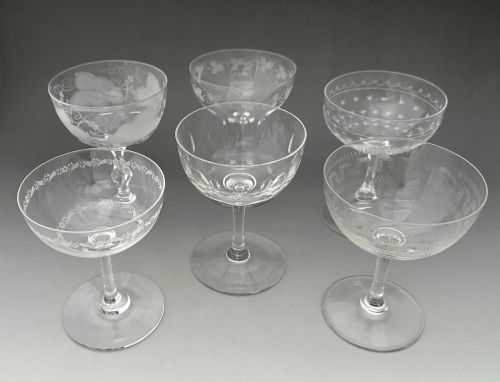
Glass champagne saucers bring period elegance to a table, offering wide bowls shaped for vintage toasts.
Glass Champagne Saucers
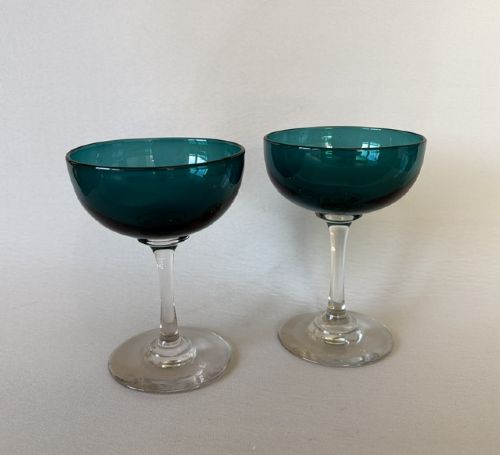
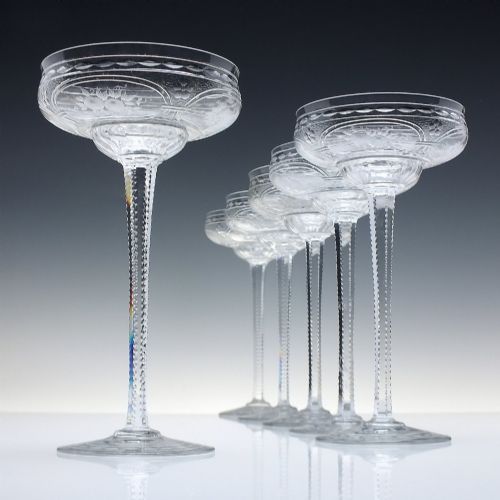
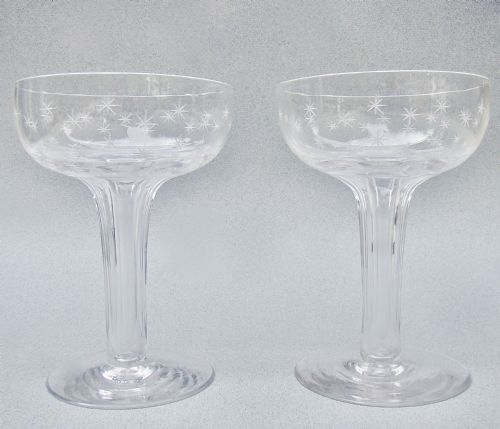
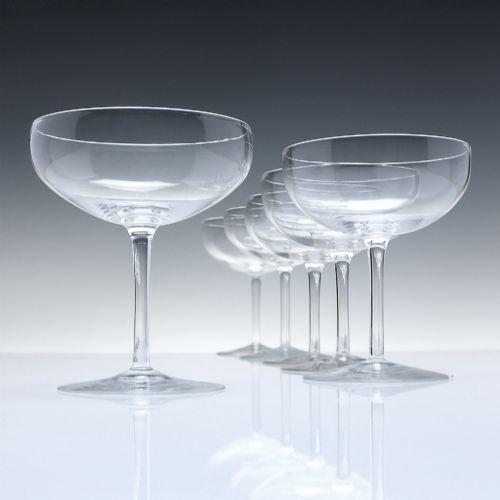
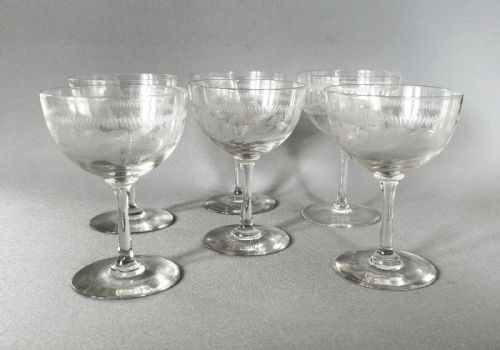
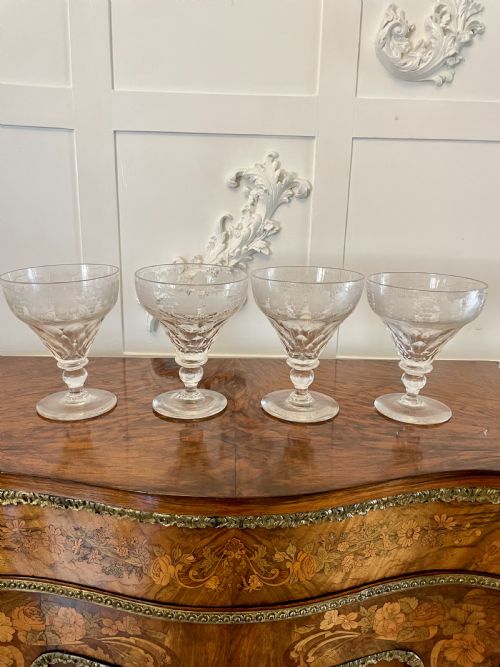
Glass champagne saucers comprise shallow, wide bowls designed for sparkling wine, and buyers seeking this phrase will find pieces spanning the Victorian, Edwardian, and Art Deco periods. The form appears as champagne saucers, coupes, bowls, and hollow-stemmed glasses, reflecting diverse nineteenth and twentieth-century dining customs.
Most examples met on this page date from the Victorian and Edwardian eras, frequently appearing in sets of six or eight. English origins predominate among the listings, alongside specialised continental production from makers such as Fritz Heckert and Webb Corbett.
Makers utilised various traditional forms, ranging from simple clear vessels to elaborate cased and engraved designs. These items function both as decorative dining accessories and practical tableware for modern hosts.
What varies in quality
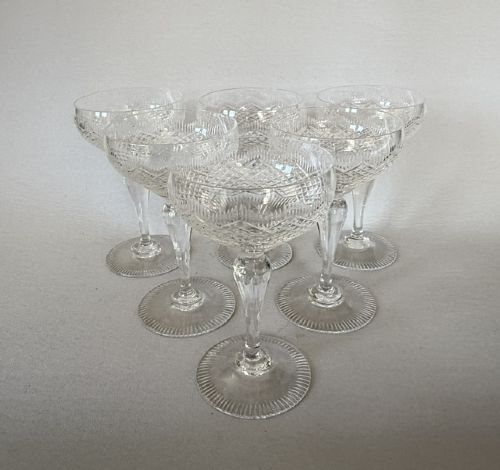
Quality in glass champagne saucers rests upon the clarity of the metal and the crispness of the hand-cut or engraved decoration. Superior pieces display deep, sharply defined facets and hand-engraved motifs executed with precision, whereas lesser examples feature shallow, soft cutting.
The weight and resonance of the lead crystal indicate the purity of the material used by the workshop. Furthermore, matched sets of six, eight, or more command greater attention than assembled groups due to the survival rate of complete antique services.
Glass Champagne Saucers Retail Price Guide 2026
Typical asking prices for glass champagne saucers among the pieces listed under this phrase on Sellingantiques today, from the lower quarter to the upper quarter. They describe what is for sale here now, not the wider market.
Victorian diners occasionally raised hollow-stemmed champagne glasses to watch the bubbles travel right down into the foot.
Fritz Heckert·Webb Corbett
The Glass Champagne Saucers Glossary
- Cranberry glass
- A rich red-pink glass coloured with gold chloride during the melting process. It is frequently seen in Victorian tableware and cased glassware.
- Facet cut
- A decorative surface treatment featuring flat, polished planes ground into the glass. This technique enhances the refraction of light through lead crystal.
- Coupe
- A broad, shallow-bowled glass traditionally associated with champagne. The wide rim allows the bubbles to dissipate quickly.
- Cased glass
- A method where a layer of coloured glass is fused over a base of clear crystal. Artisans then cut through the outer layer to create contrasting patterns.
- Hollow stem
- A stem featuring an internal channel running from the bowl to the foot. This traditional feature requires skilled blowing techniques.
Glass Champagne Saucers: Frequently Asked Questions
Can I use these for modern champagne?
Yes, although the wide bowl encourages the bubbles to dissipate faster than a narrow flute. Many collectors enjoy using them precisely because they evoke historical dining traditions.
They also function well for serving desserts or cocktails at dinner parties.
How do I date an Edwardian glass saucer?
Edwardian pieces often feature lighter cutting than heavy Victorian examples, accompanied by geometric or neoclassical motifs like Greek key patterns. Look for the typical forms and proportions popular around nineteen-ten.
Maker's marks, where present, can also help narrow down the exact decade of manufacture.
Why are matching sets harder to find?
Fine glassware suffered high attrition rates over a century or more of regular use at dining tables. Individual pieces were easily broken during washing or social gatherings.
Consequently, finding a complete set of six, eight, or ten undamaged saucers remains unusual.