
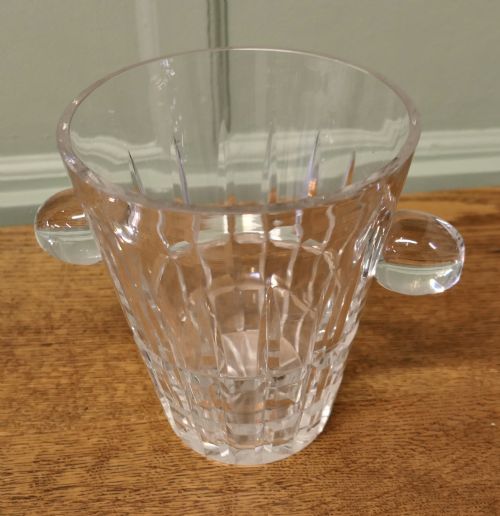
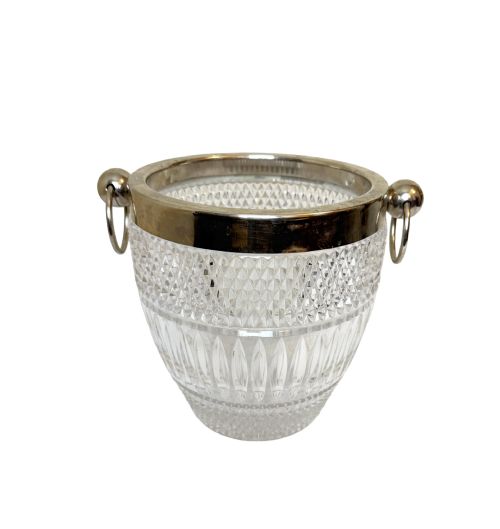


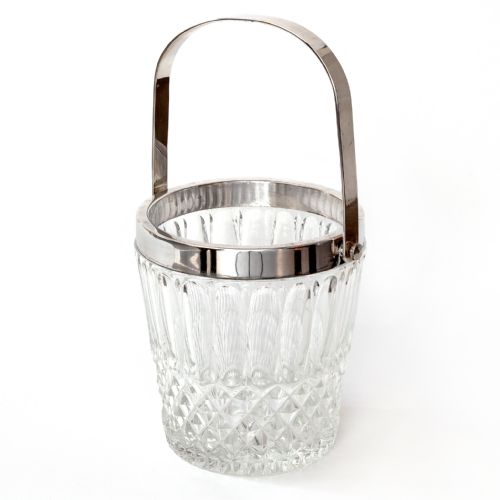


Glass Champagne Bucket
A glass champagne bucket holds the table, catching the light through cut crystal and holding ice alongside silver plate.
Glass Champagne Bucket
A glass champagne bucket is a vessel designed to chill wine and champagne at the table, appearing in forms from the Regency period through to the 1940s. These pieces serve as both functional coolers and decorative containers, taking the shape of ice buckets and wine coolers.
Buyers on this page most frequently meet French and English examples from the nineteenth and twentieth centuries. The selection ranges from heavy lead crystal bodies with silverplate mounts to hand-blown glass formations spanning Art Deco, Art Nouveau, French Empire, and Regency styles.
How they were made
Glass champagne buckets rely on the combination of hand-blown or cut glass with metal mounts in silver plate, silverplate, silver-plate, brass, and gilt bronze. Makers shaped lead crystal and cut glass through heavy carving, producing deep facets that catch the ambient light.
Metal elements such as silverplate and gilt bronze are secured to the glass rims and bases, creating robust vessels designed to withstand ice and water. Heavy lead crystal provides the structural weight necessary to keep the bucket stable when filled with bottles and ice.
The site listings feature glass champagne buckets spanning the 1800s, 19th Century, 1890, 1900, 1910, 1920, and 1940 periods.
What varies in quality
The standard of a glass champagne bucket rests on the weight and clarity of the crystal body and the execution of the cutting. Heavy lead crystal with precise hand-cut facets sits at the upper end, offering greater brilliance and structural substance than simpler moulded glass.
The quality of the metal mounts further separates the pieces, with detailed silver plate, silverplate, or gilt bronze mounts indicating finer production. The integration between the glass vessel and its metal fittings determines the overall finish of the cooler.
Rene Lalique
The Glass Champagne Bucket Glossary
- Lead crystal
- Glass containing metal oxide that increases weight, brilliance, and clarity. This material allows for deeper and sharper cutting.
- Silver plate
- A thin layer of silver applied over a base metal foundation. It provides the appearance of solid silver for mounts and handles.
- Gilt bronze
- Bronze decorated with a thin layer of gold applied to the surface. It appears on mounts of the nineteenth century.
- Art Deco
- A design style from the early twentieth century featuring geometric shapes and clean lines. Pieces from the 1920s often show these symmetrical patterns.
Glass Champagne Bucket: Frequently Asked Questions
What is a glass champagne bucket?
A glass champagne bucket is a heavy glass or crystal vessel designed to hold ice and chill wine bottles at the table.
These pieces combine glass bodies with metal mounts, appearing across periods from the Regency era to the mid-twentieth century.
How do I date a glass champagne bucket?
Dating relies on the style of the cutting, the metal mounts, and the overall form of the vessel. Art Deco pieces show geometric patterns from the 1920s, while Regency and French Empire examples display earlier neoclassical lines.
Materials such as silver-plate, brass, and gilt bronze also help indicate the manufacturing period of the cooler.
Can I use an antique glass champagne bucket?
These vessels were built to hold ice and water for chilling wine at the table. Heavy lead crystal and silver-plate constructions remain robust for modern dining use.
Care should be taken with older hand-blown glass and delicate metal mounts during handling and cleaning.
What styles are common for these buckets?
The listings include pieces from the Art Deco, Art Nouveau, French Empire, Regency, and Edwardian styles. Each style brings distinct decorative elements to the glass cutting and metal mounts.
French and English origins dominate the selection, showing regional preferences in handle design and glass thickness.