



Glass Candle Holders Drops
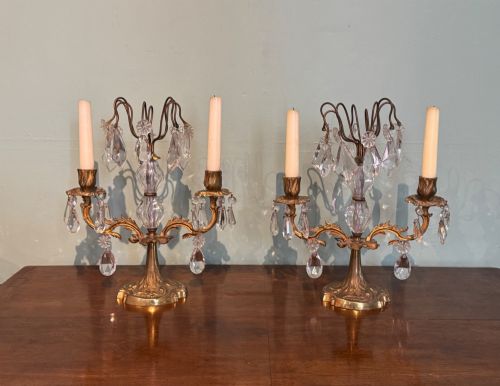
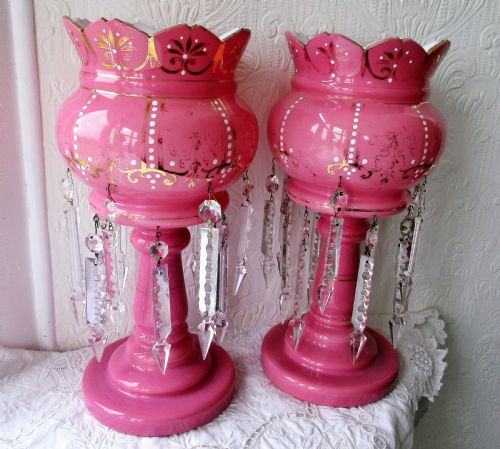
Glass candle holders drops bring together the brilliance of crystal and cut glass with the movement of hanging lustres to light a room.
Glass Candle Holders Drops
When you search for glass candle holders drops, you find a collection of candlesticks, candelabras and mantel lustres designed to catch and refract light. These pieces primarily emerge from the nineteenth century, including Victorian, Regency and William IV periods, alongside French Empire and Rococo Revival styles.
The most common form on this page is the pair of lustres, often fashioned in ruby, green, pink or clear cut glass. They combine a central candle socket with hanging crystal drops that shimmer as the flame flickers.
Originating largely from English and French workshops, these objects serve both as functional lighting and decorative garniture for mantelpieces and tables. They demonstrate the nineteenth-century preference for elaborate table settings and reflective surfaces.
What varies in quality
The distinction between standard examples and top-tier pieces lies in the crispness of the glass cutting and the weight of the metal mounts. Deep, sharp facets on the body and matching hand-cut crystal drops indicate superior workmanship.
Makers who invested greater effort into the piece achieved symmetry in the paired forms and richer saturation in flash glass layers. The quality of the gilding on the brass and bronze bases also separates everyday decorative objects from finer display pieces.
Some nineteenth-century makers added storm shades to protect the flame, ensuring your dining table remained undisturbed by a sudden draught.
The Glass Candle Holders Drops Glossary
- Lustre
- A candle holder hung with cut glass drops designed to refract candlelight. These pieces often stand on mantelpieces as decorative garniture.
- Flash glass
- Glass formed by fusing a thin layer of coloured glass over a clear or contrasting body before cutting through the top layer. This technique creates sharp contrast and vibrant colour.
- Ormolu
- Finely ground high-carat gold cast and chased upon a bronze base, used for mounts and decorative accents. It provides a warm metallic sheen beside the glass.
- Garniture
- A set of ornamental objects designed to display together on a mantelpiece or sideboard, typically comprising a central candelabra flanked by matching lustres.
- Prism
- A cut glass drop suspended from the rim of a lustre to catch and scatter light. They hang from metal pins passed through drilled holes.
Glass Candle Holders Drops: Frequently Asked Questions
What are mantel lustres?
Mantel lustres are decorative candle holders featuring hanging glass drops designed to sit upon a fireplace mantel. They serve as ornamental display pieces that reflect ambient light.
Unlike standard candlesticks, they incorporate a ring of suspended crystal prisms around the sconce. This configuration was popular during the Victorian and Regency periods for formal reception rooms.
How do I clean glass lustres?
Cleaning requires removing the hanging crystal drops individually and washing them in lukewarm soapy water. You should dry each drop thoroughly with a soft cloth before reattaching them with their original metal connectors.
The main body of the candle holder should be wiped gently with a damp cloth, taking care to avoid harsh abrasives on gilt brass or enamel surfaces.
Are these pieces English or French?
The selection includes both English and French examples from the nineteenth century. English pieces frequently display robust Victorian cut glass, while French items often incorporate gilt bronze and Rococo Revival or Empire styling.
Maker attribution relies on stylistic traits and material choices typical of each region. Many continental pieces lean towards ornate metalwork alongside the glass.
How can I date these candle holders?
Dating relies on observing the style of the metal mounts, the cut of the glass, and the colour palette used. Victorian pieces often feature rich ruby or green flash glass, while Regency examples lean towards clear cut crystal with bronze or ormolu mounts.
Structural clues such as the shape of the candle socket and the method used to suspend the drops also help place an object in its period.