
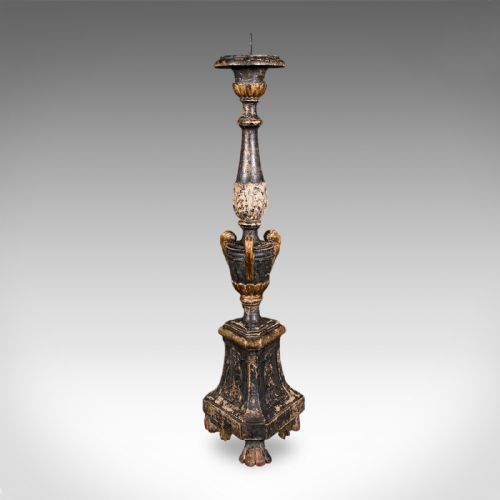


Gilt Wood Candle Holder
These gilt wood candle holder pieces bring warmth and texture to a room, offering genuine period character for any interior.
Gilt Wood Candle Holder
A gilt wood candle holder encompasses a range of forms designed to support illumination, including candlesticks, wall sconces, candelabra, table lamps, and wall lights. Buyers searching for a gilt wood candle holder will encounter items originating from various eras such as the 17th century, 18th century, 19th century, and the early 20th century.
The selection includes pricket sticks, altar-style candlesticks, twin-arm girandoles, and triple-light candelabra. Styles represented span the Baroque, Georgian, French Rococo, Italian Rococo, Italian Neoclassical, and French Neoclassical traditions.
Most examples appear in pairs, with origins spanning English, French, and Italian workshops. Forms range from simple table lamps adapted from pricket sticks to elaborate wall sconces.
How they were made
Makers primarily utilised carved wood, gesso, and timber as foundational substrates for these items. Artisans applied gold leaf and silver leaf to achieve the characteristic metallic surface finish.
Certain pieces incorporate ebonised wood, polychrome details, iron, and treen alongside the core gilded wooden structures. Carving techniques define the decorative motifs across Italian and French examples from the 17th to the 20th centuries.
Materials documented across the inventory include carved wood, gesso, gold leaf, silver leaf, iron, and ebonised timber.
What varies in quality
The refinement of the wooden carving distinguishes the execution of individual pieces, with crisp details on acanthus leaves, cherubs, and architectural moulding indicating superior craftsmanship. The application and preservation of the gold leaf or silver leaf also determine the visual impact of the surface.
Proportion and structural integrity matter greatly, particularly in taller altar sticks and multi-branch candelabra where balance is essential. The depth of the gesso layer beneath the gilding affects how well the fine details endure over the centuries.
The Gilt Wood Candle Holder Glossary
- Giltwood
- Wood that has been coated with gold leaf or metal leaf. This surface treatment provides the bright, reflective finish seen on Baroque and Neoclassical lighting.
- Pricket
- A sharp metal spike on a candlestick designed to secure a candle in place. This form is frequently found on older altar-style sticks.
- Girandole
- An ornamental wall-mounted bracket holding candles, often featuring a mirror or decorative backplate. These fixtures are typically paired with arms for multiple lights.
- Gesso
- A plaster-like mixture applied to wood surfaces as a base for gilding. It allows artisans to carve intricate relief patterns before applying gold leaf.
- Treen
- Small handmade wooden objects produced before the widespread use of plastics. These items display the natural grain and turned forms of domestic timber.
Gilt Wood Candle Holder: Frequently Asked Questions
How do I clean a gilt wood candle holder?
Gilded surfaces require delicate handling to avoid removing the thin layer of gold or silver leaf. Dust gently with a soft, dry brush without applying moisture or chemical cleaning agents.
Harsh polishes will damage the underlying gesso and wood. Regular, gentle dusting is sufficient to maintain the appearance of the finish over time.
Are these pieces wired for electricity?
Some items are listed as lamp bases or candle-lamps, indicating prior conversion for electrical use. Others retain their original configuration for wax illumination.
Reversible conversions allow buyers to choose between traditional candle use and fitted electrical wiring. Professional assessment is recommended for older wiring.
How do I date a wooden candle holder?
Stylistic indicators such as Baroque curves, Neoclassical symmetry, or Georgian proportions provide the primary clues to age. Tool marks and the composition of the gesso layer further assist in determining the period.
Wear patterns on the timber and the type of leaf applied offer additional context. Comparing construction methods with documented examples helps narrow down the era of manufacture.