
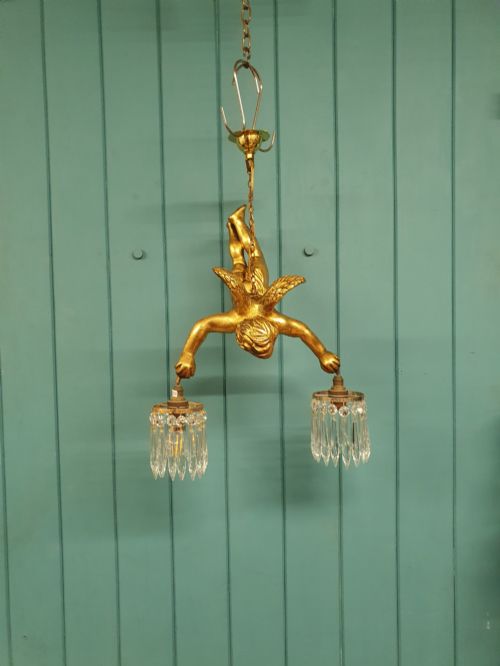
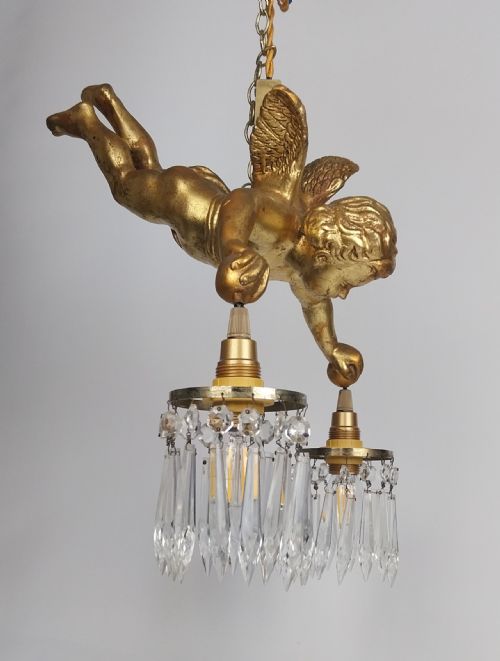


Gilt Cherub Pendant
These gilt cherub pendant options bring ornate character and historic lighting into a room, offering metalwork figures paired with hanging illumination.
Gilt Cherub Pendant
When you search for a gilt cherub pendant, you encounter light fittings, ceiling lights, and chandeliers incorporating cast figures of winged putti alongside metal frames. The items appearing here date from the nineteenth century and the early twentieth century, spanning decades such as 1900, 1910, 1920, and 1930.
The most common versions on this page are chandeliers and light fittings finished in gilt metal, bronze, and gilded bronze. These pieces frequently incorporate hanging glass or crystal spikes and shades, reflecting Rococo Revival, French Neoclassical, and French Chateau styles.
Smaller light pendants and ceiling lights featuring bronze putti also appear alongside multi-arm chandeliers holding several lights. The forms range from single figures supporting central drops to complex arrangements of multiple arms and cut glass elements.
How they were made
Cut glass and crystal spikes are integrated into the designs, often suspended around the central fixture or beneath the cherub figures to refract light. Brass components and structural arms hold the light fittings together, secured with traditional fixings.
Some cherubs fly while others just hang about holding spikes.
What varies in quality
The integration of glass and crystal elements also defines the standard, with precision-cut spikes offering superior light refraction compared to plain pressed glass. Heavier bronze and gilded bronze frameworks generally indicate higher production grades than lighter spelter or basic gilt metal alternatives.
The Gilt Cherub Pendant Glossary
- Cherub
- A winged celestial figure often depicted as a small child in decorative art. In these pieces, they appear supporting or integrated into light fittings.
- Putto
- An artistic representation of a chubby male child, frequently winged, common in classical and revivalist ornamentation. They serve as the central figural element in many of these bronze light fittings.
- Gilt
- Covered thinly with gold leaf or gold paint. This finish gives the metal components their characteristic bright, reflective surface.
- Spelter
- An alloy of zinc and other metals used as a substitute for bronze in decorative castings. It provides a workable medium for detailed figural work during the nineteenth and early twentieth centuries.
- Rococo Revival
- A nineteenth-century design movement drawing on asymmetric scrolls, naturalistic motifs, and exuberant ornamentation. It heavily influences the decorative frames of these chandeliers.
Gilt Cherub Pendant: Frequently Asked Questions
What periods do these chandeliers come from?
The pieces listed originate primarily from the nineteenth century and the early decades of the twentieth century, including specific dates such as 1900, 1910, 1920, and 1930.
Design characteristics align with revival styles popular during those eras, such as French Rococo and Neoclassical.
How are the cherubs incorporated into the lights?
Cherubs and putti appear as central figures supporting the frame, suspended among the arms, or mounted above the main body of the ceiling light.
They are cast directly from metal materials like bronze, spelter, or gilt metal, often positioned alongside cut glass or crystal spikes.
What materials make up these light fittings?
The primary materials consist of gilt metal, brass, bronze, and gilded bronze used for the figures and structural frames.
Cut glass and crystal components are added in the form of spikes, droplets, and shades to complement the metalwork.
Are these items French in origin?
Many of the listed pieces carry designations relating to French design styles, including French Rococo Revival, French Chateau, and French Neoclassical.
The aesthetic follows continental European decorative traditions from the 19th and early 20th centuries.