
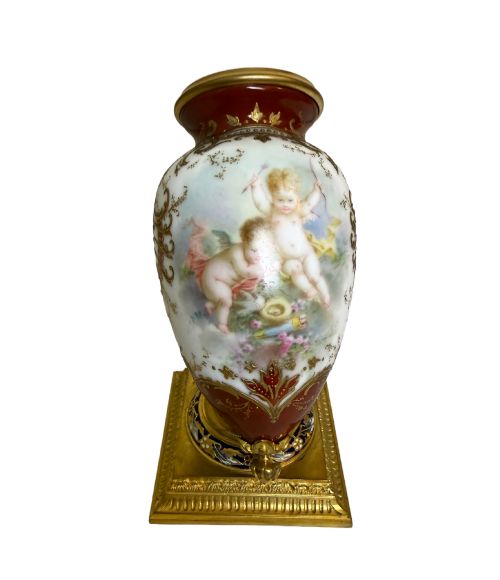
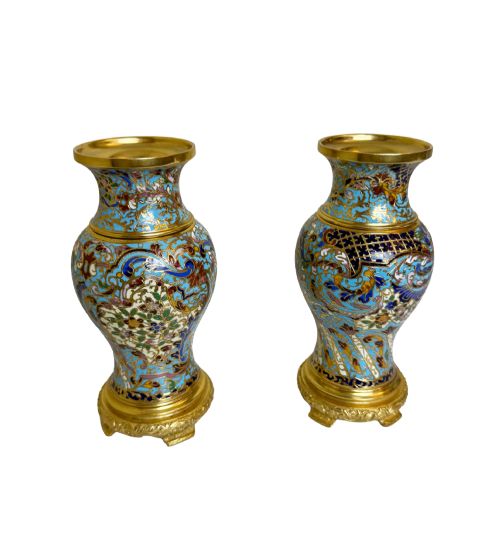


Gilt Bronze Enamel Vase
A gilt bronze enamel vase combines heavy cast metal with bright vitreous colour, offering a striking display piece for any mantel or side table.
Gilt Bronze Enamel Vase
When you search for a gilt bronze enamel vase, you encounter nineteenth-century objects spanning French decorative arts and Chinese export traditions. These pieces appear as lidded vessels, clock garniture sets, or items adapted into table lamps.
Many of these vessels serve double duty as wiring was added later to convert them into lamps while retaining their original ceramic or metallic bodies. Alongside standard decorative vases, you will find candelabra and clock sets sharing the same opulent materials.
Materials and construction
The foundation of these works relies on cast bronze, brass, or copper shaped into robust bodies. Artisans applied fire-gilding or ormolu mounts to create a bright metallic finish framing the decorated surfaces.
Enamel work takes two primary forms across these examples, utilising cloisonné wire cells or champlevé troughs sunk directly into the metal. Once filled with vitreous paste, the pieces were fired and polished to a smooth lustre.
Several examples incorporate porcelain bodies, such as Sevres ceramic or Famille Verte wares, secured within elaborate gilt bronze mounts. Fabric elements occasionally appear in the associated lamp fittings or shades.
Materials recorded across the inventory include gilt bronze, cloisonné enamel, champlevé enamel, brass, porcelain, copper, fabric, and ormolu.
Judging quality and craftsmanship
Quality rests in the crispness of the bronze casting and the precision of the enamel work. Finer pieces show tight wire boundaries in cloisonné or cleanly carved recesses in champlevé without pitting in the coloured vitreous paste.
The integration of the gilt mounts defines the upper tier of these objects. Superior examples feature heavy, well-chased ormolu that hugs the ceramic or metallic body seamlessly rather than relying on crude mechanical fasteners.
Sevres
The Gilt Bronze Enamel Vase Glossary
- Gilt bronze
- Metal cast and coated with a thin layer of gold, often providing a bright reflective surface on decorative mounts. It is frequently called ormolu in nineteenth-century French pieces.
- Cloisonné enamel
- Technique where thin metal wires are soldered to a metal base to create compartments filled with enamel paste. These cells form intricate patterns before firing.
- Champlevé enamel
- Method in which troughs or cells are dug directly into the surface of a thick metal plate and filled with enamel. The remaining metal walls form the outlines of the design.
- Ormolu
- French term for gilt bronze applied to decorative hardware, furniture mounts, and vase bases. It gives a warm golden tone to nineteenth-century decorative objects.
- Clock garniture
- A set comprising a mantel clock flanked by matching decorative objects such as vases or candelabra. These matched sets were designed to sit together on a fireplace mantel.
Gilt Bronze Enamel Vase: Frequently Asked Questions
What is a gilt bronze enamel vase?
These are decorative vessels made from metal and ceramic, decorated with fused glass powder and mounted in gilded bronze. They originate from nineteenth-century European and Chinese workshops.
Buyers select them for their rich colours and heavy metallic mounts, which suit traditional and eclectic interiors alike.
How do I clean a gilt bronze enamel vase?
Dust the surface gently with a soft, dry brush to prevent dirt from settling in the recessed enamel cells. Avoid commercial metal polishes, which can strip the delicate fire-gilding from the bronze mounts.
Keep these objects away from direct sunlight and damp environments to protect the vitreous enamel and the metallic finish.
Were these vases originally made as lamps?
Many nineteenth-century examples were originally manufactured as decorative urns, mantel garnitures, or display vases. They were frequently converted into table lamps during later periods by drilling or adding electrical fittings.
Converters often retained the original handles, bases, and body decoration while adapting the top to hold a bulb and shade.
How do I distinguish French from Chinese pieces?
French examples often display Napoleon III, Rococo Revival, or Chinoiserie styles with cast ormolu mounts framing Sevres or cloisonné panels. Chinese export and Qing Dynasty pieces rely on traditional cloisonné or Famille Verte palettes with integrated handles and distinct bronze bases. Ninth-century trade between Europe and Asia also led to Chinese pieces receiving French gilt bronze mounts upon arrival in Europe.