




Gilded Dial Mantle Clock
A gilded dial mantle clock brings brass cases, enamel panels and French movement into a room.
Gilded Dial Mantle Clock
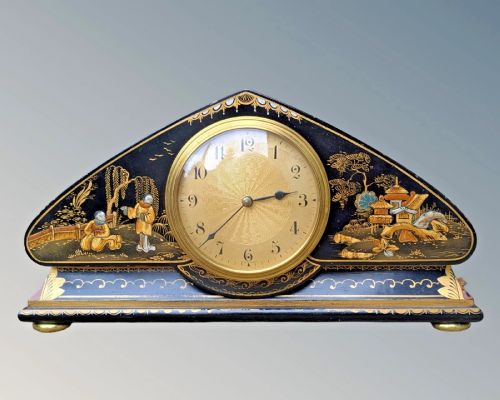
When you search for a gilded dial mantle clock, you encounter nineteenth-century pieces spanning the Victorian era up to nineteen-twenty. The selection leans heavily toward French carriage clocks and mantel clocks housed in marble, ormolu, and gilt brass. Forms range from simple four-glass mantel pieces to elaborate Chinoiserie designs and Sevres style porcelain panelled clocks.
You are most likely to meet French carriage clocks with enamel panels alongside large Victorian marble and ormolu mantel clocks. These pieces originate predominantly from nineteenth-century workshops, with dates clustering around eighteen-eighty and eighteen-ninety. The dial remains the focal point, often framed by glass, filigree masks, or engraved brass cases.
How they were made
The construction relies on metals such as brass, gilt brass, ormolu, and gilt bronze to form the structural cases and decorative mounts. Workshops combined these metallic elements with glass panels, enamel dials, and occasionally porcelain or pink marble. Engraving appears on the brass cases, while filigree masks add detail around the faces.
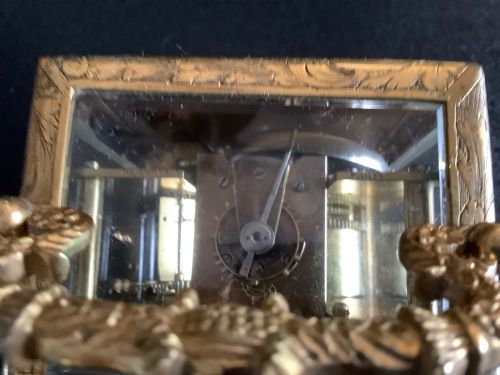
Movements span eight-day mechanisms, repeating functions, and striking trains housed within gorge cases or serpentine marble bodies. Makers utilised precise mechanical gearing alongside hand-finished surface gilding to achieve the polished appearance seen across the selection.
Several clocks hide complex striking trains and repeating mechanisms inside deceptively neat glass boxes.
What varies in quality
The refinement of the casting and the crispness of the chasing on ormolu and gilt brass separate standard examples from finer work. Heavier cases utilising marble or multiple glass panels display greater structural ambition, while signed movements by established makers elevate a piece above unmarked workshop productions.
Dial execution dictates visual distinction, with hand-painted enamel panels and detailed engraved masks showing superior craftsmanship compared to plain metal faces. The presence of specialised complications like a petit sonnerie striking train or repeater mechanism further defines the upper tier of the range.
Henri Jacot·C. Detouche Paris·Margaine·Tiffany·Paul Garnier·Alfred Drocourt·P.H Mourey
The Gilded Dial Mantle Clock Glossary
- Ormolu
- Gilded bronze or brass applied to decorative objects and clock cases. It provides a bright metallic finish characteristic of nineteenth-century French pieces.
- Carriage clock
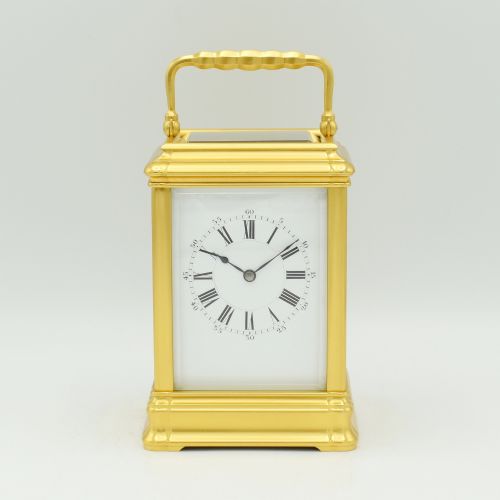
- A portable spring-driven timepiece designed for travelling during the nineteenth century. These clocks typically feature a rectangular brass case with glass panels and a handle on top.
- Petit sonnerie
- A striking mechanism that chimes the hours and the quarters as they pass. It represents a more complex movement than a standard hourly striker.
- Four glass clock
- A mantel clock housed in a brass frame with glass panels on all four sides to expose the movement. This style gained popularity during the late nineteenth century.
- Gorge case
- A stepped brass carriage clock case with characteristic curved mouldings around the top and bottom. It provides a sturdy and traditional housing for the movement.
Gilded Dial Mantle Clock: Frequently Asked Questions
What is a carriage clock?
A carriage clock is a portable timepiece developed in the nineteenth century for travel, featuring a protective brass case with glass panels and a folding handle.
Most examples run on an eight-day spring movement and sit securely on mantels or desks today.
How do I wind these clocks?
Winding requires a matching key inserted into the winding arbours on the dial or backplate, turned gently until resistance is felt.
Care must be taken not to overwind the mainspring, ensuring the mechanical movement continues to keep accurate time.
How do I date a mantle clock?
Dating relies on stylistic clues such as the form of the marble case, the presence of Sevres style porcelain, and the design of the brass framing.
Maker signatures and serial numbers engraved on the movement backplate also help narrow the decade of production.
What is a repeating carriage clock?
A repeating carriage clock includes a mechanism that chimes the last hour and quarters on demand when a button on the top is pressed.
This function allowed owners to check the time in the dark during the nineteenth century without lighting a candle.