


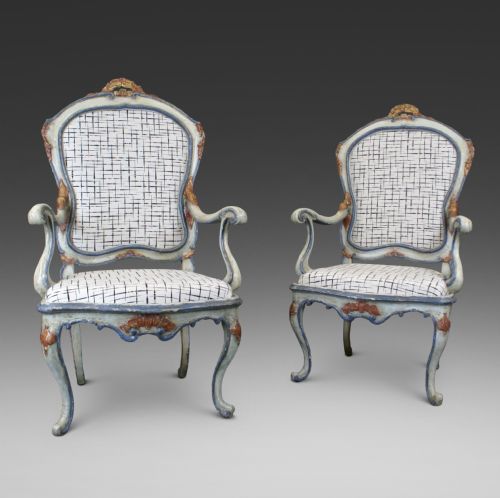
Gilded Carver Chairs
These gilded carver chairs bring striking presence and formal seating to a room, spanning revival styles from the eighteenth century to the twentieth.
Gilded Carver Chairs
When buyers search for gilded carver chairs, they seek formal seating distinguished by open armrests and gilded surfaces. The selections on this page encompass armchairs and dining chairs created across several centuries.
The assortment includes French Rococo, Louis XVI style, Italian Neoclassical, and Regency revival pieces. Examples range from eighteenth-century Italian silver gilt armchairs to twentieth-century sets finished with gold leaf.
Common forms on display include paired armchairs and larger dining suites upholstered in silk damask or fabric. Many pieces incorporate carved wood frames reflecting French Empire, Baroque revival, and Chinoiserie aesthetics.
How they were made
Carpenters shaped foundational frames from timber, beech, solid walnut, and carved wood. Craftsmen then applied gesso as a smooth preparatory layer to receive subsequent ornamentation.
Artisans finished surfaces using gold leaf, silver gilt, paint, and lacquer in various revival styles. Upholsterers completed the seating using traditional textiles such as silk damask and patterned fabric.
Gilded Carver Chairs Retail Price Guide 2026
Typical asking prices for gilded carver chairs among the pieces listed under this phrase on Sellingantiques today, from the lower quarter to the upper quarter. They describe what is for sale here now, not the wider market.
Listings feature periods spanning from the eighteenth century through the 1930s, utilising giltwood, beech, walnut, and silk damask.
What varies in quality
Quality rests upon the crispness of the carved wood details and the precision of the underlying gesso. Earlier pieces from the eighteenth century display hand-carved depth that differs from later twentieth-century interpretations.
The integrity of the giltwood or gold leaf surface layer dictates the visual impact. Original upholstery choices, such as silk damask, contribute significantly to the overall coherence and historical character of the suite.
The Gilded Carver Chairs Glossary
- Giltwood
- Wood that has been treated with a thin layer of gold leaf or powder. This finish provides a luminous and reflective surface characteristic of formal seating.
- Carver chair
- An armchair designed with open sides, traditionally placed at the head of a dining table or used as a standalone seat. Such chairs feature prominent armrests.
- Gesso
- A mixture of binder and chalk applied to wood surfaces before gilding. It creates a smooth base that allows fine details to be carved sharply.
- Silk damask
- A reversible fabric woven with patterned motifs, frequently used for upholstery. It appears on large suites of dining chairs to denote formality.
- Barocchetto
- An Italian variation of the Baroque style featuring lighter, more playful ornamentation. Pieces from this aesthetic display fluid carved lines.
Gilded Carver Chairs: Frequently Asked Questions
What is a carver chair?
A carver chair is an armchair traditionally designed to sit at the head of a dining table. These seats feature supportive armrests alongside a matching set of dining chairs.
Today, they function equally well as standalone accent chairs in living spaces or hallways. Their decorative frames add architectural interest to a room.
How do I identify French Rococo style?
French Rococo style relies on asymmetrical motifs, C-scrolls, and naturalistic carved foliage. The aesthetic prioritises flowing lines and ornate decorative flourishes.
In seating, this translates to curved frames and richly gilded wooden structures. Craftsmen utilised these organic shapes to create a sense of movement.
Where should I place a gilded armchair?
Gilded armchairs command visual attention, making them ideal focal points in drawing rooms or studies. Pairing them with simpler furniture allows the metallic finish to stand out.
They also serve effectively in pairs flanking a fireplace or console table. Proper placement highlights the carved details of the timber frame.
What distinguishes Regency revival pieces?
Regency revival pieces draw inspiration from early nineteenth-century British design, often incorporating classical motifs. These items frequently utilise ebonised finishes alongside gilded highlights.
Such chairs combine structural restraint with bold decorative accents. They reflect a period fascinated by classical antiquity and refined silhouettes.