



Gilded Cabriole Leg Chair
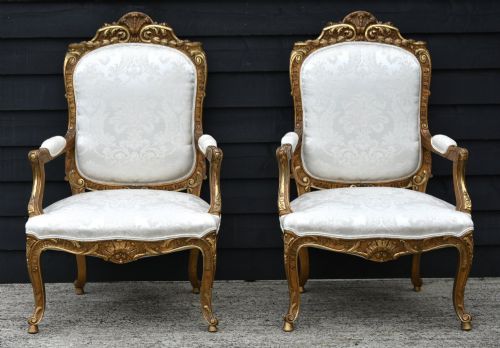
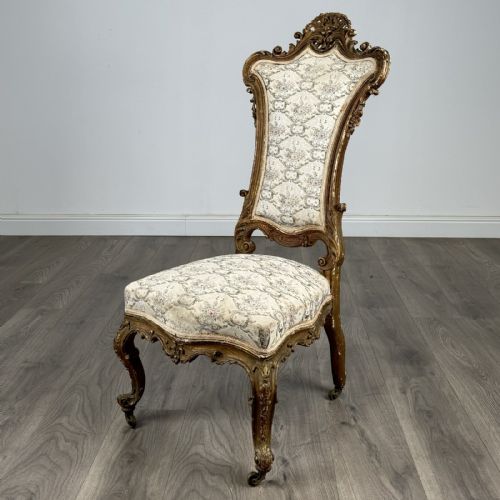
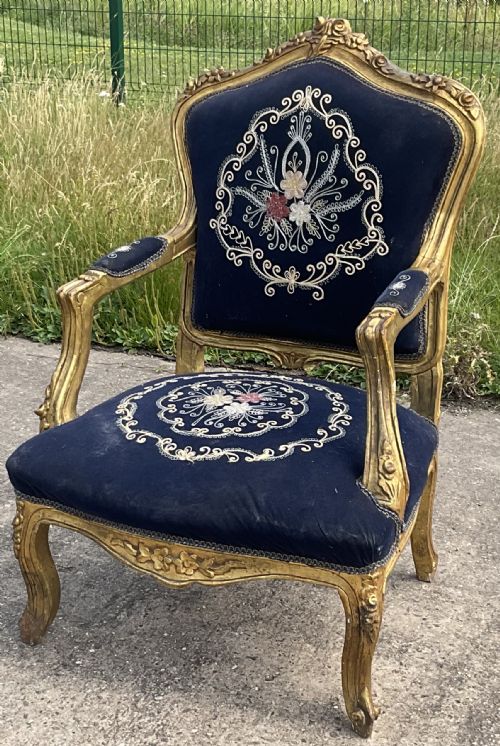
A gilded cabriole leg chair brings curved lines and reflective surfaces into a room, offering both seating and ornamental presence.
Gilded Cabriole Leg Chair
When you search for a gilded cabriole leg chair, you are looking at seating defined by its characteristic double-curved leg, which arches outward at the knee and tapers inward toward the foot. These pieces frequently appear in French Louis XV Revival, Victorian, and Edwardian styles, reflecting historic European design influences.
The selection on this page ranges from 18th-century open armchairs and Dutch lacquered side chairs to later Victorian and Edwardian interpretations. You will encounter armchair and side chair formats, often upholstered in silk, velvet, or fabric.
Origins span English, French, and Dutch workshops, showing how different makers adapted the curved leg form across centuries. The pieces bridge formal salon seating and domestic fireside comfort.
Construction and materials
Carpenters shaped the structural frames using timber such as beech and walnut, employing traditional joinery to support the sweeping contours of the cabriole legs and scroll arms. Beech provided a reliable base for carving complex Rococo motifs and channelled details.
Surface decoration relied on the application of giltwood or applied lacquer, creating a metallic or polished finish over the wood base. Upholstery techniques integrated silk, silk damask, silk embroidery, and velvet secured over padded foundations.
Gilded Cabriole Leg Chair Retail Price Guide 2026
Typical asking prices for gilded cabriole leg chair among the pieces listed under this phrase on Sellingantiques today, from the lower quarter to the upper quarter. They describe what is for sale here now, not the wider market.
Markers of quality
Quality rests in the precision of the wood carving along the cabriole legs and frame, where crisp contours distinguish superior work from softer execution. The fluidity of the curved lines dictates how successfully the maker captured the intended style.
The integrity of the original gilt decoration or lacquer finish preserves the historical character of the piece. Upholstery choices, from silk damask to simple fabric, reflect the original intended status of the chair.
Blaise Maucuy
The Gilded Cabriole Leg Chair Glossary
- Cabriole leg
- A furniture leg that curves outward at the top and inward at the foot, resembling the leg of an animal. This form became central to 18th-century furniture design.
- Giltwood
- Timber that has been coated with a thin layer of gold leaf or gilt decoration. It produces a reflective surface popular in formal salons.
- Fauteuil
- An open-framed armchair with upholstered armrests, originating in France. These chairs typically feature exposed wooden frames.
- Japanned
- European furniture decorated with imitation East Asian lacquered finishes. The technique involves layered varnishes and often depicts oriental motifs.
Gilded Cabriole Leg Chair: Frequently Asked Questions
How do I identify a Louis XV style chair?
Louis XV style chairs are defined by asymmetrical ornamentation, organic curves, and scrollwork. The frames typically lack straight lines and emphasise flowing floral and leaf motifs.
Evidence from listings shows examples attributed to this style, often featuring open arms, giltwood, and cabriole legs characteristic of French rococo revival design.
Where were these chairs used?
Historically, gilded and carved chairs served in formal salons, withdrawing rooms, and parlours where hosts entertained guests. Their decorative finishes were intended to catch candlelight and display status.
Today, similar pieces function as occasional chairs, boudoir seating, or statement armchairs in contemporary living spaces.
What is the difference between a side chair and an armchair?
An armchair includes structural armrests designed to support the sitter's arms, making it suitable for lounging or fireside use. Side chairs are built without arms and were traditionally placed against walls or around dining tables.
The listings here include both open armchairs, wing armchairs, and side chair variants across 18th-century and 19th-century origins.