
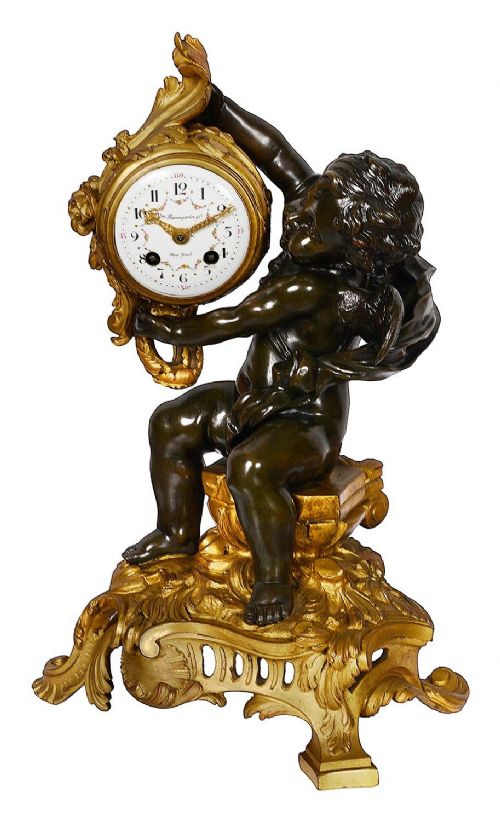

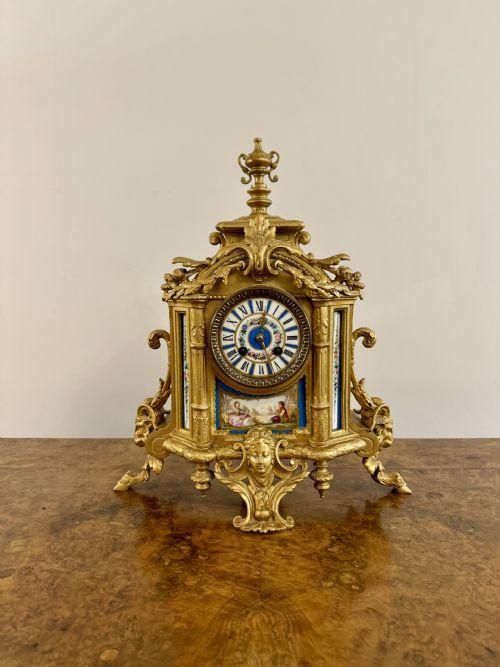


Gilded Bronze Mantle Clock
A gilded bronze mantle clock brings heavy nineteenth-century presence to a room, combining cast metalwork with functional timekeeping.
Gilded Bronze Mantle Clock
When you search for a gilded bronze mantle clock, you encounter nineteenth-century French and Victorian pieces produced in various revival styles. These objects function as domestic timepieces while serving as sculptural centrepieces for mantelpieces and sideboards.
The selections span French Rococo Revival, Louis XVI Revival, and Empire designs, often incorporating porcelain panels, enamel dials, and glass enclosures. Many examples arrive as garniture sets accompanied by matching side ornaments.
The most frequently encountered versions on this page originate from French workshops of the eighteen-eighties and eighteen-nineties. They utilise cast metal foundations finished with gilding, patination, or mercury ormolu.
Materials and construction methods
Foundations are typically formed from cast bronze, brass, or gilt metal, which is then chased and gilded to produce a bright metallic finish. Ormolu application involves a mercury-gilding technique that creates a durable, deep lustre on the bronze substrate.
Movements are mechanical eight-day mechanisms requiring manual winding via a key, frequently housing pendulum regulation. Dials are constructed from painted enamel or porcelain segments, sometimes featuring hand-painted numerals and floral motifs.
Listings feature nineteenth-century French and Victorian clocks constructed from gilt bronze, ormolu, marble, and porcelain across various revival styles.
Distinctions in craftsmanship and preservation
The refinement of the cast ornamentation dictates the grade of the piece, where sharper relief and deeper chisel work distinguish superior castings from softer production. The crispness of foliate scrolls, figural limbs, and architectural drapery reveals the skill of the original bronze-worker.
The preservation of the original mercury gilding or ormolu surface affects the integrity of the object, as polished-through brass or later re-plating alters the visual depth. The original association between the movement, dial, and bronze case also influences the standing of the clock.
Philippes Paris·Leroy & Fils·Phillipe H. Mourey·Dehné of Paris
The Gilded Bronze Mantle Clock Glossary
- Ormolu
- Gilded bronze produced by applying a mercury and gold amalgam to a bronze base and firing it to drive off the mercury. This historical technique yields a distinctive matte and burnished gold surface.
- Garniture
- A set consisting of a central clock flanked by matching ornamental pieces such as urns or candelabra. These matched groupings were designed to decorate a mantelpiece as a cohesive decorative arrangement.
- Four glass clock
- A clock encased in glass panels on all four sides, often revealing the pendulum and movement within. This style gained popularity during the late Victorian period.
- Portico clock
- A timepiece housed within a architectural frame supported by four or more columns. They frequently feature a suspended pendulum swinging freely between the structural pillars.
- Champleve
- An enamelling technique where troughs or cells are hollowed out of the metal surface and filled with vitreous enamel paste before firing. The resulting pattern displays coloured enamel flush with the surrounding metal borders.
Gilded Bronze Mantle Clock: Frequently Asked Questions
How do I wind an antique mantle clock?
Most mechanical nineteenth-century clocks utilise an eight-day movement driven by springs, requiring a key inserted into the winding arbours on the dial. You turn the key gently until resistance is felt, taking care not to overwind the mechanism.
Regulating the pendulum speed is achieved via a small adjustment nut located below the bob. Turning the nut raises or lowers the pendulum to correct timekeeping gains or losses.
What is a crystal regulator clock?
A crystal regulator is a style of timepiece featuring heavy bevelled glass panels on all sides held within a brass or gilt bronze framework. This transparent housing allows light to pass through and exposes the mechanical movement and mercury or gridiron pendulum.
These pieces typically date from the late nineteenth century and often incorporate delicate porcelain dials with painted enamel decoration. Their open construction makes them sensitive to placement in direct sunlight or drafts.
How do I identify a Louis XVI style clock?
Louis XVI style clocks reflect eighteenth-century neoclassical aesthetics revived during the nineteenth century, featuring geometric symmetry, architectural urns, and laurel garlands. The cases often display straight lines, fluted columns, and classical motifs rather than the asymmetrical curves of earlier Rococo designs.
Ormolu mounts on these pieces emphasise classical restraint, incorporating ribbons, swags, and fire-gilt bronze surfaces. Porcelain plaques painted in the Sevres style frequently complement the neoclassical proportions.
Where should I place a heavy marble clock?
Heavy marble and bronze clocks require a sturdy, level surface capable of supporting considerable weight without sagging. Mantelpieces, heavy sideboards, or dedicated console tables provide suitable stable foundations for these substantial objects.
Ensuring the surface is completely level is essential for the escapement to beat evenly and keep accurate time. Placing the clock away from exterior walls with damp issues protects both the internal steel components and the exterior gilding.