
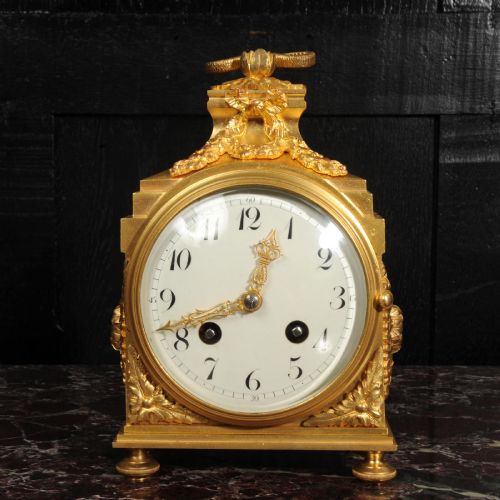
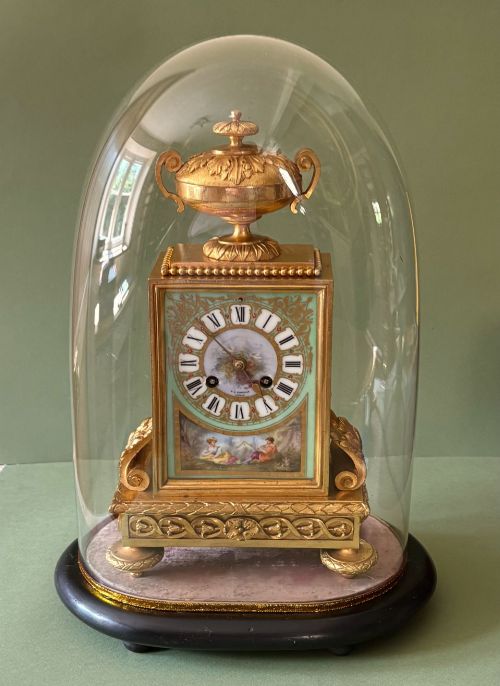
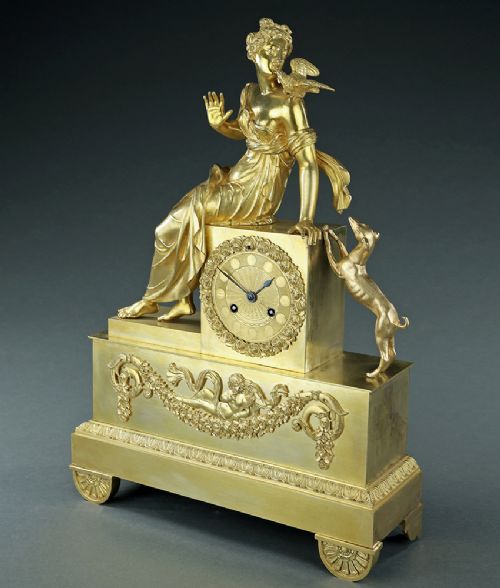
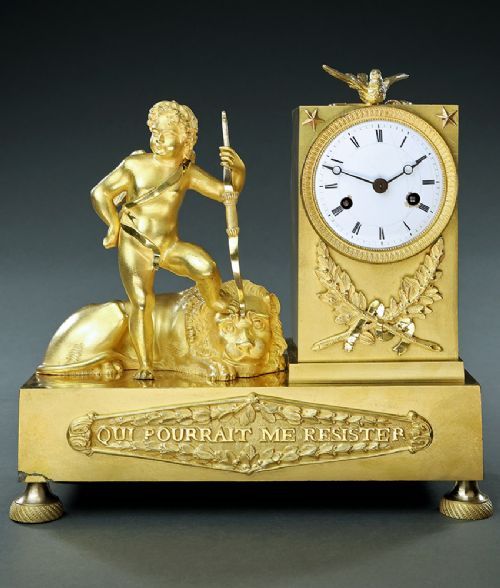


Gilded Bronze Mantel Timepiece
A gilded bronze mantel timepiece sits heavily on the shelf, bringing the gilt metal and enamel dials of nineteenth-century French workshops into a room.
Gilded Bronze Mantel Timepiece
A gilded bronze mantel timepiece is a freestanding domestic clock designed for the fireplace shelf or side table, combining heavy cast metal cases with mechanical movements. When you search for this phrase, you meet predominantly nineteenth-century French examples spanning the Victorian era and earlier decades.
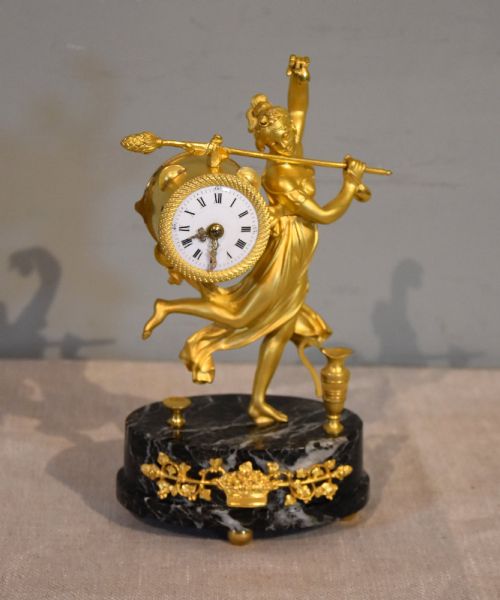
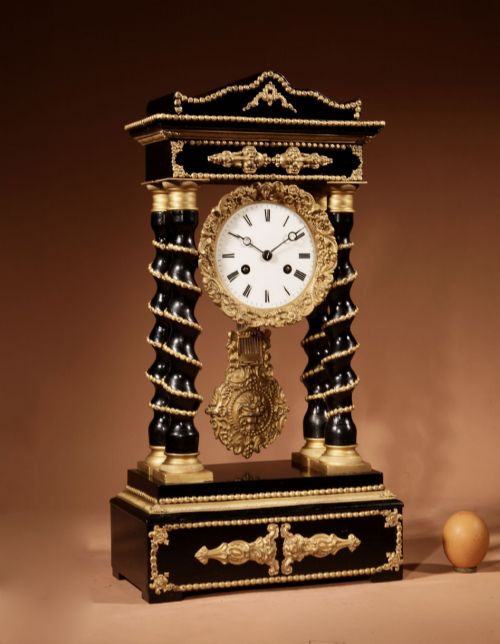
The selection on this page consists largely of French mantel clocks, portico clocks, and crystal regulators from periods like the Regency and the later Victorian years. These pieces draw on French Empire, Rococo, and Louis XVI styles, showing classical motifs, floral garlands, and figural subjects.
Most pieces date from the nineteenth century, though variations stretch back to the mid-eighteenth century and forward into the art deco period. They serve primarily as decorative objects that also keep time, often paired with matching side ornaments or mounted on marble bases.
How They Were Made
The construction relies heavily on ormolu, gilt bronze, and brass, cast in sections and then assembled over iron or wooden internal frameworks. Ormolu work involves applying finely ground gold amalgam to a bronze base and heating it to drive off the mercury, leaving a durable golden skin.
Many cases incorporate panels of white or coloured marble, porcelain plaques in the manner of Sevres, and glass panels for crystal regulators that reveal the swinging pendulum. Dials are frequently white enamel with painted Roman numerals, protected behind small hinged bezels with convex glass.
The listings span the eighteenth, nineteenth, and early twentieth centuries, featuring marble, porcelain, and tortoiseshell alongside gilt bronze.
What Varies in Quality
Quality rests significantly on the crispness of the bronze chasing and the depth of the mercury gilding, where sharper cast details reflect superior workshop standards. Finer pieces show careful hand-finishing on fur, foliage, and drapery rather than the softened edges typical of hurried production.
The movement itself dictates the calibre of the clock, with signed makers' marks on the backplate separating standard commercial work from workshop masterpieces. Heavier marble mounts, well-executed enamel dials, and intact original glass panels complete the higher tier.
Le Roy Paris·Philippes Paris·Japy Frers·Henri Jacot·Le Roy and Fils·A.D. Mougin·Deniere Et Fils·Hessen Paris
The Gilded Bronze Mantel Timepiece Glossary
- Ormolu
- Gilded bronze produced by applying a gold and mercury mixture to a cast bronze object and heating it until the mercury evaporates. This technique creates a distinct warm lustre found on nineteenth-century French clock cases.
- Portico clock
- A tall, architectural mantel clock style supported by four columns resembling a classical temple facade. These often house a pendulum swinging visibly between the upright supports.
- Champleve
- An enamelling technique where troughs are dug into the bronze surface, filled with coloured glass paste, and fired. It appears frequently on late nineteenth-century clock bezels and dial surrounds.
- Pendule d'Officier
- A portable military-style desk or travel clock fitted with a carrying handle on top. They originate from French military and officer traditions.
- Crystal regulator
- A mantel clock enclosed entirely by bevelled glass panels held in a brass or gilt bronze frame. This design allows light to pass through the case and exposes the movement and mercury pendulum from all angles.
Gilded Bronze Mantel Timepiece: Frequently Asked Questions
How do I wind a mantel timepiece?
Most of these clocks use a key inserted into winding holes on the enamel dial to tension the mainspring inside the movement. Care should be taken not to overwind the spring.
Regulating the timekeeping is usually managed via a small square arbor on the dial or by adjusting the pendulum bob up and down with a regulating nut.
Where should I place my clock?
Mantel timepieces need a stable, level surface such as a wooden sideboard, mantelpiece, or heavy table. Placing them securely prevents the mechanical beat from becoming uneven.
Avoid locations exposed to direct sunlight, damp air, or significant temperature fluctuations that might affect the enamel and internal metal parts.
How can I tell the difference between styles?
French Empire clocks lean towards military trophies, sphinxes, and classical restraint, often rendered in dark patinated bronze with bright ormolu mounts. Louis XVI style pieces display symmetrical floral garlands, urns, and ribbons.
Rococo and Louis Quinze designs feature asymmetrical scrollwork, naturalistic shell motifs, and exuberant curves without straight lines.
What is a fusee movement?
A fusee is a conical pulley used in some clocks to maintain equal power to the gear train as the mainspring unwinds. This mechanical addition helps ensure more accurate timekeeping throughout the running period.
They appear more commonly in English pieces and select Regency bracket or mantel clocks rather than standard French drum movements.