



Gilded Brass Clock Case
These gilded brass clock cases bring heavy French carriage forms and monumental mantel designs into a room, offering bright metalwork that catches every angle of light.
Gilded Brass Clock Case
A gilded brass clock case provides the protective housing and decorative framework for complex horological movements, spanning substantial mantel designs and portable travel pieces. When searching for a gilded brass clock case, collectors typically encounter domestic French carriage clocks from the nineteenth century alongside larger mantel pieces.
The selection here encompasses robust gorge cases, four glass designs, and monumental gilt bronze or ormolu housings. Pieces range from the Georgian era through to mid twentieth century examples, drawing heavily on French Rococo and Louis XVI styles.
Many of these housings incorporate glass panels, enamel dials, and delicate engravings to showcase the inner mechanics. Longcase examples also appear, featuring lacquered wood bodies paired with substantial brass movements.
Materials and construction
The foundational framework relies on cast brass, finished with heavy layers of gilding, ormolu, or gilt bronze to create a durable, luminous surface. Glass panels frequently enclose the movement, allowing light to pass through the housing and illuminate the escapement.
Makers integrated decorative enamel panels, hand-engraved brass bezels, and cast metal appliques such as lion masks into the primary structure. Lacquered wood occasionally forms the body for larger tallcase housings, contrasting with the metallic brilliance of the dial surrounds.
Listings feature brass, gilt bronze, and ormolu materials across French carriage clocks, crystal regulators, and tallcase housings.
Markers of distinction
Quality rests in the crispness of the cast bronze and brass work, where sharp relief and clean chasing distinguish superior housings from softer, worn castings. The thickness and uniformity of the original gilding also mark the difference between standard production and higher grade workshop output.
Henri Jacot·Margaine·Samuel Marti·Joseph Soldano·Alfred Hollinge·Jaeger Le Coultre
The Gilded Brass Clock Case Glossary
- Gorge case
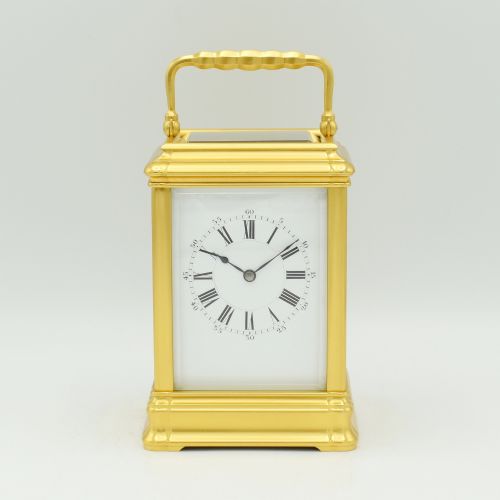
- A distinct rectangular carriage clock housing style featuring stepped top mouldings and a heavy carrying handle. It provides a robust architectural frame for viewing the movement.
- Ormolu
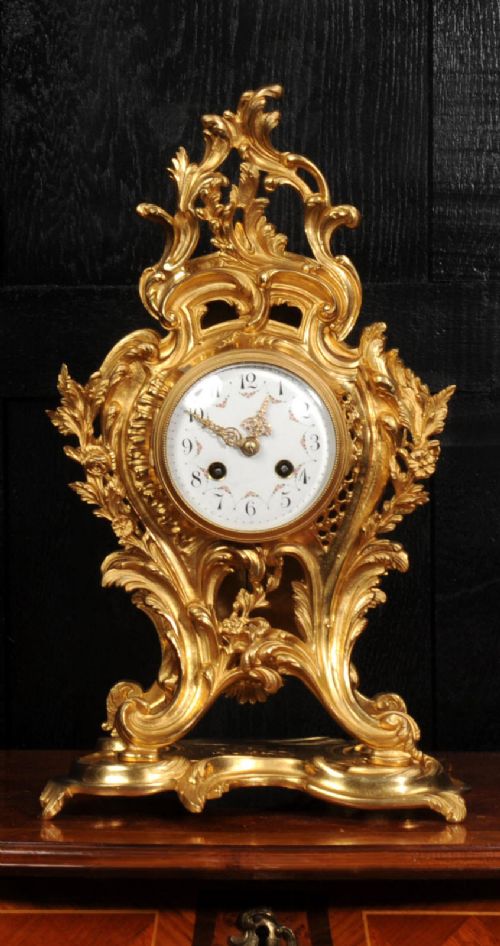
- Finely ground high-carat gold mercury-gilded onto a bronze or brass base. This technique creates a rich, lasting metallic lustre on nineteenth century French housings.
- Petit sonnerie
- A striking clock train that chimes the hours and the passing quarters automatically. It represents an advanced level of horological complication housed within the brass case.
- Chinoiserie
- A decorative European style imitating Chinese artistic motifs, seen on lacquered clock bodies. It reflects eighteenth century taste for exotic painted landscapes.
- Four glass clock
- A mantel clock design enclosed entirely by bevelled glass panels within a brass frame. This configuration provides an unobstructed view of the movement from every side.
Gilded Brass Clock Case: Frequently Asked Questions
What is a gorge case?
A gorge case is a specific rectangular housing style used predominantly for French carriage clocks, featuring a stepped top plate and a sturdy folding handle. This design provides structural strength while framing the glass panels.
These housings were built to protect the delicate movement during travel while remaining visually refined enough for domestic display on a mantelpiece.
How do I identify French ormolu?
French ormolu consists of finely ground gold applied via mercury amalgamation to a cast bronze or brass base. It exhibits a deep, warm golden tone that does not tarnish like raw brass.
Examining the metal under magnification reveals the heavy layer of gold adhered to the cast decorative mounts and surface details.
Where were carriage clocks used?
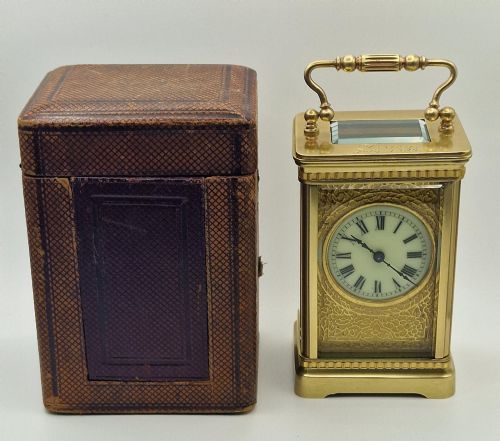
Carriage clocks were originally designed for travellers during the nineteenth century, built to withstand the rigours of transit while keeping accurate time in temporary lodgings. They typically came fitted with protective leather travelling cases.
Over time, these portable timepieces transitioned into stationary decorative objects displayed prominently on drawing room mantels and desks.
What is a grande sonnerie?
A grande sonnerie is a complex striking mechanism that chimes both the hours and the quarters automatically with every passing interval. It represents the pinnacle of nineteenth century clockmaking skill.
Housed within heavy gilt brass or ormolu cases, these movements require precise engineering and substantial interior space to operate reliably.