



Ormolu Four Glass Clock
These striking ormolu four glass clock examples bring fine nineteenth-century French metalwork and bevelled glazing together for any mantelpiece.
Ormolu Four Glass Clock
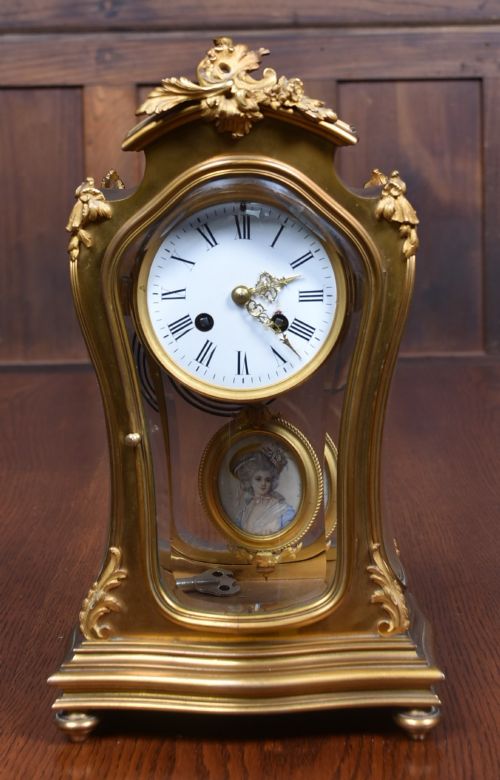
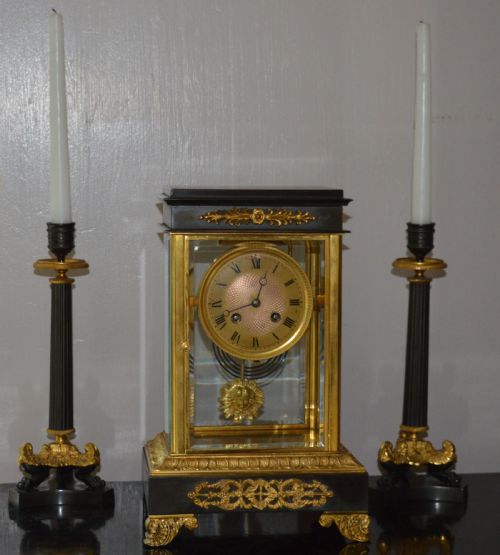
An ormolu four glass clock presents a dial suspended within a brass, gilt bronze, or gilded bronze frame fitted with transparent glass panes on all four sides. The form emerged strongly during the nineteenth century, particularly under the Victorian and Napoleon III periods, often aligning with French Louis XVI style or Rococo Revival aesthetics.
Materials and construction
Gilding metal surfaces with mercury or electroplated gold creates the characteristic warm ormolu finish that defines the heavy cast brass and bronze mounts. Bevelled glass panels are carefully fitted into the metal framework to enclose the delicate clockwork without distorting the internal view.
Dials are frequently constructed from white enamel with painted Arabic or Roman numerals, sometimes complemented by hand-painted porcelain panels in the Sevres style. Bases and architectural elements incorporate natural stones including marble and onyx, secured with threaded metal fixings.
Some models hide miniature hand-painted portraits behind their brass bezels, offering a tiny secret face to anyone winding the clock.
Assessing craftsmanship and finish
The crispness of the cast ormolu mounts determines the visual sharpness of the scrollwork and neoclassical details, separating superior pieces from softer secondary castings. Heavy gauge brass and thick bevelled glass panels provide structural integrity that lighter constructions lack.
Signed movements by known makers such as Samuel Marti or Japy Freres indicate higher manufacturing standards and reliability in the escapement and striking train. The integration of specialty materials like specimen marble or hand-painted porcelain panels elevates the overall refinement of the piece.
Samuel Marti·Japy Freres·Rodier
The Ormolu Four Glass Clock Glossary
- Ormolu
- Finely ground high-carat gold applied to a bronze or brass base through mercury amalgamation or electroplating. This technique produces a durable, luminous surface characteristic of fine French decorative objects.
- Crystal Regulator
- A mantel clock featuring glass panels on all four sides that reveal the internal movement and swinging pendulum. The designation highlights the transparent enclosure rather than precise crystal composition.
- Garniture
- A matching set consisting of a central clock flanked by coordinating decorative ornaments such as urns or vases. These sets share identical marble bases and ormolu mounts.
- Bevelled Glass
- Panes featuring an angled edge ground down along the perimeter to catch and refract light. This traditional glazing method adds depth to the cabinet housing the clock movement.
- Striking Mechanism
- An internal clockwork train that sounds the hours and half-hours on a bell or gong. Most nineteenth-century examples utilise an eight-day spring-driven movement.
Ormolu Four Glass Clock: Frequently Asked Questions
What is a four glass clock?
A four glass clock is a mantel timepiece housed in a brass or gilt bronze frame with transparent glass panels on the front, back, and both sides. This design allows light to pass through and exposes the mechanical movement from multiple angles.
Most surviving examples originate from nineteenth-century France and reflect styles ranging from neoclassical revival to Rococo. They frequently sit upon marble or onyx bases and include visible mercury pendulums.
How do I wind the movement?
Winding requires a matching key inserted into the winding holes on the enamel dial to tension the internal springs. Care must be taken not to overwind the mechanism, which operates on an eight-day cycle.
Many French movements require the pendulum to be secured or centralised when relocating the clock to prevent damage to the suspension spring. Professional servicing every few years ensures the striking train remains accurate.
Are these clocks French?
The vast majority of four glass clocks encountered on the market are nineteenth-century French productions, often associated with Parisian workshops. Makers such as Samuel Marti and Japy Freres supplied movements to retailers across Europe.
Stylistic cues like Louis XVI urn motifs, Sevres style porcelain panels, and mercury-gilt bronze frames point directly to French manufacturing traditions of the Victorian and Napoleon III eras.
How do I style a mantel clock?
These architectural clocks suit traditional mantelpieces, sideboards, or console tables where light can pass through the glass sides. Placing them away from direct sunlight and damp environments protects the delicate ormolu surface and enamel dial.
If the clock is part of a garniture set, position the matching side ornaments symmetrically around the central timepiece to maintain the balanced aesthetic intended by the maker.