
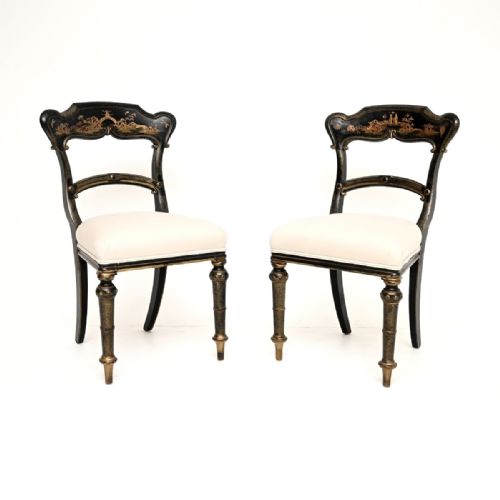


Gilded Black Accent Chair
A gilded black accent chair brings dark painted timber and bright leaf together to anchor a room with real decorative weight.
Gilded Black Accent Chair
A gilded black accent chair is a decorative seating piece combining dark surfaces with metallic highlight, appearing across periods from the eighteenth century to the twentieth century. These chairs take several specific forms including side chairs, armchairs, hall chairs, bedroom chairs, and nursing chairs.
The versions most commonly met on this page span Victorian, Regency, and Aesthetic Movement designs, often decorated with Chinoiserie motifs or lacquered finishes. Makers and workshops across England, France, Italy, and the Netherlands produced these pieces using painted, ebonised, and japanned techniques.
Buyers look for these items to introduce strong contrast and historical character into modern or traditional interiors. The selection ranges from formal Regency hall seats to intimate boudoir and bedroom chairs.
How they were made
Construction relies on carved wood and moulded papier-mâché, finished with ebonised surfaces, black paint, or dark lacquer. Artisans applied gold leaf and gilt decoration by hand to accent the turned legs, rails, and carved backs.
Upholstery materials include woven cane and various decorative fabrics suited to the specific period of the chair. Lacquered pieces often feature hand-painted Chinoiserie details layered over the dark ground.
Listings feature periods from the eighteenth century up to nineteen-twenty, utilising ebonised wood, cane, and gold leaf.
What varies in quality
The standard of a gilded black accent chair rests on the crispness of the carved wood and the finesse of the original gilt decoration. Pieces with intact hand-painted lacquering and well-preserved gold leaf hold greater visual authority.
Structural integrity of the joints and the authenticity of the ebonised or japanned finish define the tier of the piece. Subtle variations in the execution of Chinoiserie motifs distinguish workshop output.
Bruce J. Talbert·Jennens and Bettridge
The Gilded Black Accent Chair Glossary
- Ebonised wood
- Timber stained or painted to imitate expensive ebony. This dark finish provides the primary contrasting ground for gilt highlights.
- Japannan
- European imitation of Japanese and Chinese lacquering techniques. Artisans built up layers of varnish and painted motifs over a dark base.
- Gilt
- Gold leaf or gold paint applied to surfaces. It catches the light and outlines the structural details of the frame.
- Chinoiserie
- European artistic style reflecting Chinese motifs. It appears frequently on lacquered side chairs and cabinets.
- Cane
- Woven plant material used for seat panels. It offers a light, patterned texture against heavy dark frames.
Gilded Black Accent Chair: Frequently Asked Questions
What periods do these chairs come from?
The listings span the eighteenth century through the nineteenth century and into the early twentieth century.
Key periods represented include Regency, Victorian, and Aesthetic Movement eras.
Where were these chairs used?
These seating pieces served varied roles in historic homes, from formal halls to private bedrooms and boudoirs.
Specific forms like nursing chairs and side chairs were designed for low seating or occasional use in reception rooms.
How do I care for ebonised surfaces?
Maintain the dark wood and gilt highlights by dusting gently with a soft dry cloth.
Avoid harsh chemical cleaners that can lift gold leaf or dull the original lacquer finish.
What is the difference between ebonised and lacquered?
Ebonised timber is stained or painted black to mimic ebony wood, creating a solid dark tone.
Lacquered surfaces involve layered varnishes and often incorporate painted decorations or Chinoiserie scenes.