
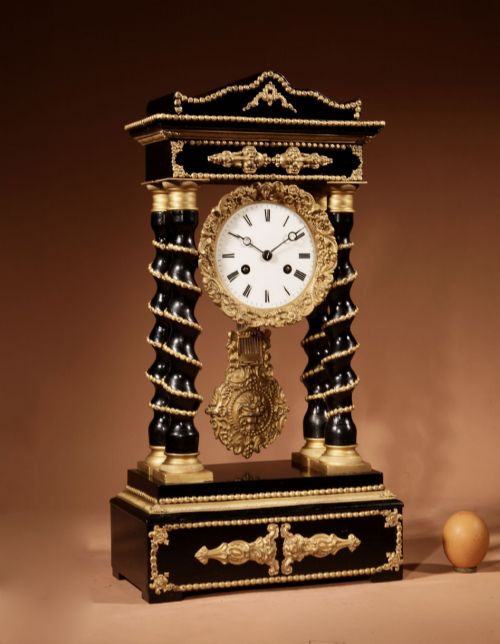


Gilded Architectural Clock
These gilded architectural clock examples bring stately classical presence to a room, combining precise horology with imposing sculptural form.
Gilded Architectural Clock
A gilded architectural clock stands as a miniature building on a mantel or table, designed with columns, pediments, and classical proportions. When searching for a gilded architectural clock, collectors encounter grand portico designs, monumental marble mantel pieces, and turret clock faces spanning the eighteenth and nineteenth centuries.
Originating largely from French workshops and British importers, these timepieces reflect diverse European revivals from the Georgian period through to the late nineteenth century. The form commands attention through sheer verticality and disciplined symmetry.
How They Were Made
Makers built these pieces using heavy structural materials such as Belgian slate, white marble, and ebonised wood to form the architectural carcasses. Ormolu and gilt bronze mounts were then cast, chased, and applied to accent columns, cornices, and bezels.
Movements required skilled mechanical engineering to power eight-day escapements, perpetual calendars, and striking trains behind enamel dials and cut crystal panels. Copper hands and glass domes completed the intricate assembly of individual components.
Materials appearing across the current selection include brass, enamel, ormolu, gilt bronze, glass, copper, slate, and ebonised wood.
What Varies in Quality
The refinement of the cast bronze and ormolu decoration dictates the upper tier of these clocks, where crisp chasing reveals sharp botanical and classical motifs. Weaker examples show soft detailing and flat, uniform gilding that lacks depth.
Structural integrity of the marble or slate housing and the originality of the movement distinguish superior specimens. Marrying a later movement to an early architectural case diminishes the integrity of the piece.
Philippes Paris·Benson Ludgate Hill London
The Gilded Architectural Clock Glossary
- Portico clock
- A distinct architectural clock style featuring two or more supporting columns beneath a prominent lintel, housing a suspended pendulum in the central void. This form gained immense popularity in France during the early nineteenth century.
- Ormolu
- Finely chopped gold leaf amalgamated with mercury and applied to a bronze base through heat gilding. This historic technique creates a rich, matte yellow finish that resists tarnishing over centuries.
- Ebonised wood
- Timber treated with chemical stains or black finishes to imitate expensive ebony. Makers utilised this dark contrast to make bright gilded mounts and white enamel dials stand out.
- Perpetual calendar
- A complex clock mechanism that automatically adjusts for the varying lengths of months and leap years. Such additions elevate the horological importance of the timepiece.
- Turret clock
- A large timekeeping mechanism designed for public buildings or grand estates, often featuring an exposed exterior face. Surviving fragments preserve early hand-painted numerals and heavy iron motion work.
Gilded Architectural Clock: Frequently Asked Questions
How do I wind a portico clock?
Insert the appropriate winding key into the designated arbors on the enamel dial, turning gently until resistance meets you. Care must be taken not to overwind the mainspring.
Ensure the pendulum is securely seated on its suspension spring before setting the hands to the correct time.
Where should I place a heavy marble clock?
Position the piece on a structurally sound, level surface capable of supporting considerable weight, such as a strong mantelpiece or a dedicated side table. Avoid areas exposed to direct sunlight or damp conditions.
A stable foundation prevents vibrations that can disrupt the delicate balance of the pendulum escapement.
What maintenance do these movements require?
Professional cleaning and lubrication are recommended every few years to remove accumulated dust and dried oils from the brass gears. Qualified horologists should handle all internal adjustments.
External gilt surfaces require only light dusting with a dry, soft cloth to preserve the original finish.
How can I distinguish French from English models?
French makers often signed the movement plates or dials directly, focusing heavily on neoclassical or portico architectural forms with fire-gilded ormolu mounts. English interpretations frequently utilise robust marble and slate housings with distinct regional framing.
Examining the escapement type and dial signature usually reveals the true origin of manufacture.