

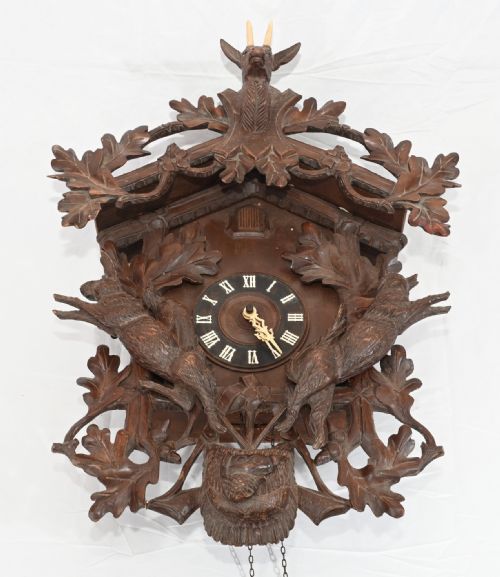


German Black Forest Carving
A german black forest carving brings tactile warmth to a room through intricately worked wood and animal forms.
German Black Forest Carving
A german black forest carving encompasses domestic objects and decorative items produced primarily during the nineteenth and early twentieth centuries, drawing upon regional traditions of woodland craftsmanship. These pieces range from functional household items to sculptural panels and timepieces.
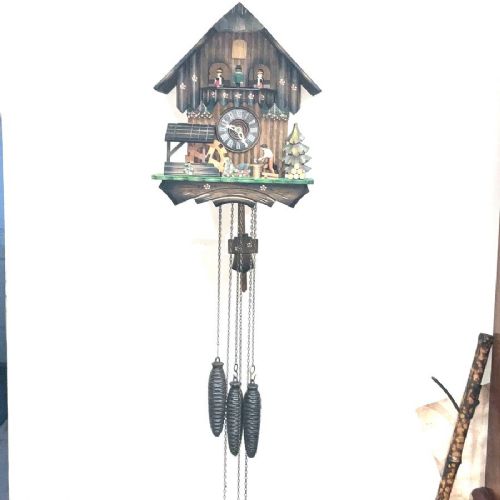
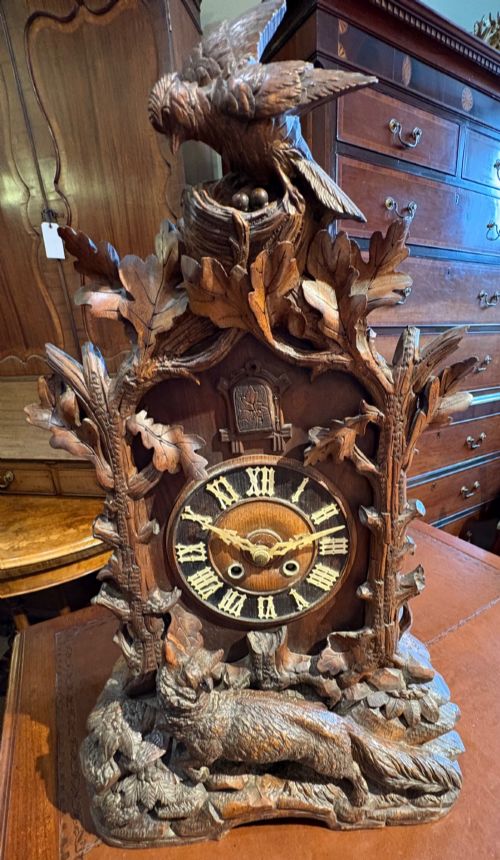
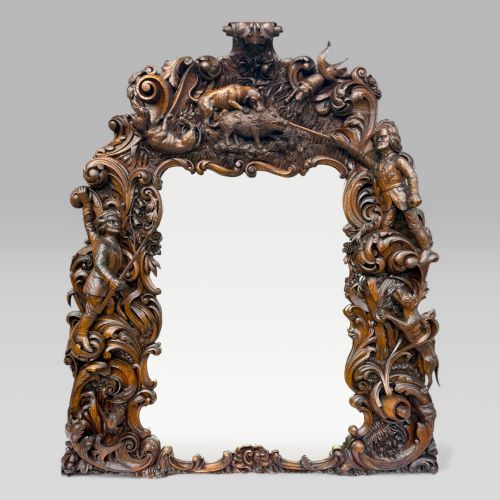
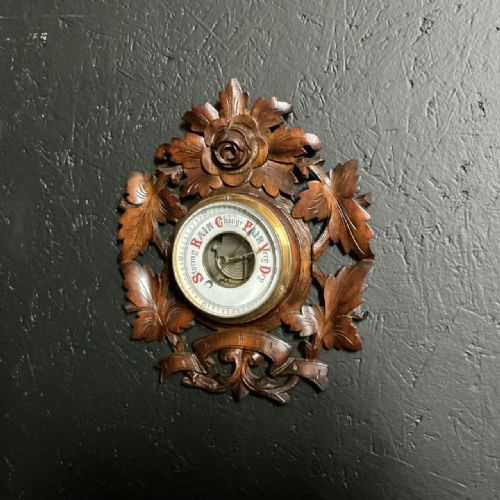
The most prevalent forms encountered on this page are cuckoo clocks, mantel clocks, barometers, and wall mirrors, frequently decorated with naturalistic motifs. Collectors also find occasional figures, nutcrackers, walking sticks, and hat stands among the listings.
The objects frequently display stylistic influences from French Rococo, Historicism, and Folk Art alongside traditional Black Forest aesthetics. Originating largely from German and Swiss workshops, they reflect a distinct period of elaborate carved woodwork.
Materials and Techniques
Makers utilised locally available hardwoods such as walnut, oak, and linden wood, selecting timber with suitable grain for deep sculptural relief. Metal movements, brass dials, bone details, and glass components were integrated into functional clocks and barometers.
Carvers employed hand gouges and chisels to render detailed foliage, hunting scenes, and animals with realistic depth and texture. Natural horns and deer antlers were occasionally incorporated into larger wall-hanging pieces like coat stands.
Construction techniques combined traditional carpentry for casework with precise mechanical engineering for musical automata, cuckoo mechanisms, and aneroid barometer dials.
Listings span the nineteenth and twentieth centuries, incorporating materials such as brass, bone, glass, and various hardwoods.
Assessing Quality and Execution
The distinction between standard output and the finest pieces lies in the depth and vitality of the carving. Superior items display crisp undercut foliage, expressive animal anatomy, and meticulous hand finishing rather than mechanical uniformity.
Complexity of function also elevates a piece, such as multi-train clock movements, musical carillons, and fully articulated mechanical elements. Integration of high-grade materials like golden walnut and bone further separates exceptional works from basic production.
Johann Baptist Beha·Lenzkirch
The German Black Forest Carving Glossary
- Aneroid barometer
- A device that measures atmospheric pressure using a flexible metal box rather than liquid mercury. These dials frequently feature ornate carved wooden surrounds.
- Cuckoo clock
- A striking clock, typically mechanical, that uses whistles and a carved bird automaton to mark the hours. Many examples incorporate intricate leaf and wildlife carvings.
- Fusee
- A conical pulley used in clock mechanisms to maintain even driving force as the mainspring unwinds. This mechanism indicates higher precision and quality in older timepieces.
- Relief panel
- A sculptural carving where figures and motifs project from a flat background. These often depict hunting scenes or peasant figures.
- Twin fusee
- A clock movement utilising two separate fusee cones, usually to power both the going train and the striking train independently.
German Black Forest Carving: Frequently Asked Questions
How do these clocks operate?
Most of these timepieces rely on mechanical movements driven by weights or springs, requiring periodic manual winding to function properly.
Cuckoo variants utilise small bellows and whistles activated by the clockwork to produce the characteristic bird sound on the hour.
How should I clean carved wood?
Dust these items regularly with a soft, dry brush to prevent dirt from settling into the deep recesses of the carving.
Avoid liquid cleaners and polishes that can build up in the textured grain and darken the natural wood over time.
Were these items purely decorative?
While many pieces served a clear ornamental purpose, a large proportion combined art with everyday household utility.
Objects such as barometers, clocks, mirrors, pipes, and coat stands were designed for active daily use within Victorian homes.
How can I tell the period?
Dating relies on examining the style of the carving, the materials utilised, and the mechanics of any integrated clock or barometer movements.
Nineteenth-century examples frequently show hand-carved depth and traditional regional motifs, while later twentieth-century pieces often reflect simplified production methods.