
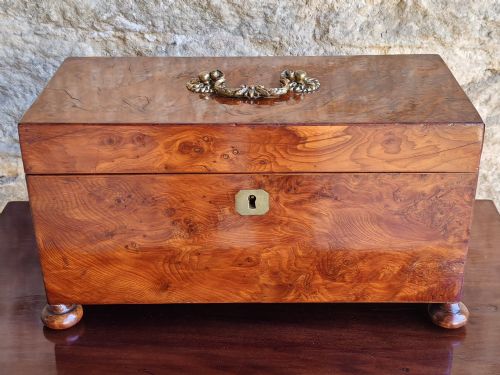
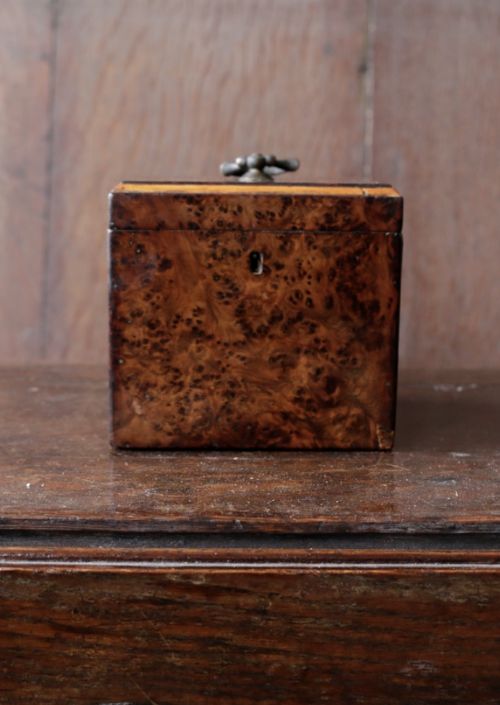


Georgian Yew Tea Box
A georgian yew tea box combines rich timber grain with period form, offering a compact storage piece that holds historical charm.
Georgian Yew Tea Box
A georgian yew tea box is a lidded container designed for storing dry tea leaves safely away from damp air and odours. These items emerge primarily from the eighteenth and nineteenth centuries, spanning Georgian and Regency eras.
How they were made
Cabinet makers utilised yew wood and burr yew timber to build the carcases of these boxes, capitalising on the decorative qualities of the grain. Carpenters selected figured timber slices to create patterned exterior surfaces.
Secondary materials such as brass fittings, bone elements, and boxwood or ebony stringing provide contrast and structural support. Artisans applied fine marquetry work to specific hexagonal and geometric caddies to enhance the visual depth.
Several boxes sport extra geometry, ranging from semi-circular shapes to precise cubes and six-sided hexagons.
What varies in quality
The visual appeal of a georgian yew tea box depends significantly on the density and figuring of the burr wood veneer chosen by the maker. Highly figured timbers command attention through complex grain patterns rather than plain surfaces.
Execution of fine details like stringing in boxwood and ebony, alongside the preservation of original brass hardware, separates standard domestic containers from finer examples of period craftsmanship.
The Georgian Yew Tea Box Glossary
- Burr Yew
- A growth on a yew tree that produces a deformed grain with complex swirls and knots. This highly decorative wood veneer covers the exterior surfaces of many caddies.
- Stringing
- Thin inlay lines of contrasting wood, such as boxwood or ebony, used to edge panels and lids. This technique highlights the geometric shapes of the boxes.
- Teapoy
- A larger tea caddy mounted on a central pillar with feet, or a standalone box designed for similar domestic utility. These pieces occasionally appear alongside standard tabletop caddies.
- Marquetry
- The art of applying pieces of veneer to a structure to form decorative patterns. Georgian makers utilised this method on hexagonal boxes.
Georgian Yew Tea Box: Frequently Asked Questions
What is a georgian yew tea box?
A georgian yew tea box is a lidded wooden container made during the eighteenth or nineteenth century to store dry tea leaves securely.
These pieces utilise yew and burr yew timber, often featuring inlaid stringing and brass components across various geometric forms.
How were these boxes used?
Tea was an expensive commodity during the Georgian and Regency periods, requiring secure storage inside locked containers.
Households kept these boxes in public rooms to protect the leaves from moisture and pilfering by domestic staff.
How do I date a yew tea caddy?
Dating relies on examining the structural form, construction techniques, and decorative details like stringing or marquetry.
Pieces span the eighteenth century, the Georgian period, and the Regency era up to the mid nineteenth century.
What wood types appear on these caddies?
The primary timber is yew, frequently selected in its burr form to display intricate grain patterns.
Additional materials include ebony and boxwood for contrasting inlay, alongside brass hardware and bone accents.