




Georgian Weather Glass
A georgian weather glass reads the pressure of the air to foretell change, housed in cabinet work that sets the tone of an interior.
Georgian Weather Glass
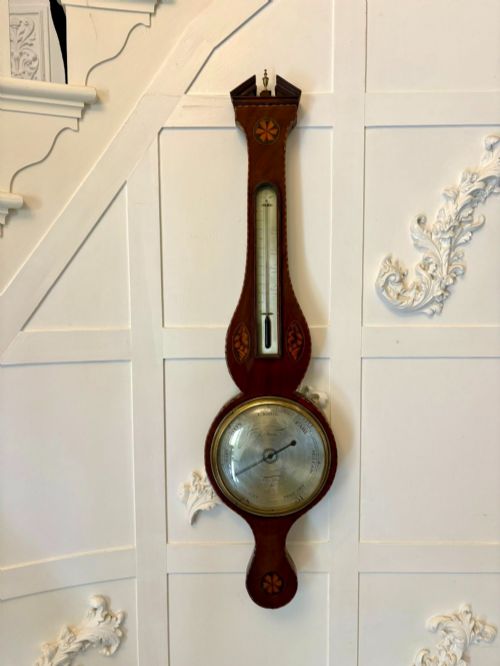
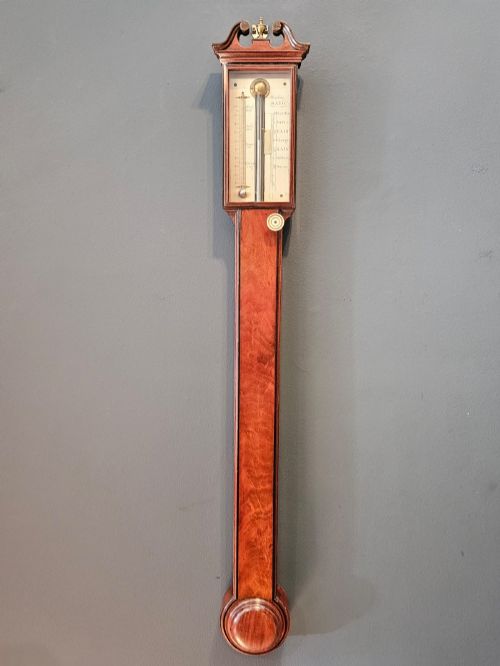
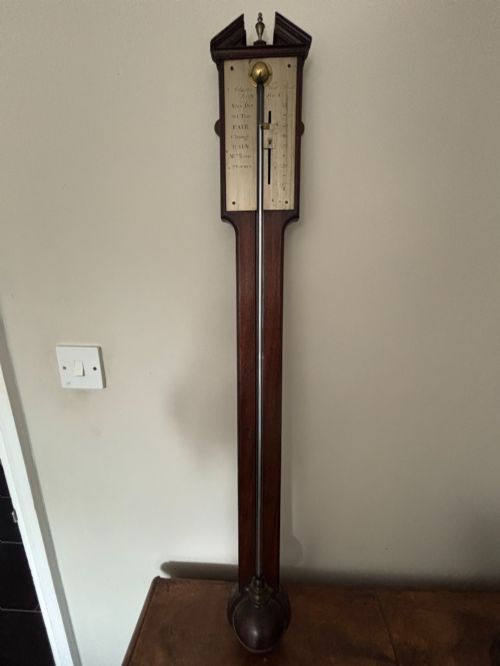
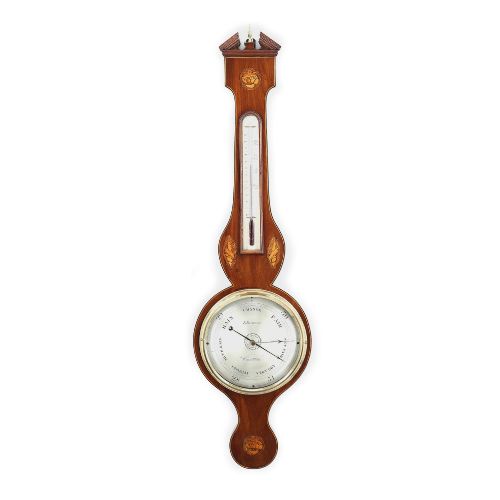
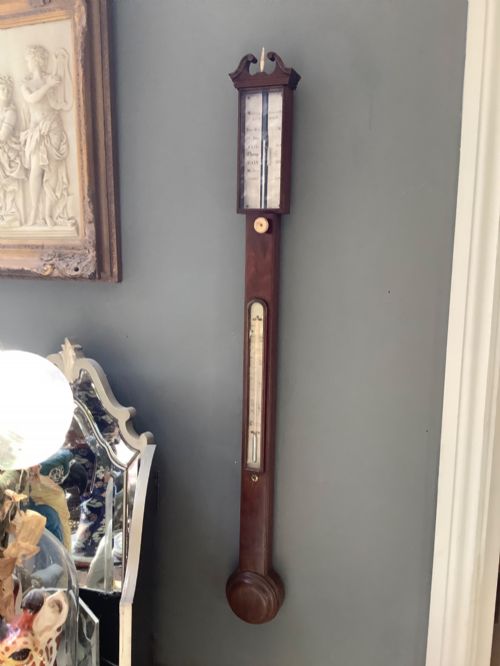
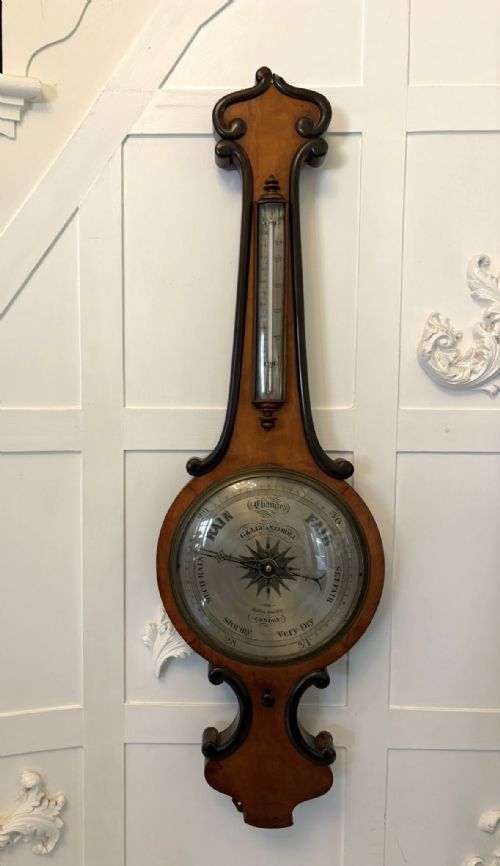
A georgian weather glass takes the form of either a slender stick barometer or a wider wheel barometer, both designed to measure atmospheric pressure through the rise and fall of mercury in a glass tube. The stick pattern presents a tall, narrow profile enclosing the tube directly against a backboard, whereas the wheel pattern houses the mechanism in a circular dial head above a trunk.
The examples gathered here span the Georgian, Regency, and early Victorian periods, drawing on centuries of domestic science and cabinet making. Mahogany forms the predominant timber of the selection, accompanied by walnut and rosewood in both plain and marquetry-inlaid finishes.
Makers from London and provincial towns across England signed these instruments, ranging from well-known scientific instrument makers to regional opticians and clockmakers. Buyers meet everything from simple stick barometers to elaborate banjo instruments fitted with bone scale plates and brass dial surrounds.
Materials and Construction
Cabinet makers built the chassis using solid and veneered timbers such as mahogany, walnut, and rosewood, often shaping the trunk with shell inlays, stringing, or bow fronts. The timber was selected for stability and grain figure, housing the delicate glass tube securely behind glass doors or open frames.
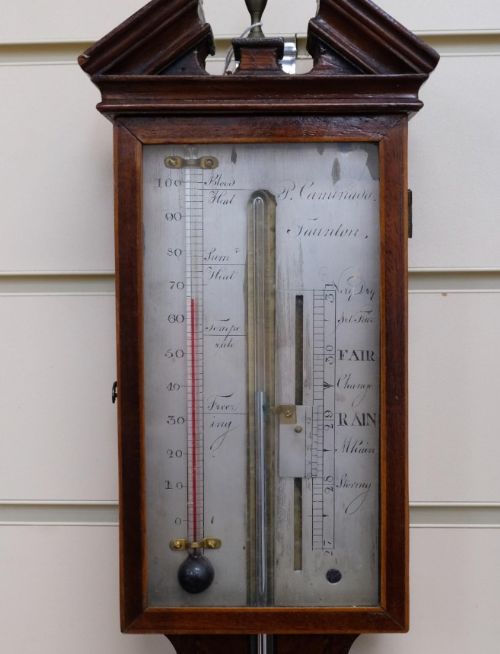
The dials and vernier scales utilise silvered brass or metal plates, engraved with weather descriptions and barometric measurements that correspond to the movement of the mercurial column. Brass bezels, dampeners, and hanging rings complete the metalwork components, fastened with small hand-turned brass screws.
Listings feature both mahogany and rosewood cases, spanning the 18th century through the Victorian era.
Distinctions in Execution
The caliber of the cabinet work dictates the grade of the piece, separating standard provincial joinery from the refined veneers and marquetry of London workshops. Sharper mouldings, delicate string inlay, and well-proportioned swan-neck pediments denote superior craftsmanship.
The legibility and detail of the silvered brass dial affect the desirability of the barometer, as deeply engraved lettering and crisp calibration scales require skilled handwork. Intact original glass tubes and mercury columns maintain the integrity of the instrument.
P. Caminada·George Adams London·B. Besozzi·G & L Guanziroli·Blunt·Ganthony of London·JB Bergna·Prada of High Wycombe·Molton of Norwich·Luisetti of London·Fagioli·Giana·Bate·Jenkins·Ronchetti·Watkins·Sandrino·Hayward·Vecchio & Co·Gilbert London·Bianchi
The Georgian Weather Glass Glossary
- Stick barometer
- An instrument containing a vertical glass tube filled with mercury that rises and falls with atmospheric pressure against a fixed scale. This form provides a direct reading without mechanical multipliers.
- Wheel barometer
- A round-faced instrument where a float on the mercury column connects to a silk thread and pulley, turning a pointer around a dial. This layout displays pressure changes on a clear circular scale.
- Banjo barometer
- A popular domestic wheel barometer housed in a case shaped like a banjo, featuring a circular dial at the top and a long trunk below. Many include a spirit thermometer or hygrometer set into the stem.
- Vernier scale
- A small movable auxiliary scale that allows the reader to take precise fractional measurements from the main barometer scale. It slides alongside the principal graduation to record minute shifts in pressure.
- Silvered brass
- A sheet of brass treated with a silver composition to produce a bright, matte finish suitable for engraving dial numbers and inscriptions. The surface is often protected with a clear lacquer.
Georgian Weather Glass: Frequently Asked Questions
How do I read a stick barometer?
Observe the height of the mercury column inside the glass tube, using the engraved scale on the brass plate to note the pressure level. Higher readings indicate settled weather, while falling mercury points toward unsettled conditions.
Compare the primary column against the vernier scale if fitted, noting any shift since your last observation. Tapping the instrument gently before reading helps settle the mercury against surface tension.
Where should I hang a weather glass?
Position the instrument on an interior wall away from direct sunlight, central heating radiators, and draughty doorways. Stable ambient temperatures ensure the internal mechanism reacts solely to barometric pressure rather than thermal expansion.
Mount the case securely using appropriate fixings suited to the weight of the timber frame and glass components. Ensure the backboard hangs plumb so the barometer tube remains strictly vertical.
Are these barometers still accurate today?
These instruments continue to measure atmospheric pressure reliably if the sealed mercury column remains intact and free of air bubbles. They reflect actual barometric trends just as they did when first constructed centuries ago.
Treat the readings as relative indicators of weather change rather than precise meteorological forecasts. Regular observation of the rising and falling needle gives the best insight into coming weather.