
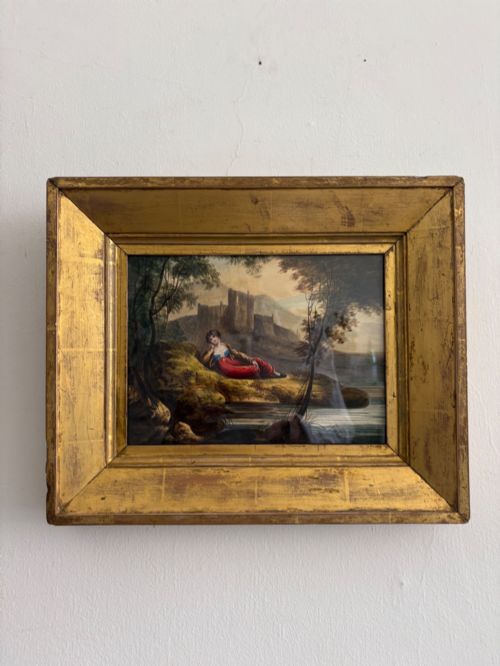


Georgian Watercolour Landscape
These georgian watercolour landscape works capture pastoral views and ancient ruins on paper.
What these pieces are
When you search for georgian watercolour landscape examples, you encounter works executed on paper from the eighteenth and nineteenth centuries. These fine art paintings record English scenery, including vineyard rocks near Buxted, Windsor Castle, and Fountains Abbey.
You meet various forms on this page, ranging from framed works featuring reclining figures to architectural views of ruined gatehouses. The pieces span the Georgian period, Romanticism, and early nineteenth century schools.
Makers and circles represented include William Payne OWS, Thomas Rowlandson, Samuel Hieronymus Grimm, and E. Becker. The subjects focus predominantly on British landscapes, rural roads, and historic Yorkshire and Devonshire vistas.
How they were made
The foundation of every work is paper, upon which artists applied watercolour pigment and ink. Many examples incorporate grisaille or fluid washes to establish depth and atmospheric perspective across the scene.
Framing materials for these paintings typically involve wood, often finished with gilt to complement the paper support and protect the delicate pigments under glass.
Subjects documented across these paintings include architectural ruins, castles, and figures near streams.
What varies in quality
The distinction between standard works and exceptional examples lies in the precision of the brushwork and the clarity of the attribution. Pieces linked directly to notable painters or documented circles command greater interest than anonymous English school outputs.
Preservation of the watercolour pigment and ink on the paper support governs the visual strength of the landscape. Strong contrast and well-maintained framing under glass enhance the longevity of the composition.
William Payne OWS·Thomas Rowlandson·Samuel Hieronymus Grimm·E. Becker·John White Abbott
The Georgian Watercolour Landscape Glossary
- Grisaille
- A painting executed entirely in shades of grey or neutral monochrome. This technique was frequently utilised to establish tonal studies or mimic sculptural reliefs.
- Watercolour
- A painting method where the pigments are suspended in a water-based solution. Artists apply these transparent washes onto paper to achieve luminous atmospheric effects.
- English School
- A designation for artists working within Britain who shared stylistic approaches during a specific era. It often denotes works by unrecorded hands operating within a regional tradition.
- Gilt
- A thin layer of gold applied to wood frame surfaces. This decorative finish was standard for framing fine art paintings of the period.
Frequently Asked Questions
What subjects appear in these works?
The subjects centre on British topography, rural roads, and historic architectural sites like castles and abbeys.
Artists also recorded figures within these natural settings, blending daily life with expansive pastoral scenery.
How should I hang these paintings?
Keep these works away from direct sunlight to prevent the watercolour pigment from fading on the paper support.
Ensure the room maintains a stable humidity level to protect the wooden and gilt frames.
How do I identify the period?
Examine the paper quality, ink tones, and subject matter for stylistic markers typical of the eighteenth and nineteenth centuries.
Attributions or signatures often provide direct links to documented painters active during the Georgian era.
Are these works original?
The inventory comprises original paintings and period interpretations created by artists or associated schools.
Each piece was executed by hand using period watercolour pigment and ink on paper.