




Georgian Wall Weather Glass
A georgian wall weather glass measures atmospheric pressure with mercury and sits in a timber case to guide daily life.
Georgian Wall Weather Glass
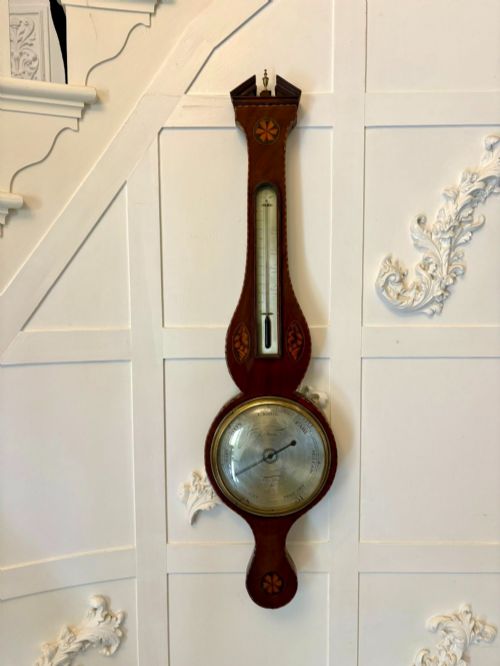
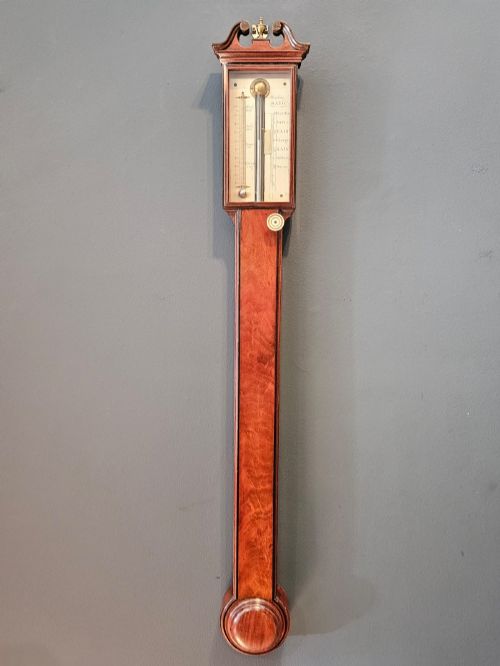
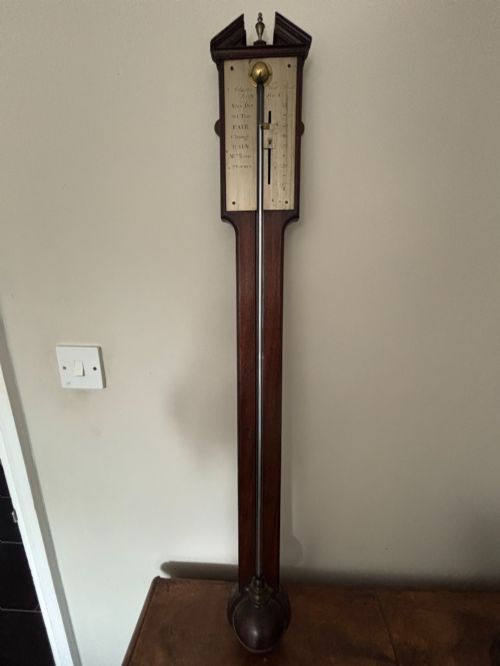
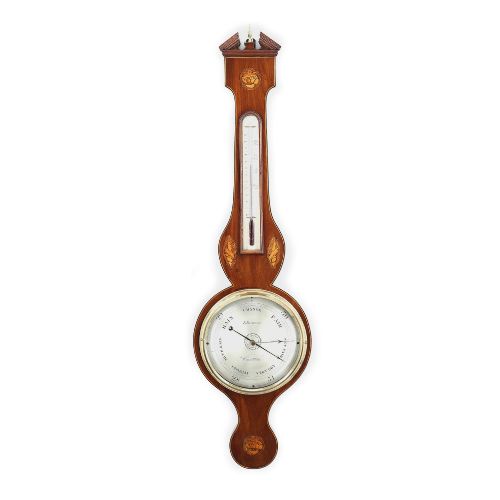
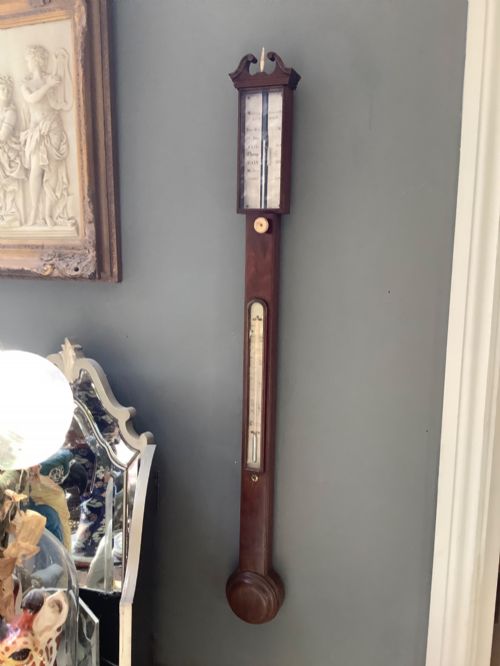
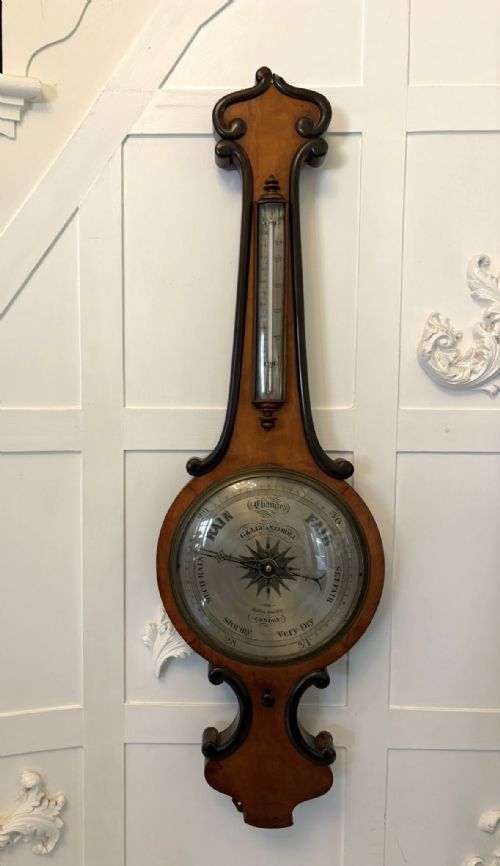
A georgian wall weather glass takes the form of either a tall, slender stick barometer or a wider banjo barometer housing a circular dial. Most examples found here date from the Georgian and Regency periods, though some extend into the Victorian era.
Makers housed these instruments in wooden wall cases designed to hang in domestic hallways and parlours. The stick format tracks the vertical movement of mercury in a narrow tube, whilst the wheel format uses a pulley mechanism to turn a pointer around a marked face.
The regional variety spans London makers alongside provincial craftsmen working in towns such as Taunton, Newcastle, and Norwich. These wall barometers reflect both high metropolitan standards and the skilled output of regional workshops.
Materials and Techniques
Craftsmen built the cases primarily using mahogany, walnut, and rosewood timbers selected for stability and grain figure. Marquetry, parquetry, shell inlay, and mother-of-pearl ornamentation frequently embellish the main body of the instrument.
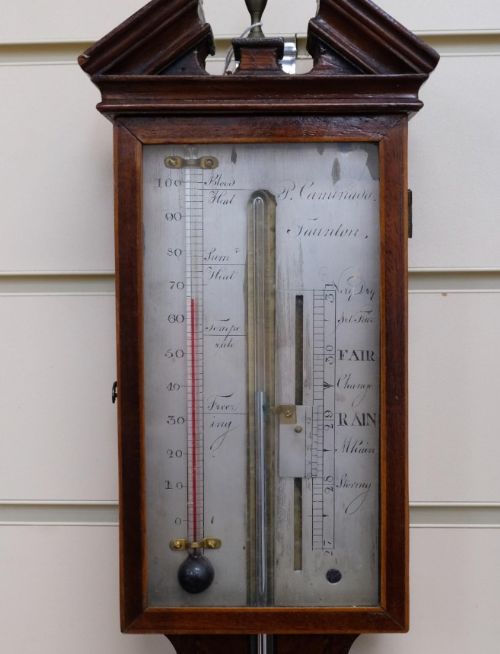
The visible instrumentation relies on glass tubes, brass fittings, and silvered metal or silvered brass dials engraved with weather descriptions and scales. Bone details occasionally appear on specific components of the instrument.
Makers mounted the sensitive mercurial columns carefully within the timber trunk, often protecting the cistern at the base with an exposed or enclosed wooden cover. The dials feature precise hand-engraved lettering detailing the maker and location.
Distinctions in Quality
The refinement of the cabinetwork separates standard production from superior pieces. Finely figured timbers, intricate shell inlay, and delicate marquetry indicate a workshop that spent greater time on the exterior housing.
The distinction also lies in the signature upon the dial. Instruments bearing the names of esteemed London makers or documented provincial practitioners carry greater distinction than unsigned or plain utilitarian versions.
P. Caminada Taunton·George Adams London·B. Besozzi of Weymouth·G & L Guanziroli London·JB Bergna Newcastle·Prada of High Wycombe·Molton of Norwich·Luisetti of London·Fagioli of Clerkenwell London·Bate of London·Jenkins Of Old Swindon·Ronchetti Of Holborn·Sandrino of Liverpool·Hayward of Ashford·Vecchio & Co of Shaftsbury·Gilbert London·BIANCHI IPSWICH
The Georgian Wall Weather Glass Glossary
- Stick barometer
- A tall, narrow wall instrument containing a vertical glass tube where mercury rises and falls to show atmospheric pressure. This form offers a direct and precise visual reading of barometric changes.
- Banjo barometer
- A wall weather glass featuring a bulbous lower body and a flared neck, topped with a hygrometer or spirit level. The shape resembles the musical instrument and houses a large round dial.
- Wheel barometer
- An instrument that translates the movement of mercury using a float and silk thread attached to a pulley wheel. This turns the pointer on a circular dial to display the weather.
- Silvered brass
- A metal alloy treated with a silver compound to create a bright, reflective surface for engraving dials. The finish provides clear contrast for the marked weather scales.
- Marquetry
- The art of forming decorative patterns on woodwork by fitting together small pieces of different coloured veneers. This technique ornaments the exterior of more elaborate banjo and stick barometers.
Georgian Wall Weather Glass: Frequently Asked Questions
How do I read a georgian wall weather glass?
Observe the position of the mercury column in a stick barometer or the pointer on the dial of a wheel barometer. Rising pressure points toward settled weather, whilst falling levels indicate approaching rain or wind.
Compare the current reading against the engraved weather words on the silvered brass scale, such as stormy, rain, change, set fair, or very dry.
Where should I hang a wall barometer?
Hang your instrument on an interior wall away from direct sunlight, radiators, and heavy draughts. Sudden temperature fluctuations can affect the wood case and the mercury response.
Ensure the wall provides a secure fixing point so the timber case hangs plumb and steady for accurate atmospheric measurement.
Are these barometers still accurate?
Many mercurial barometers retain their mechanical sensitivity and continue to track barometric pressure changes reliably. They function as both historical scientific instruments and practical household gauges.
Calibration can sometimes be checked against a modern digital barometer to confirm the pointer aligns correctly with local air pressure.
How do I tell an 18th century barometer from a 19th century one?
Eighteenth-century examples often feature simpler, elegant mahogany or walnut stick cases with architectural pediments. The early pieces by named makers emphasise clean lines and restrained proportions.
Nineteenth-century instruments frequently adopt the banjo shape with broader frames, heavier dial surrounds, and more extensive use of marquetry, shell inlay, or mother-of-pearl.