
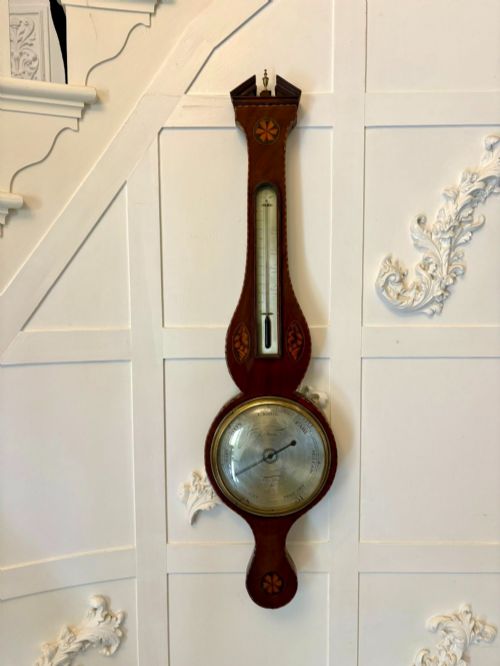
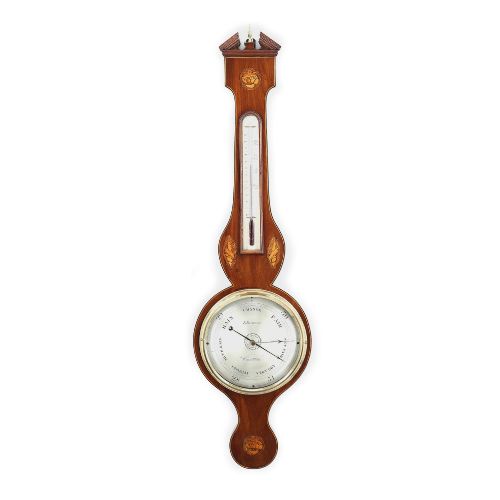


Georgian Inlaid Banjo Barometer
A georgian inlaid banjo barometer is a domestic wall instrument measuring atmospheric pressure, prized for both practical weather prediction and decorative elegance.
Georgian Inlaid Banjo Barometer
A georgian inlaid banjo barometer takes its name from the distinctive shape of the wooden case, which expands from a narrow stem into a circular dial chamber at the base. These wall instruments originated in the Georgian period and continued into the Regency and Victorian eras.
The version most commonly met on this page uses a mahogany or rosewood carcass, often highlighted with contrasting boxwood stringing and shell paterae. The long vertical trunk houses the mercury tube, while the lower drum holds the main dial.
Makers from London and provincial towns across Britain signed these pieces, adding regional character to the standard domestic form. Collectors find examples dating from the late eighteenth century through the nineteenth century.
Quality Variations
The precision of the cabinetwork and the delicacy of the boxwood inlay separate finer examples from standard production. Artisans who spent extra hours on the marquetry shell motifs and edge stringing created more desirable pieces.
Signatures on the silvered brass dial elevate an instrument, particularly when the maker worked in London or a notable provincial centre. Plain dials without maker names often indicate simpler workshop origins.
The preservation of the original wooden case, brass fittings, and silvered finish determines the overall integrity of the piece. Replacements or heavy restoration alter the original character of the barometer.
Some provincial makers proudly added their home towns to the dial, turning a simple weather glass into a local landmark.
B Besozzi of Weymouth·Ganthony of London·Prada of High Wycombe·Molton of Norwich·Luisetti of London·Fagioli of Clerkenwell·L Casatelli of Liverpool·Vecchio and Co·A Rivolta·J Groce·F Salteri and Co·Dominic Gatty·Schiavi of Chesham
The Georgian Inlaid Banjo Barometer Glossary
- Banjo barometer
- A wall barometer housed in a wooden case shaped like a banjo, featuring a narrow stem and a round base. This form dominated domestic meteorological instruments throughout the Georgian and Regency periods.
- Silvered metal
- A brass or copper dial plate treated with a silver solution to create a pale, reflective surface. Fine lettering and calibrations are engraved through this layer.
- Boxwood inlay
- Narrow strips of pale boxwood inserted into grooves in darker cabinet timbers to create geometric borders or decorative lines. It provides sharp visual contrast against mahogany.
- Mercurial barometer
- An instrument that measures atmospheric pressure using a column of liquid mercury sealed in a glass tube. Changes in pressure cause the column to rise or fall, moving a pointer on the dial.
- Patera
- A circular ornamental motif resembling a classical dish or shell, frequently inlaid in contrasting woods on the base of the instrument. It serves as a focal point for the marquetry design.
Georgian Inlaid Banjo Barometer: Frequently Asked Questions
How do these barometers work?
The internal glass tube contains mercury that responds to shifts in atmospheric pressure by moving up and down. A delicate pulley and weight system connects this movement to the pointer on the visible dial.
Changes in the weather alter the pressure, causing the visible hand to turn towards rain, change, or fair. Owners read the secondary dials, such as the thermometer or hygrometer, for additional atmospheric data.
Where should I hang my barometer?
Select an interior wall away from direct sunlight, central heating radiators, and damp draughts. Rapid temperature swings can affect the wood case and the mercury response.
Position the instrument at eye level in a room where temperature remains relatively stable throughout the day. Secure the wall fixing firmly, as these mahogany and rosewood instruments carry significant weight.
How do I date a Georgian banjo barometer?
Examine the style of the wooden case, the shape of the pediment at the top, and the engraving on the silvered dial. Earlier examples from the late eighteenth century often feature sharp triangular pediments and delicate floral inlay.
Later nineteenth-century versions tend towards rounded damp-proof bezels and heavier proportions. The signature of a documented maker whose working dates are known provides the most reliable guide.
Are these barometers still accurate for weather forecasting?
Most surviving instruments continue to register atmospheric pressure changes reliably if the sealed mercury tube remains intact. They offer a working indication of impending weather shifts.
While digital instruments provide continuous local data, a traditional mercurial barometer connects the observer directly to historical domestic science. Calibration against a known standard ensures correct readings.