






Georgian Style Demilune Tables
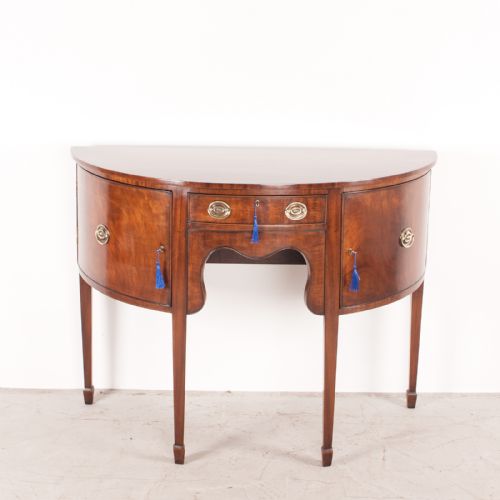
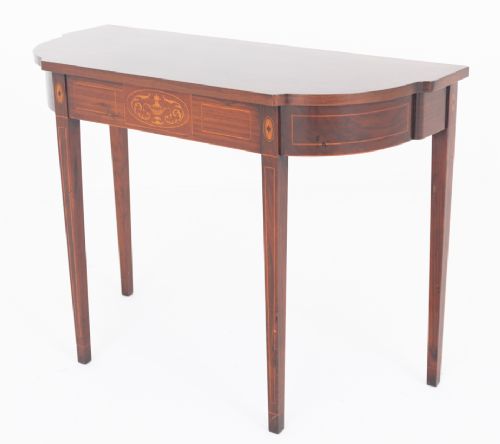
Georgian style demilune tables are semicircular items of furniture built for formal rooms, valued for their graceful wall-hugging profile and adaptable folding tops.
Georgian Style Demilune Tables
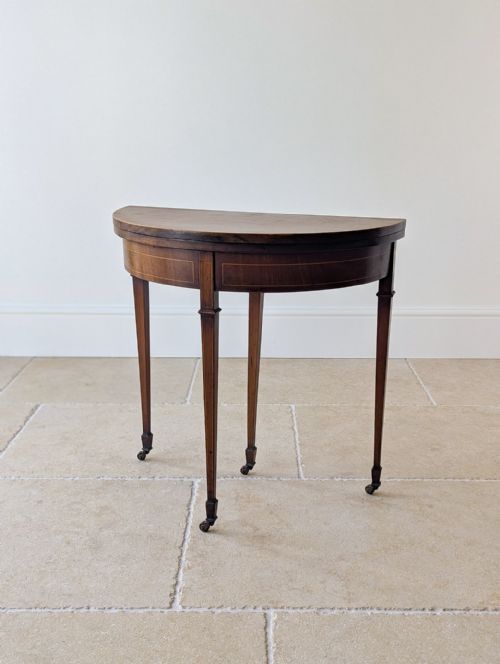
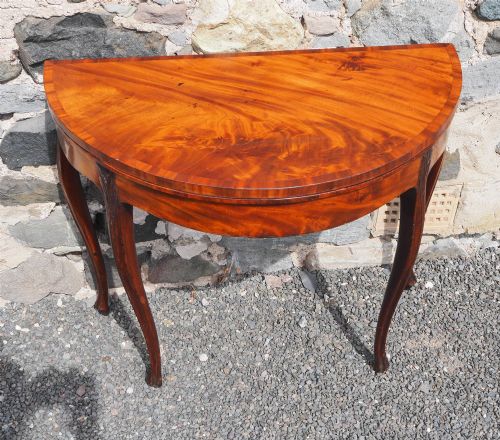
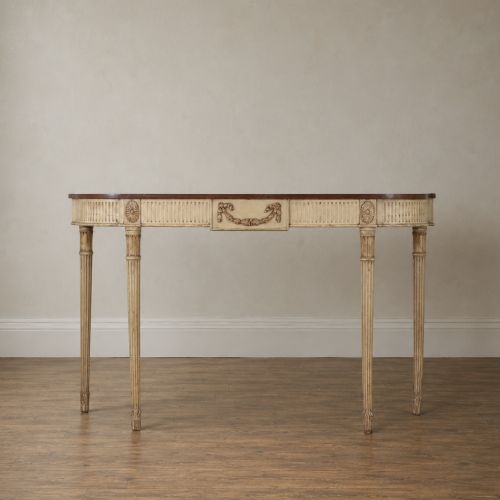
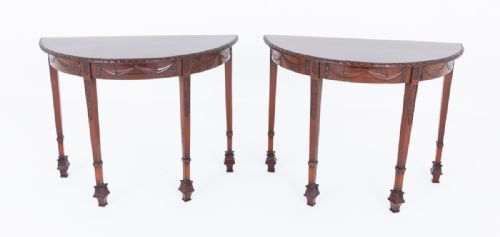
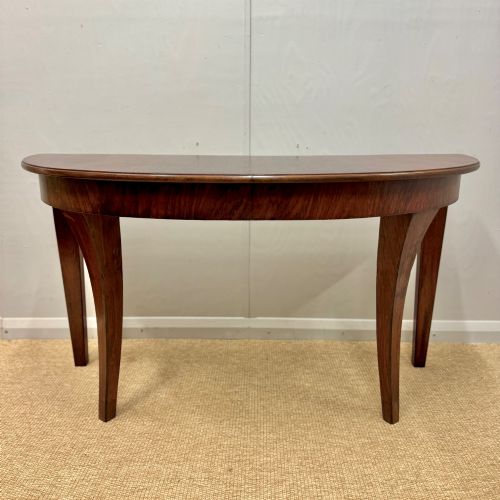
Georgian style demilune tables present a semicircular footprint designed to stand flush against a wall whilst offering a decorative surface. This selection contains console tables, card tables, and tea tables spanning the eighteenth century through to revival periods of the early twentieth century.
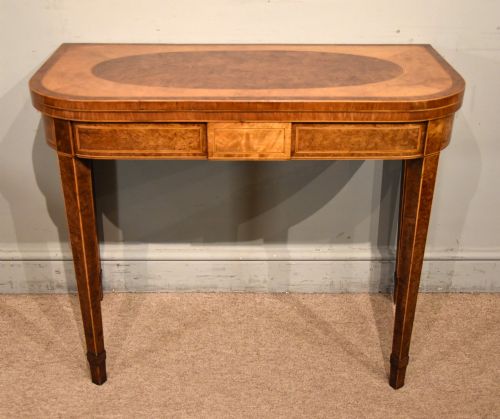
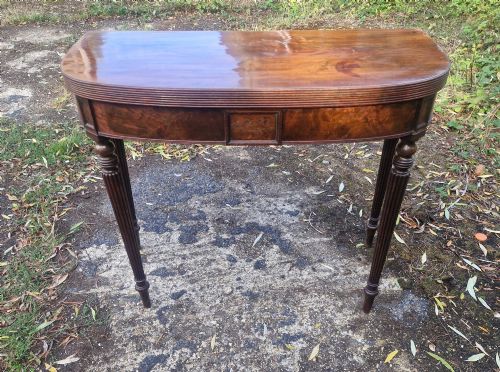
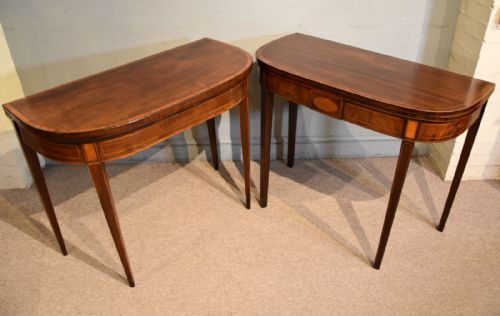
The versions most commonly met on this page combine mahogany or satinwood with inlaid banding, appearing either as single pieces or balanced pairs. Many feature fold-over tops intended for card games or tea service, resting upon square tapered legs or turned supports.
Examples originate from diverse decades, encompassing authentic eighteenth-century craftsmanship alongside Edwardian interpretations and later revival pieces. Makers drew inspiration from classical forms, incorporating walnut, rosewood, and painted finishes into the semicircular format.
Materials and Construction Methods
Cabinetmakers constructed these tables using a solid timber frame faced with fine veneers such as mahogany, satinwood, and burr walnut. Crossbanding and stringing in contrasting woods defined the curved edges and tabletops.
Techniques relied on precise joinery to stabilize the curved aprons and support the pivoting rear legs required for fold-over card tables. Brass hinges and swing-out mechanisms facilitated the transformation from a slim console to a functional gaming surface.
The listings feature demilune tables spanning the 18th century, the Victorian era, and the Edwardian period, utilising mahogany, satinwood, and burr walnut.
Distinctions in Quality and Execution
The standard of a demilune table rests upon the choice of timber and the intricacy of its surface decoration. Finely figured burr yew, padoukwood, or meticulously hand-painted motifs elevate an ordinary frame into a distinguished focal point.
Execution of the inlay and the crispness of the carving along the frieze and legs separate workshop output. Superior examples demonstrate seamless joint work where the semicircular top meets the rail and precise alignment in the folding leaves.
The Georgian Style Demilune Tables Glossary
- Demilune
- A half-moon shape characteristic of tables designed to sit flat against a wall. This profile saves floor space while providing a decorative surface.
- Crossbanding
- A strip of veneer applied perpendicularly to the grain of the main surface around the border. It creates a defined visual frame on tabletop edges.
- Console table
- A table supported by wall brackets or console legs, built to stand against a vertical surface. They often feature elaborate carving or painting on the front apron.
- Card table
- A folding table designed specifically for card games, containing a hinged top that opens to reveal a baize-lined surface. A pivoting leg pulls out to support the opened leaf.
- Stringing
- Thin lines of contrasting wood inlay used to outline panels and borders on furniture. This technique highlights the geometric curves of the woodwork.
Georgian Style Demilune Tables: Frequently Asked Questions
How were demilune tables used?
These tables served primarily as decorative console pieces in hallways and reception rooms to hold decorative objects or lighting. When equipped with a folding top, they converted quickly into gaming tables for cards or auxiliary surfaces for tea.
Their shallow depth allowed them to occupy minimal floor space along a perimeter wall while remaining easily movable for social gatherings.
How do I distinguish eighteenth-century pieces from later revivals?
Differentiating original period items from Edwardian or later copies involves examining the construction methods, secondary timbers, and wear patterns. Eighteenth-century joinery utilises hand-cut joints and native woods appropriate to the specific decade of manufacture.
Revival pieces often display machine-cut elements, standardised screw types, or twentieth-century secondary timbers beneath the decorative surface veneers.
How do I care for polished mahogany and satinwood surfaces?
Maintenance requires keeping timber items away from direct sunlight and steady heat sources to prevent veneer lifting and timber drying. Regular dusting with a dry, soft cloth preserves the polish without introducing moisture.
Application of traditional wax polish helps nourish the wood grain periodically, maintaining the sheen across inlaid borders and curved aprons.