


Georgian Satinwood Console Tables
Georgian satinwood console tables bring a luminous warmth to a room, offering elegant demi-lune forms and intricate marquetry for the discerning interior.
Georgian Satinwood Console Tables
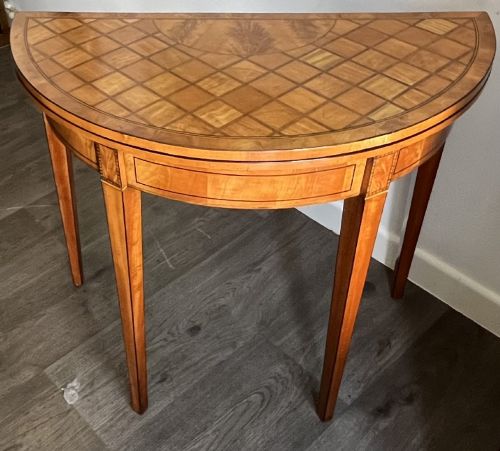
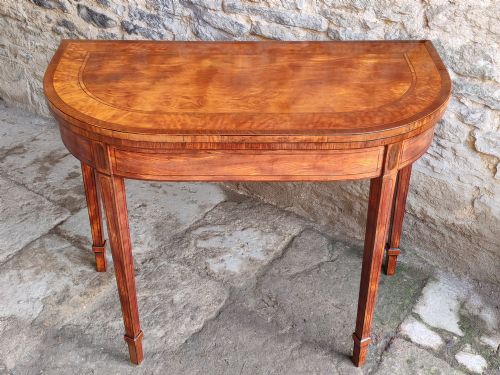
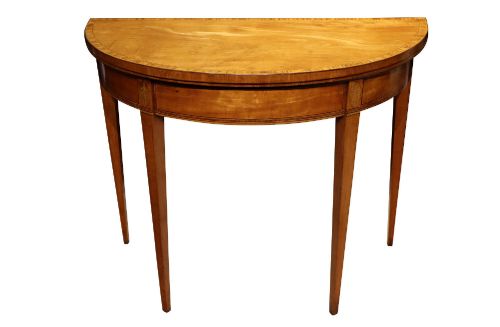
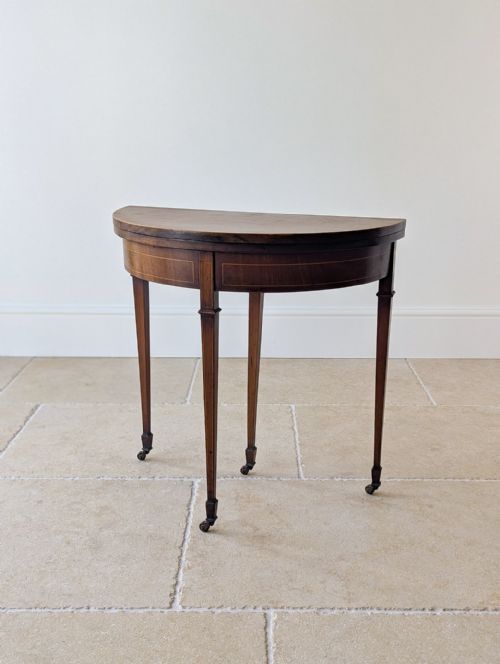
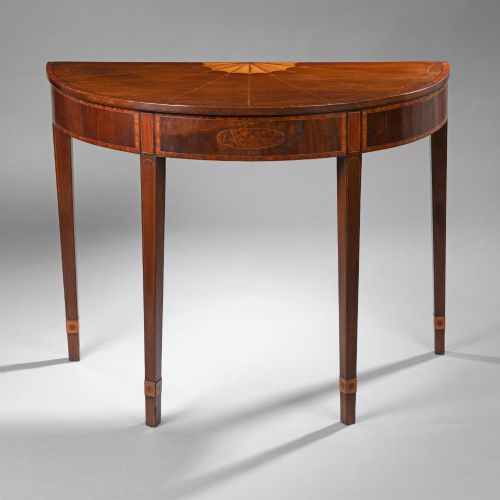
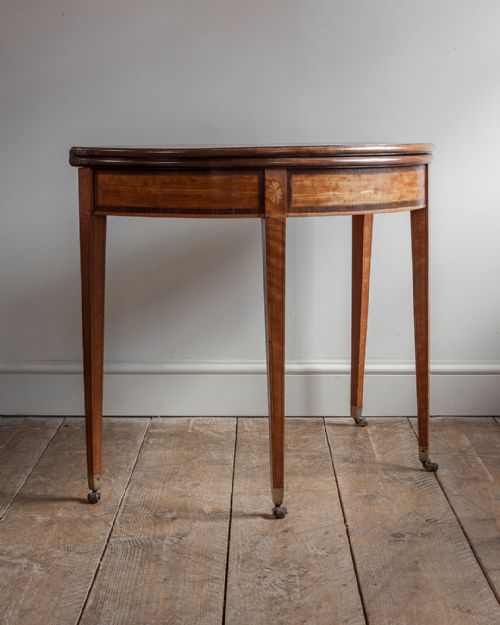
When you search for georgian satinwood console tables, you are looking at sophisticated furniture designed for refined 18th-century and 19th-century interiors. These pieces typically present as demi-lune or semi-circular side tables, often functioning as card tables, games tables, or serving tables with fold-over leaves.
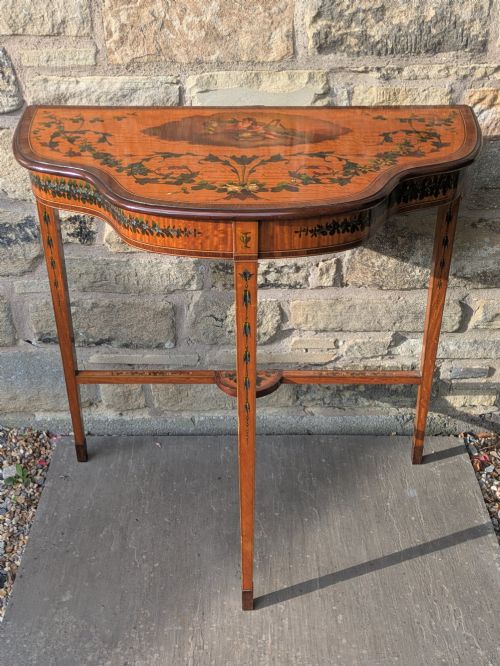
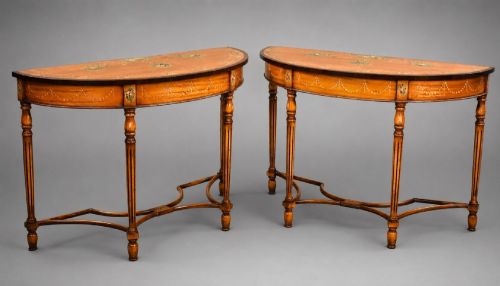
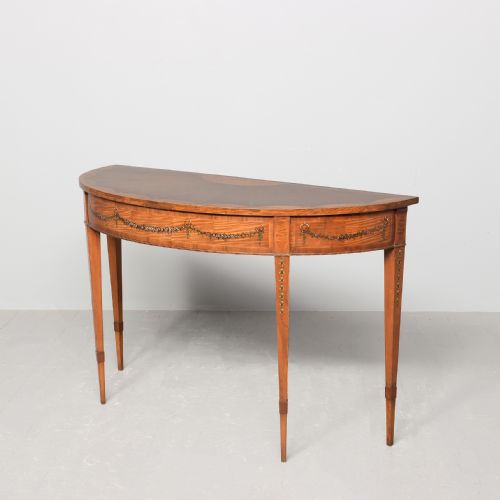
The pieces on this page span the 18th century, the Georgian period, and later revivals such as Edwardian and Sheraton Revival interpretations. The most common forms are graceful demi-lune tables that sit flush against a wall, frequently incorporating contrasting timbers and delicate painted details.
How they were made
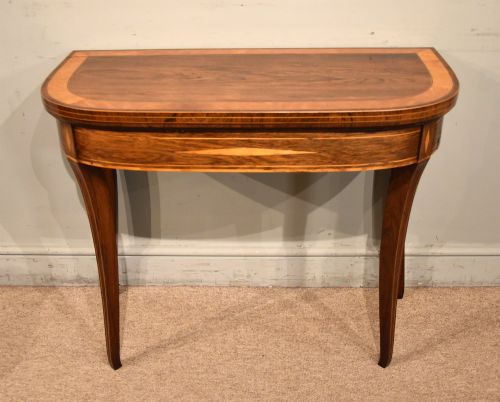
Cabinet makers utilised finely figured satinwood veneers laid over sturdy secondary timbers such as mahogany, constructing curved demi-lune frames that required immense precision. They applied contrasting stringing and banding in timbers like ebony, boxwood, and kingwood to define the edges and geometric borders.
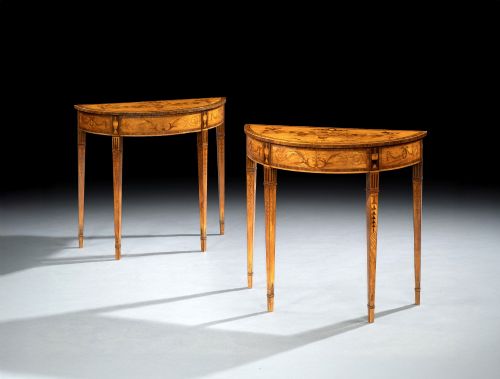
Surface ornamentation often relied on marquetry inlay and hand-painted motifs, creating elaborate floral swags or classical urns upon the fold-over tops. Crossbanding was carefully mitred at the corners to frame the luminous grain of the primary satinwood.
Listings feature satinwood, mahogany, and rosewood alongside intricate boxwood and ebony inlay across pieces spanning the 18th century to the Edwardian era.
What varies in quality
The distinction between ordinary and exceptional georgian satinwood console tables lies in the choice of veneers and the crispness of the inlay. Top-tier pieces display intensely figured, book-matched satinwood grain paired with meticulously cut boxwood and ebony stringing that remains completely flush to the touch.
Hand-painted decoration and marquetry also dictate the tier of craftsmanship, where superior examples exhibit fine, expressive brushwork rather than stencilled uniformity. Furthermore, the structural integrity of the fold-over mechanism and the subtlety of the crossbanding separate standard workshop output from museum-quality commissions.
Edwards & Roberts
The Georgian Satinwood Console Tables Glossary
- Demi-lune
- A half-moon shape characteristic of many console and card tables designed to stand flat against a wall. This profile became exceptionally popular during the late 18th century for serving and display.
- Crossbanding
- A strip of veneer applied around the border of a tabletop with the grain running perpendicular to the centre panel. It provides a neat contrasting frame that highlights the main timber.
- Marquetry
- The art of forming decorative patterns using thin pieces of wood veneer and other materials applied to a structure. Craftsmen cut intricate floral and classical motifs to adorn the top surfaces.
- Stringing
- Inlaid lines of contrasting timber set flush into the surface of furniture to outline panels and borders. This delicate linear detail defines the Sheraton and George III aesthetic.
- Fold-over
- A hinged tabletop design that opens to double its surface area, frequently utilised on card and games tables. When closed, the piece functions as a slim console or side table.
Georgian Satinwood Console Tables: Frequently Asked Questions
How were console tables used originally?
In period homes, these tables served primarily against walls in hallways, drawing rooms, or dining parlours for display or serving. Many double as card tables with fold-over tops designed for evening entertainment.
They provided a decorative surface for porcelain or candelabra when closed, transforming into functional playing surfaces when guests gathered for cards.
How do I care for satinwood furniture?
Protect antique satinwood from direct sunlight and sudden humidity changes to prevent the delicate veneers from fading or lifting. Use a soft, dry cloth for dusting and avoid silicone-based polishes.
Applying a traditional beeswax sparingly helps nourish the timber and maintain the subtle sheen characteristic of period surfaces.
How do I distinguish George III from Sheraton Revival?
Genuine George III pieces date from the late 18th century and display period-appropriate construction methods, timber ageing, and hand-cut joinery. Sheraton Revival pieces typically date from the late 19th or early 20th century, imitating the earlier neoclassical style.
Examining the secondary woods, screw types, and overall wear helps establish whether a piece is an original 18th-century creation or a later Edwardian homage.
Where should I place a demi-lune table?
A demi-lune console table fits naturally in a narrow hallway, an entryway, or as an accent piece beneath a mirror in a living room. Its flat back allows it to hug the wall without obstructing walkways.
Because the curved front draws the eye, it works effectively as a focal point in rooms where floor space is at a premium.