

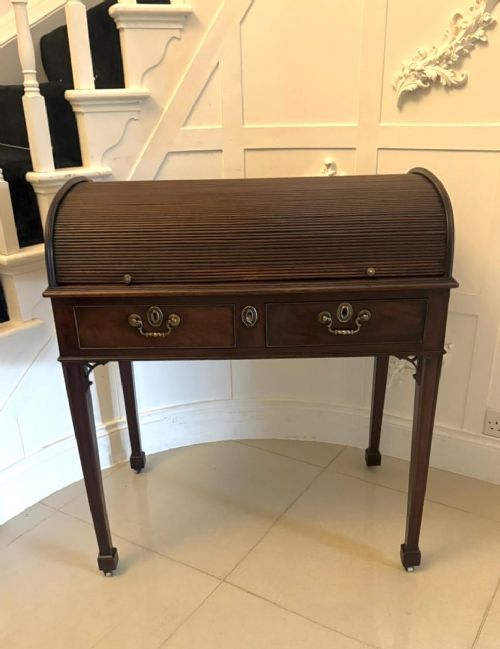
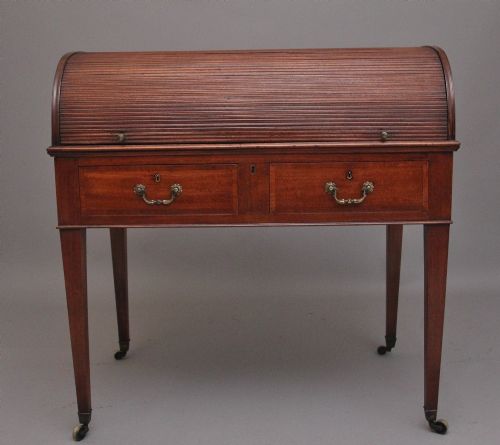


Georgian Rolltop Desk
A georgian rolltop desk offers clever enclosed writing space with sliding tambour mechanisms and rich timber figure, prized for elegant domestic organisation.
Georgian Rolltop Desk
A georgian rolltop desk is a sophisticated form of writing furniture designed to conceal paperwork beneath a slatted wooden tambour or rigid cylinder. These desks span the georgian, Regency, and early nineteenth century periods, appearing in forms from compact writing tables to grand bureau bookcases.
The pieces on this page represent diverse regional interpretations and stylistic influences, including Hepplewhite proportions and Dutch bombe silhouettes. Woods such as mahogany, yew wood, fruitwood, and satinwood dominate the selection, often enriched with boxwood inlay or floral marquetry.
Most examples combine a pull-out writing slide with internal pigeonholes and small drawers behind the rolling cylinder mechanism. This layout allows a desk to remain tidy without requiring a separate key for every internal compartment.
How they were made
Cabinetmakers constructed these cylinder and tambour desks using dense primary timbers like mahogany and figured yew wood, reinforced with secondary framing. The curved rolltop itself relies on precision-fitted wooden slats glued to canvas or leather backing to glide smoothly within concealed tracks.
Decorative detailing incorporates contrasting veneers and boxwood inlay, alongside floral marquetry found on continental examples. Brass handles, escutcheons, and hinges provide functional hardware that complements the dark tones of walnut and fruitwood.
Georgian Rolltop Desk Retail Price Guide 2026
Typical asking prices for georgian rolltop desk among the pieces listed under this phrase on Sellingantiques today, from the lower quarter to the upper quarter. They describe what is for sale here now, not the wider market.
Listings feature mahogany, yew wood, walnut, fruitwood, and satinwood, spanning georgian, Regency, and Victorian periods.
What varies in quality
Quality rests upon the selection of timber figures, such as highly figured mahogany or figured yew wood, and the precision of the tambour mechanism. Smooth operation of the sliding slats without binding indicates superior cabinetmaking and careful seasoning of the wood.
The sophistication of internal stationery fittings and the crispness of boxwood inlay or floral marquetry distinguish standard domestic pieces from masterwork examples. Integrated glass bookcase sections and secondary satinwood veneers further elevate the status of individual pieces.
The Georgian Rolltop Desk Glossary
- Tambour
- A flexible shutter formed of narrow vertical wooden strips glued to fabric backing, allowing the surface to curve around a track. This mechanism conceals the desk interior when closed.
- Cylinder desk
- A piece of furniture featuring a quarter-circle solid or panelled wooden cylinder that rolls back to reveal a writing surface and pigeonholes. It offers a more rigid closure than a tambour.
- Bureaux
- Sloping-front writing desks or cylinder variants often paired with drawers or bookcase tops. The term encompasses various configurations from the georgian era.
- Marquetry
- Decorative patterns created by fitting different woods and veneers into a carved wooden ground. Floral marquetry is particularly associated with Dutch bombé forms.
- Escutcheon
- A protective brass plate surrounding a keyhole. It prevents the surrounding wood from wearing down through repeated use.
Georgian Rolltop Desk: Frequently Asked Questions
What is a tambour?
A tambour is a flexible rolling shutter made from narrow wooden slats attached to canvas or leather backing. It slides smoothly along curved tracks to cover the desk interior.
This ingenious mechanism allowed eighteenth-century cabinetmakers to enclose writing surfaces without needing the deep clearance space required by a hinged lid.
How do I date a cylinder desk?
Dating relies on observing timber choices, secondary woods, hardware styles, and overarching design characteristics such as Hepplewhite proportions or Regency elements. Eighteenth-century pieces often display native solid mahogany or figured yew wood.
Cabinetmaking techniques inside the small drawers and the presence of hand-cut dovetails help narrow the period of manufacture between the georgian era and the nineteenth century.
Were these desks used for writing?
These desks served as private workstations for correspondence, account keeping, and reading. The pull-out writing slides often contained adjustable leather-lined surfaces.
Internal pigeonholes and small drawers kept writing paper, inkwells, and sealing wax organised and securely hidden when the cylinder was rolled shut.
What woods were used?
Primary woods include mahogany, yew wood, walnut, satinwood, and fruitwood. Cabinetmakers selected these timbers for their rich natural grain and grain figure.
Boxwood inlay and contrasting veneers provided decorative borders and geometric detail across the exterior facades.