
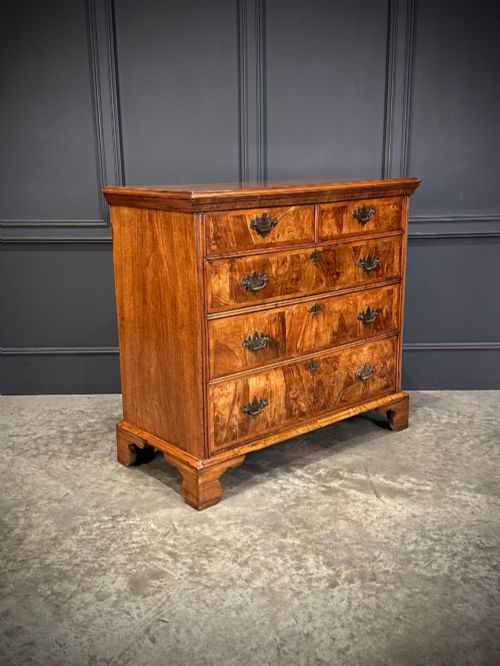
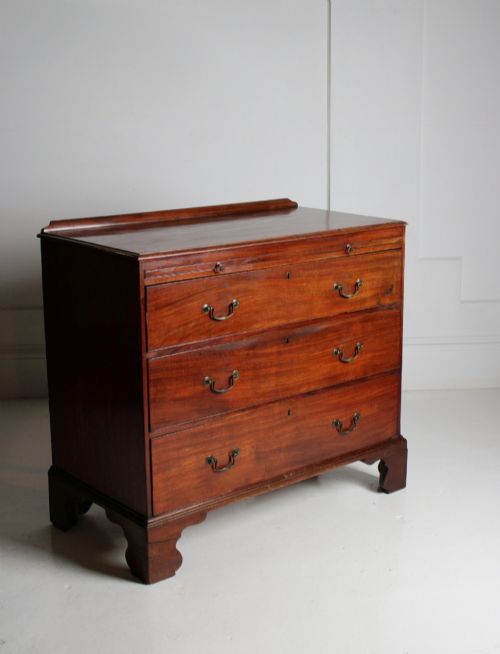
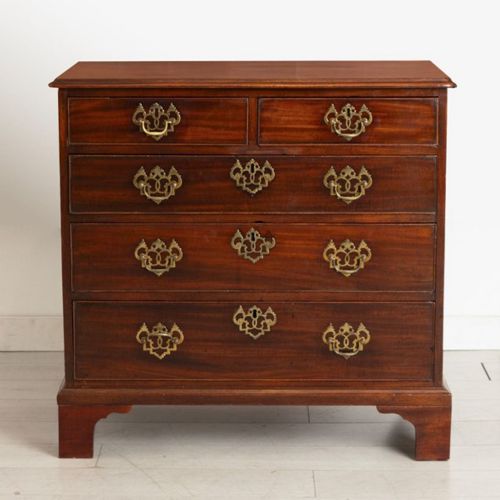


Georgian Period Bachelor Chest
A georgian period bachelor chest offers compact proportions and a pull-out brushing slide, making it a clever and practical piece for smaller rooms.
Georgian Period Bachelor Chest
A georgian period bachelor chest is a compact chest of drawers primarily found in mahogany, oak, walnut, and yew wood from the eighteenth century. These pieces date across the reigns of George I, George II, and George III, capturing the refined cabinet-making of the period.
The defining feature that separates these from standard chests is the integrated brushing slide placed just beneath the top surface. Buyers most frequently meet smaller scaled examples resting on bracket feet, designed to serve dressing or writing functions in restricted spaces.
Materials and construction methods
Cabinet-makers of the georgian period relied heavily on solid mahogany and oak, frequently employing cross-banding in finer examples to frame drawer fronts and top surfaces. Secondary timbers like pine appear in internal drawer construction.
Joinery techniques focus on dovetailed drawer construction and the integration of sliding boards, accompanied by brass hardware such as rococo or original drop handles.
Factors of distinction
The division between standard and superior pieces rests on the choice of timber figure, such as rich mahogany or figured walnut, and the crispness of cross-banding details. Original brass hardware and untouched bracket feet elevate the standing of a chest significantly.
Proportion dictates desirability, with smaller scaled pieces commanding greater interest due to their scarcity in domestic settings. The presence of a functional brushing slide and the preservation of original timber surfaces complete the hierarchy of quality.
The Georgian Period Bachelor Chest Glossary
- Brushing slide
- A pull-out shelf located beneath the top of a chest, historically used for grooming or writing before breakfast. It slides smoothly on runners built into the interior framing.
- Bracket foot
- A structural foot supporting the corners of case furniture, shaped like a bracket and frequently mitred at the corner. They range from plain profiles to ogee curves.
- Cross-banding
- A decorative border technique where thin strips of veneer are laid with the wood grain running perpendicular to the surrounding surface. This frames the top or drawer fronts of finer furniture.
- Chippendale
- A style of mid-eighteenth-century English furniture characterised by carved details, rococo brass handles, and solid proportions. It draws inspiration from the design pattern books of Thomas Chippendale.
Georgian Period Bachelor Chest: Frequently Asked Questions
How do I use a brushing slide?
The pull-out shelf sits directly below the top board and operates smoothly on internal wooden runners. It provides a convenient temporary surface for writing or folding garments without needing a full desk.
Historically, gentlemen used these boards for dressing tasks, hence the traditional name associated with the chest form.
What timbers were used?
Cabinet-makers of the era primarily utilised mahogany, oak, walnut, and yew wood, occasionally incorporating pine for internal carcase parts. Finer examples feature decorative cross-banding around the drawer fronts to add visual depth.
Surface finishes relied on natural polishes that highlighted the grain structure of these hardwoods over centuries of use.
How do I date a georgian chest?
Dating relies on observing construction details, timber choices, and hardware styles across the reigns of George I, George II, and George III. Earlier examples often feature walnut or oak, while later pieces predominantly utilise mahogany.
Foot styles and drawer dovetailing methods also shift across the decades, offering clues to the exact period of manufacture.