
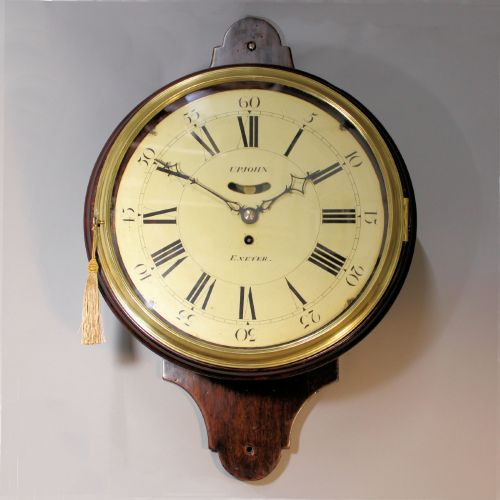
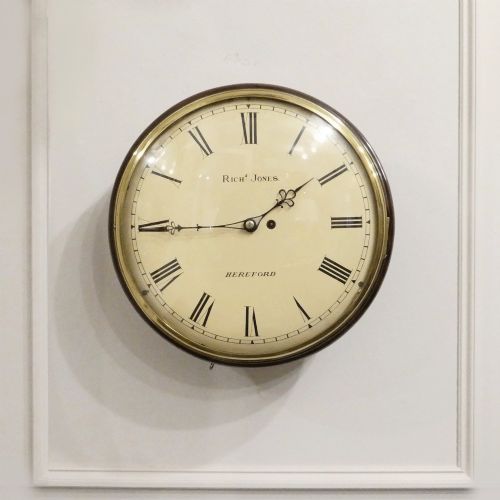
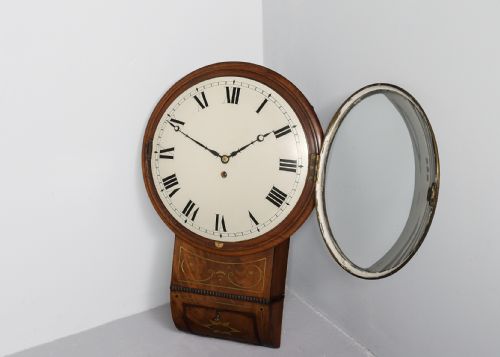
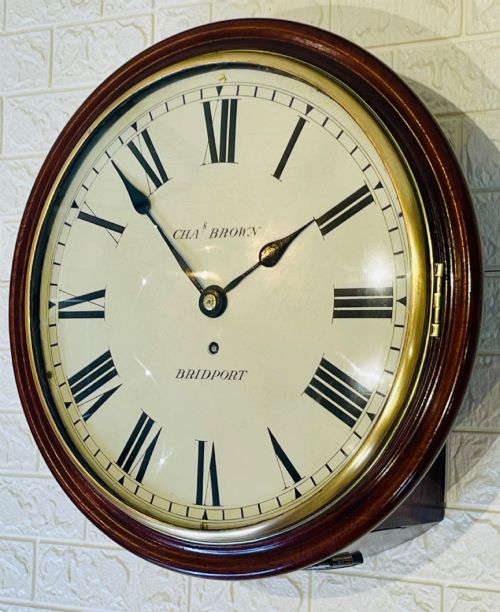



Georgian Fusee Wall Clock
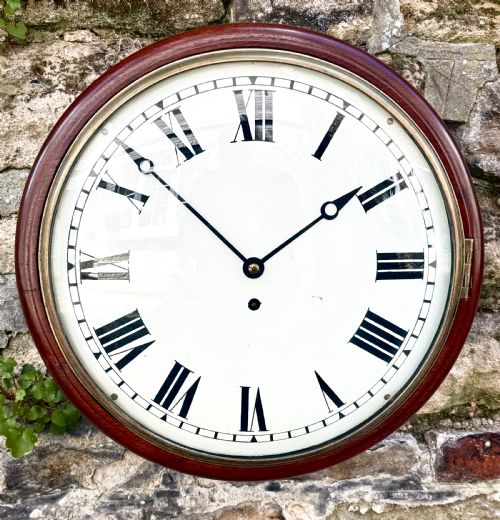
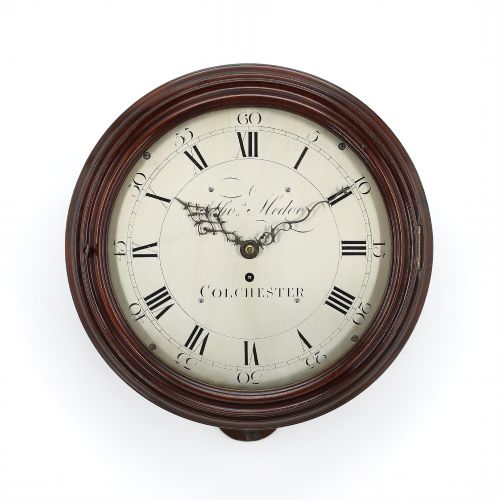
A georgian fusee wall clock delivers steady timekeeping through a spring-driven movement housed in a sturdy mahogany case designed for public or domestic spaces.
Georgian Fusee Wall Clock
When searching for a georgian fusee wall clock, buyers encounter timepieces originating primarily from the Georgian, Regency, and nineteenth-century periods. These timepieces take the form of round dial wall clocks, drop-dial clocks, and tavern clocks designed to hang securely in rooms. Most examples meet on this page feature mahogany cases paired with brass and glass components.
Makers ranged from provincial watchmakers to renowned London horologists, placing their signatures directly on the painted metal or wooden dials. Formats vary from standard circular dials to drop-dial and salt-box configurations fitted with bracket supports. These wall clocks served practical timekeeping needs in halls, parlours, and commercial premises.
How They Were Made
Craftsmen built the housings using solid mahogany timber, frequently shaping the grain to create rounded or octagonal frames and drop-dial cases. Brass inlay, iron reinforcement, and glass doors protected the internal mechanisms while adding decorative contrast to the timber. Cases often featured hinged side doors or bottom access boxes to allow straightforward adjustment of the pendulum.
The mechanical heart relied on a fusee movement, which used a conical pulley and a cord or chain to maintain even force as the driving spring unwound. Dials were constructed from iron, painted metal, wood, or convex glass surfaces, carrying painted Roman or Arabic numerals. Verge escapements regulated the beat of the clock, governing the release of power from the mainspring.
Listings feature mahogany, brass, and painted metal materials across the Georgian, Regency, and Victorian periods.
What Varies In Quality
Distinction across these timepieces rests upon the precision of the fusee movement and the crisp execution of the dial signwriting. Maker attribution to notable workshops elevates a piece, reflecting superior mechanical tolerances and finishing within the gear train. The integrity of the mahogany case, including original brass inlay and undisturbed timber patination, separates standard examples from exceptional ones.
Dial construction dictates visual clarity, with convex glass and wooden or painted metal faces showing varying degrees of preservation. The presence of original verge escapements and matching case components indicates higher survival integrity. Minor alterations to dial paint or movement parts alter the standing of a clock within the wider range.
Richard Jones of Hereford·Joseph Bird of Stroud·Thomas Hedge of Colchester·Cording of London·Francis Perigal London·Osborn of Kingsbridge·Haley and Milner London·Robert Salmon·John Thwaites·Atkins of Warwick·J Beckett of London·Webster·Peter Debaufre·James Murray of London·Birch of London·James Delasalle of Gosport·S B Gaze London·Heap London·Gaze of London·Daniels Liverpool·William Yonge of London·Sam White Bideford
The Georgian Fusee Wall Clock Glossary
- Fusee
- A conical pulley connected to the mainspring by a cord or chain, designed to equalise the torque as the spring unwinds. This mechanism ensures consistent power delivery to the gear train throughout the running cycle.
- Drop-dial
- A clock case featuring a circular dial at the top positioned above an extended lower wooden trunk. The lower section houses the pendulum bob and often includes a side or bottom access door.
- Verge escapement
- An early type of escapement mechanism utilising a crown wheel and a vertical rod with pallets. It controls the rotation of the gear train by allowing teeth to escape one by one.
- Convex dial
- A dial face curved outward toward the viewer rather than resting completely flat. This shaping reduces glare from room lighting and improves legibility from oblique angles.
- Tavern clock
- A large wall-mounted timepiece characterised by a prominent circular dial and a long drop trunk, traditionally used in public houses and large administrative rooms.
Georgian Fusee Wall Clock: Frequently Asked Questions
How do fusee clocks work?
A fusee movement uses a specially shaped conical pulley paired with a cord or chain to regulate the pull of the mainspring. As the spring loses tension, the chain moves to a wider section of the cone to maintain steady power.
This clever engineering compensates for the weakening spring force, helping the clock maintain accurate time until the next winding session.
Where were wall clocks hung?
These clocks hung in prominent spaces such as hallways, domestic parlours, and commercial offices where multiple people needed to check the hour. Drop-dial and tavern formats were selected for larger rooms to ensure visibility from a distance.
The sturdy mahogany cases and secure wall mountings kept the mechanisms stable and safe from everyday disruption in busy environments.
How do I wind the clock?
Winding involves inserting a key into the small winding aperture on the dial face and turning it carefully until the spring reaches full tension. Care must be taken not to overwind the mechanism, which can damage the internal components.
Most single-fusee wall clocks require winding at regular intervals, typically once a week, to keep the pendulum swinging consistently.
How do I identify a Georgian clock?
Georgian timepieces are identified by their characteristic mahogany timber construction, hand-painted dials, and specific maker signatures inscribed directly onto the face. Details such as convex metal or wooden dials and bracket supports point toward eighteenth and early nineteenth-century origins.
Comparing the movement style, such as early verge escapements, against known provincial and London makers helps confirm the period.