
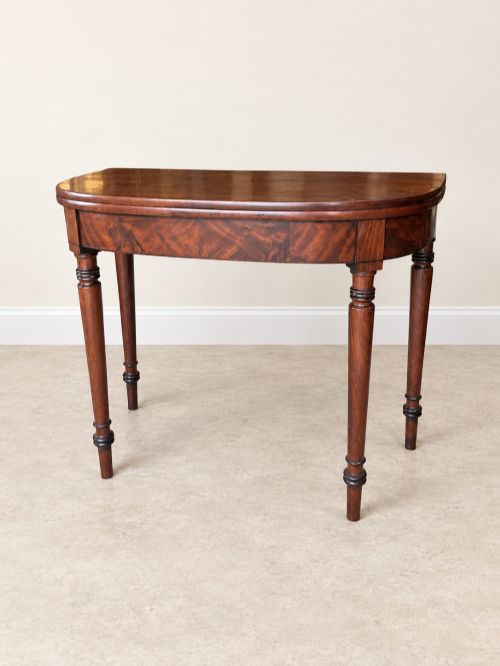

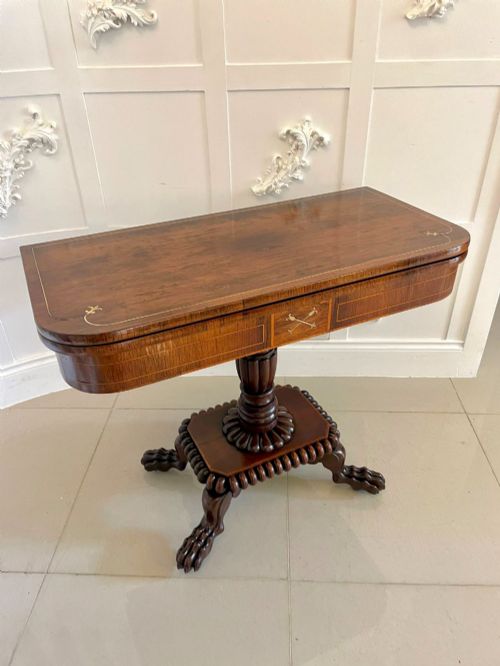
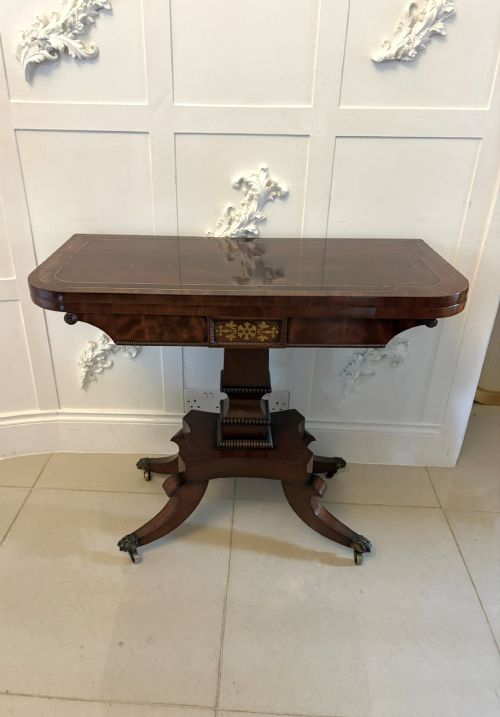
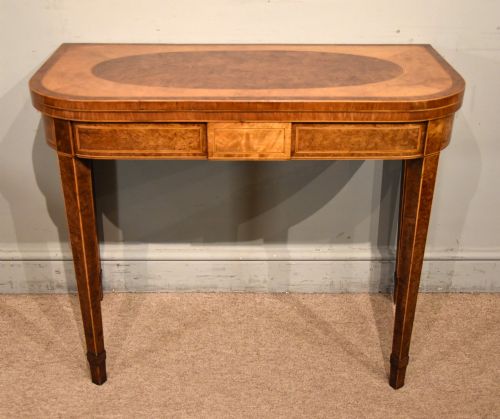
Georgian Folding Tea Table
A georgian folding tea table turns from a compact console against the wall into a broad surface for evening hospitality.
Georgian Folding Tea Table
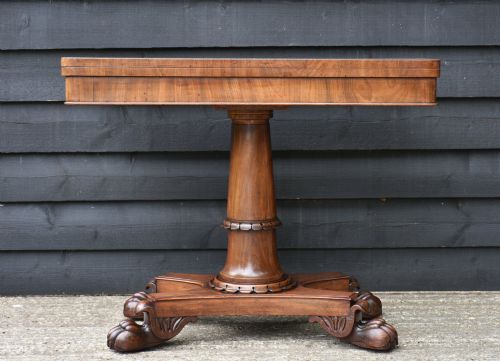
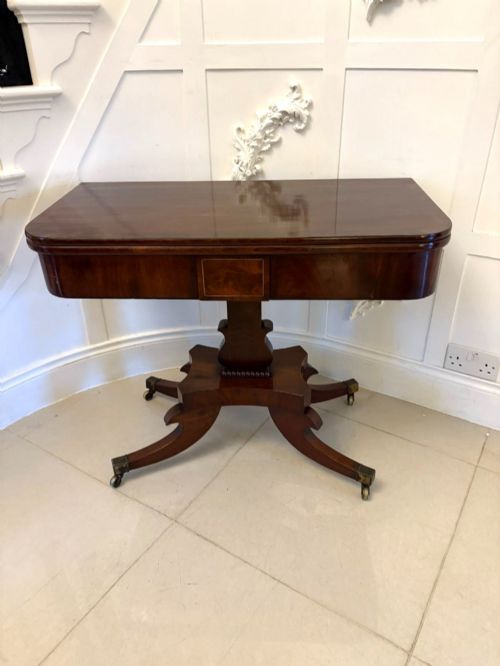
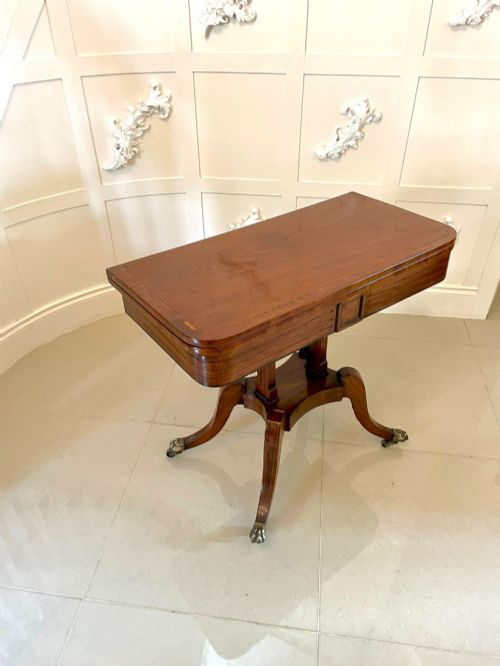
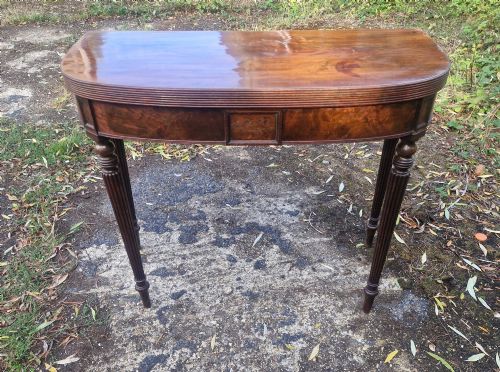
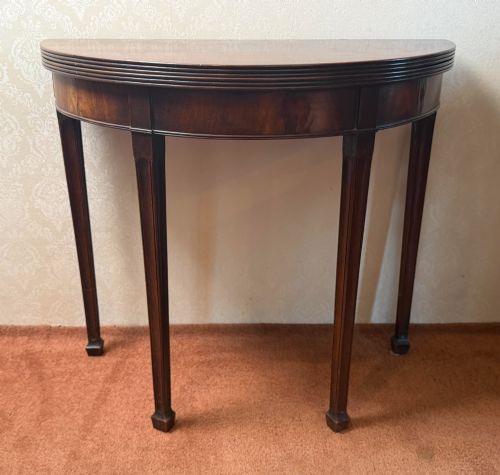
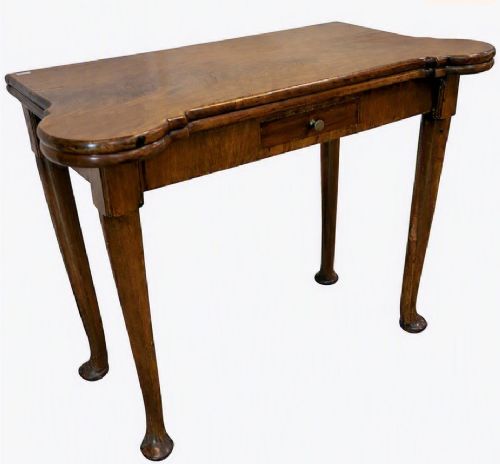
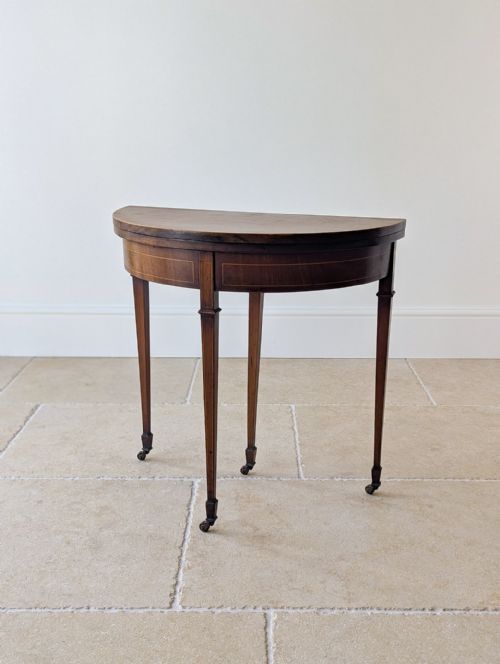
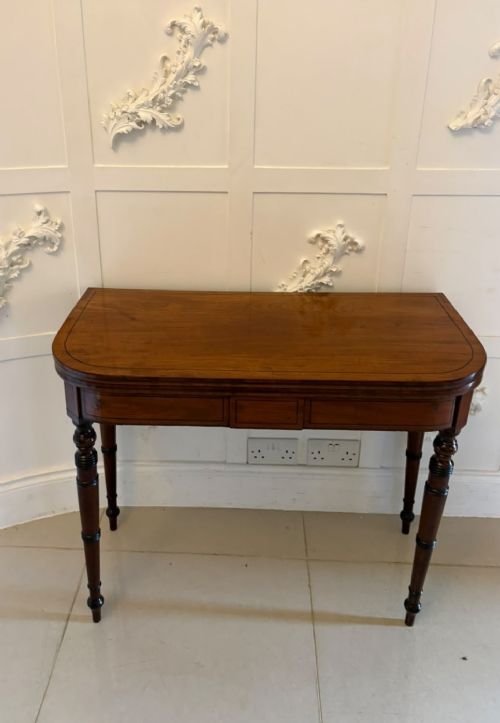
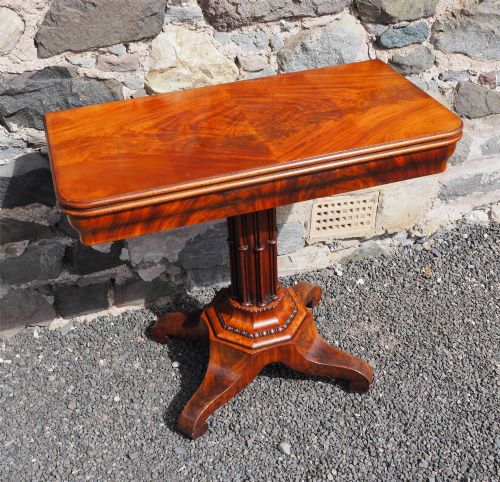
A georgian folding tea table is a multifunctional piece designed to sit against a parlour wall until needed for tea service or card games, expanding via a hinged top supported by a swing leg or concertina frame. The pieces seen here span the eighteenth and nineteenth centuries, taking the form of card tables, tea tables, and combined games tables.
Most examples you encounter on this page are constructed from mahogany, appearing in rectangular, D-shaped, or demi-lune formats. Makers adapted these tables to suit changing social rituals, producing folding surfaces that doubled as side consoles when closed.
Earlier Georgian specimens lean towards serpentine fronts and rich timber figuring, whilst later Regency and nineteenth-century iterations incorporate rosewood, satinwood inlay, and brass detailing.
Materials and construction methods
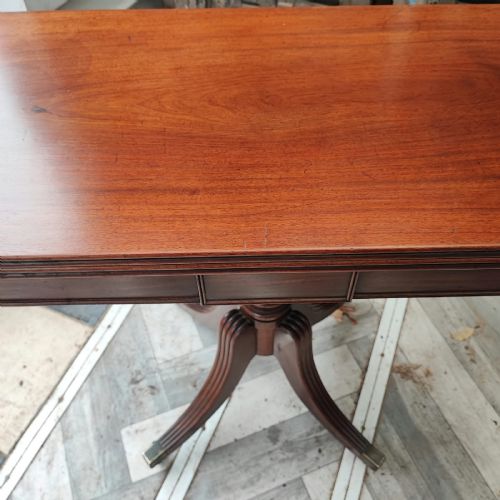
Cabinetmakers utilised solid timbers alongside fine veneers, applying flame mahogany and burr yew across the folding top surfaces to create striking visual patterns. Crossbanding in contrasting woods such as satinwood and boxwood often frames the primary grain.
Internal structures rely on clever mechanical actions, including concertina frames and swing legs that distribute weight evenly when the table is opened. Brass hinges, brackets, and inlay work provide both structural support and decorative contrast against the dark tropical hardwoods.
Listings feature mahogany, rosewood, and satinwood across eighteenth and nineteenth-century forms.
Distinguishing quality in folding tables
Quality rests upon the choice of timber and the precision of the cabinet work, particularly how seamlessly the two halves of the top meet when unfolded. Superior examples display uninterrupted grain alignment across the fold and possess heavy, stable timber frames that show little sign of warping.
The sophistication of the mechanism also marks the grade of the piece, with complex concertina actions requiring greater joinery skill than simple swinging single-leg supports. Original brass hardware, crisp carving on the legs, and deep, untouched surface patination elevate an ordinary table into a masterwork.
The Georgian Folding Tea Table Glossary
- Demi-lune
- A half-moon shape popular for console and card tables designed to stand flush against a wall. This format allowed tables to occupy minimal floor space when closed.
- Concertina action
- An expanding frame mechanism that allows all four legs to move outward when the table opens, providing balanced support for the unfolded top. This sophisticated design requires intricate internal joinery.
- Crossbanding
- A strip of veneer applied to the border of a tabletop with the grain running perpendicular to the main panel. It creates a neat visual frame around the central wood.
- Patina
- The deep sheen and surface character acquired by timber through age, handling, and waxing over decades. Collectors prize original patination for its warm, reflective quality.
- Serpentine
- A gently undulating front edge that curves outward in the centre and inward towards the corners. This flowing contour demands skilled hand-shaping of solid timber.
Georgian Folding Tea Table: Frequently Asked Questions
How were these tables used originally?
Owners placed these folding tables against parlour walls as decorative side consoles when not in use. During evening gatherings, hosts opened the leaves to serve tea or set up cards.
Once the company departed, the top folded back down to save space in the room.
How do I tell an 18th century table from a 19th century one?
Eighteenth-century examples often feature solid mahogany construction, subtle serpentine fronts, and crisp hand-carved details. Timber choice and carving styles shifted noticeably by the Regency period.
Nineteenth-century pieces frequently introduce rosewood, amboyna, brass inlay, and distinctive columnar or saber leg supports.
Will a folding table work in a modern home?
These tables adapt well to contemporary interiors because they function primarily as slim console tables against hallways or living room walls. Opening the top provides an instant serving surface or writing desk when guests arrive.
Their compact closed footprint makes them practical for smaller rooms.