



Georgian Flintlock Handgun
A georgian flintlock handgun offers a tangible link to the mechanics of eighteenth and nineteenth-century personal defence.
Georgian Flintlock Handgun
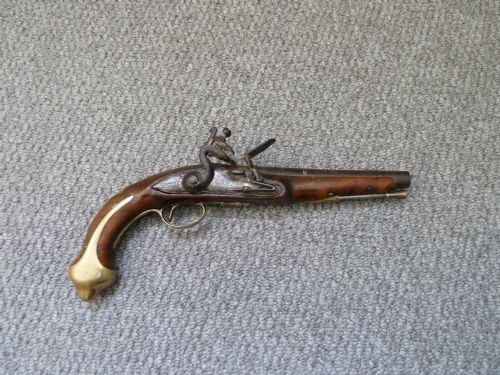
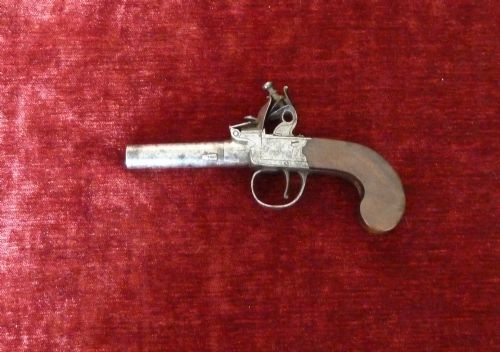
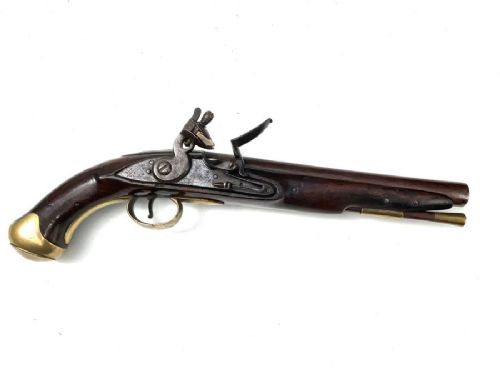
A georgian flintlock handgun encompasses pocket pistols, military holster arms, and heavy dragoon pieces originating primarily through the eighteenth and nineteenth centuries. The examples here span formats from private duelling sets bearing London proof marks to service arms marked by the Tower Armoury.
Buyers encounter distinct regional variations, including English silver-mounted pocket pieces, Irish specimens by makers such as Timothy Hughes, and Ottoman martial arms with cast barrels. Military and naval variants, such as the 1796 Pattern Light Cavalry issue or Sea Service models, sit alongside civilian overcoat and turn-off pistols.
The pieces reflect diverse ownership, from inspectors of mail coaches to cavalry officers and private travellers. Most date from the mid-eighteenth century through the Regency period, demonstrating both utilitarian government contracts and bespoke civilian craftsmanship.
How they were made
Stocks rely predominantly on figured walnut or standard wood, shaped to house the lock mechanism and barrel while accommodating brass or iron furniture. Many domestic civilian pieces incorporate decorative silver wire inlay or cast silver butt caps.
Barrels and lockplates utilise steel, iron, or cast brass, with select examples showing gilt inlay decoration or specialised cannon-barrel designs. Flintlock mechanisms depend on precise spring tension and tempered steel frizzens to create the spark against the flint.
Georgian Flintlock Handgun Retail Price Guide 2026
Typical asking prices for georgian flintlock handgun among the pieces listed under this phrase on Sellingantiques today, from the lower quarter to the upper quarter. They describe what is for sale here now, not the wider market.
Some pocket pistols were specifically built for mail coach inspectors, ensuring rogue highwaymen faced a sharp surprise.
What varies in quality
Distinction across the range rests on the signature of the maker and the crispness of engraving on the lockplate and furniture. Signed pieces by established London or provincial gunmakers command attention through superior metal finishing and balanced stock proportions.
The integrity of the original flintlock action and the retention of factory markings, such as crown and GR stamps or London proofs, determine the historical weight of an individual arm. Surviving details like silver wire inlay, baize-lined casing, and matching pairs elevate the standing of surviving items.
Harrison of London·T. Potts·Henry Nock·James Barber·Timothy Hughes·H.W. Mortimer & Son·Thomas Anelli·R. Willoughby·John Rimes·Meyer & Mortimer·Barber of Newark·Dutton·Wilson
The Georgian Flintlock Handgun Glossary
- Flintlock
- An ignition mechanism that uses a piece of flint held in a cock to strike a steel frizzen, creating sparks to ignite the priming powder. This system dominated personal and military firearms through the eighteenth century.
- Cannon barrel
- A barrel shaped with a flared, cannon-like muzzle profile, frequently found on turn-off pocket pistols of the period. This design allows the entire barrel to be unscrewed for loading.
- Proof marks
- Official stamps struck onto the barrel and breech to verify that the firearm has successfully passed pressure testing with gunpowder. These marks often help attribute the origin city, such as London.
- Bore
- The interior diameter of the barrel, measured either by caliber or by the weight of a lead ball fitting the bore size, such as eighteen-bore.
- Furniture
- The metal mounts on a firearm, including the trigger guard, sideplate, butt cap, and ramrod pipes, usually cast from brass, iron, or silver.
Georgian Flintlock Handgun: Frequently Asked Questions
How do I identify a Georgian flintlock handgun?
Look for period proof marks on the barrel and maker signatures on the lockplate, which typically date from the mid-eighteenth century to the Regency era. Government-issued arms often display Tower Armoury markings and crown stamps alongside walnut stocks and brass furniture.
Private civilian pieces frequently feature finer embellishments such as silver wire inlay, turn-off barrels, or engraved steel work. Comparing the lock geometry and barrel form helps separate standard military arms from bespoke duelling or pocket variants.
Were these pistols used for military or civilian defence?
The selection includes both government regulation military arms and private civilian weapons. Heavy holster and dragoon pistols served cavalry and naval forces, while smaller pocket and overcoat pistols protected private travellers.
Specialised examples include pieces issued to mail coach inspectors or officers requiring reliable sidearms. The scale of the bore and length of the barrel generally indicate whether a piece was designed for belt wear, saddle holster carry, or coat pocket concealment.
How should I care for an antique flintlock?
Keep the metal components lightly oiled with a suitable conservation wax or oil to prevent active corrosion on the steel, iron, and brass surfaces. Store the piece in a stable environment away from excess humidity and extreme temperature shifts.
Avoid aggressive cleaning of the wood or metal surfaces, as retaining original patinas and marks preserves the historical integrity of the piece.