




Black Powder Flintlock
These black powder flintlock pieces are historical firearms and militaria from the Georgian, Napoleonic, and 18th century periods that collectors acquire for their mechanical ingenuity and tangible connection to military history.
Black Powder Flintlock
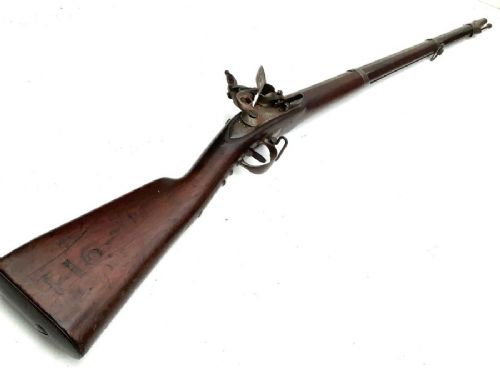
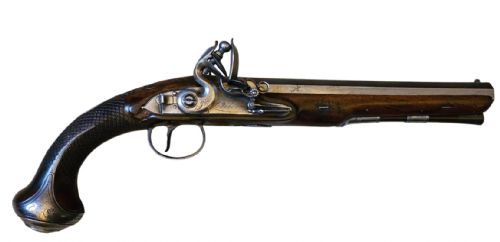
When searching for black powder flintlock, buyers encounter military muskets, service pistols, holster pistols, and blunderbusses originating from British, French, Russian, American, and Ottoman makers. These items span the 18th century, Georgian era, and the Napoleonic period.
The most common versions met on this page are military and officers' flintlock pistols alongside full-sized muskets featuring iron and steel lock mechanisms. Many examples hail from distinct European military campaigns and regional workshops.
Objects include specialised equipment such as powder measures and shoulder arms alongside handguns. Each piece represents the predominant ignition technology utilised by armed forces and civilians before percussion caps superseded the flintlock system.
How they were made
Gunsmiths utilised forged steel and iron for barrels, lock plates, and internal springs, combining these with hardwood stocks fashioned from walnut or other dense timbers. Brass furniture frequently appears on British and French military models for trigger guards, butt caps, and side plates.
The mechanics rely on a flint held in a cock that strikes a vertical steel frizzen, creating sparks that ignite black powder stored in a priming pan. Barrels were forged and bored to specific bores, while stocks were hand-carved to fit the individual lock and barrel assemblies.
Some barrels flare grandly at the muzzle just to ensure everyone nearby notes the business end of a blunderbuss.
What varies in quality
Quality separates through the crispness of the lock mechanism's action, the legibility of maker stamps or government inspection marks on the metal and wood, and the overall integrity of the stock. Finer pieces retain distinct maker signatures, such as Sargant & Son or Thomas Anelli, alongside well-preserved brass or iron mountings.
Execution of the metal engraving and the precision of the wood-to-metal fit distinguish standard military issue arms from bespoke officers' duelling pistols. Wear patterns differ depending on whether an item endured active service campaigns or remained preserved in private collections.
Sargant & Son·Thomas Anelli·Brasher·Barber of Newark·Wilson
The Black Powder Flintlock Glossary
- Flintlock
- An ignition mechanism utilising a piece of flint struck against a steel frizzen to generate sparks for black powder. This system dominated military and civilian firearms throughout the 18th and early 19th centuries.
- Frizzen
- The vertical steel plate struck by the flint to create sparks and cover the priming pan. It pivots forward upon impact to expose the black powder charge.
- Musket
- A muzzle-loading shoulder firearm used by infantry forces. These long guns formed the backbone of military tactics during the Georgian and Napoleonic eras.
- Blunderbuss
- A muzzle-loading firearm with a flared barrel designed to scatter lead shot at close range. It was commonly utilised by coach guards and naval personnel.
- Holster pistol
- A large handgun carried in a saddle holster by officers and cavalry troopers. These robust arms typically featured large bores for stopping power.
Black Powder Flintlock: Frequently Asked Questions
How do I identify a Georgian military flintlock?
Georgian military flintlocks often feature government inspection stamps, crown markings, and specific contractor names engraved on the lock plates. The incorporation of brass furniture and walnut stocks is also typical of British service arms from this timeframe.
Examination of the barrel proofs and lock geometry helps separate official military contracts from civilian or continental European manufacture of the same era.
What is the difference between a musket and a pistol?
Muskets are long-barrelled shoulder arms designed to be fired from two hands by infantry units across significant distances. Pistols are shorter, single-handed firearms utilised primarily by officers, cavalry, and civilians for personal defence.
Both systems share the same fundamental flintlock ignition mechanics but serve entirely different tactical roles in historical military operations.
How were flintlock pistols used historically?
Flintlock pistols served as secondary weapons for military officers and cavalrymen during close-quarters combat or when reloading a musket proved impractical. Civilians and travellers also carried them for protection against highwaymen along Georgian roads.
Due to their limited effective range and single-shot capacity, they required rapid deployment and dependable mechanical action to ensure reliability in the field.
What periods do these firearms cover?
The pieces span the 18th century, the Georgian era, and the Napoleonic period extending into the 19th century. This timeframe captures the height of flintlock technology before percussion cap systems gained widespread adoption.
Manufacturing styles evolved during these decades from simpler 18th-century forms toward standardised Napoleonic military patterns.