
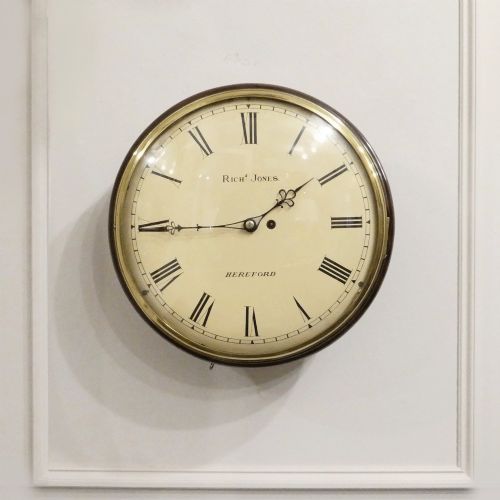
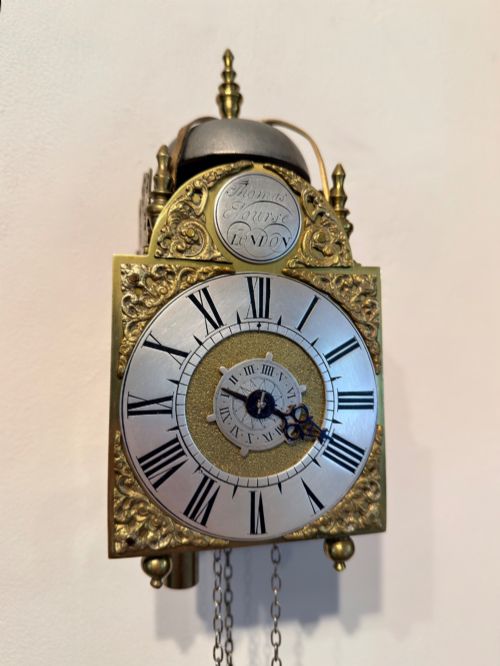
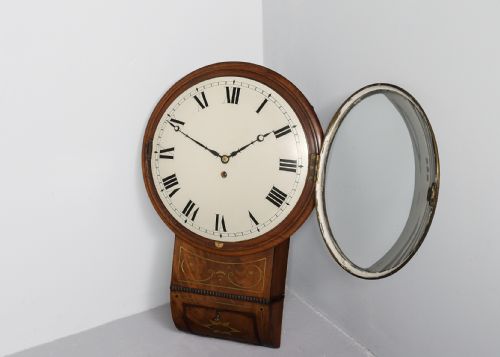
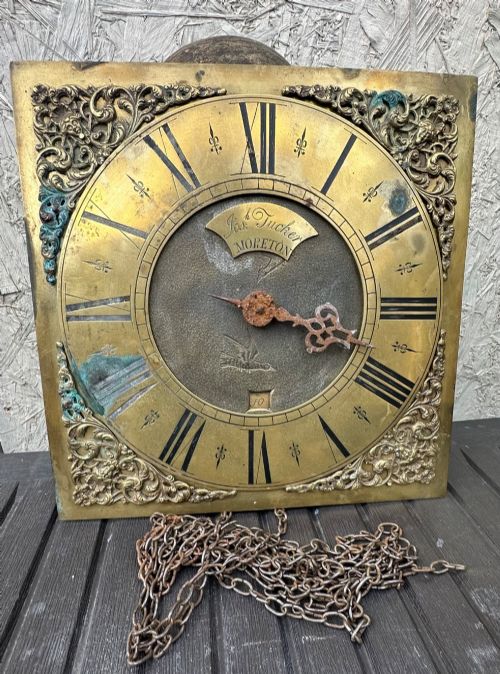
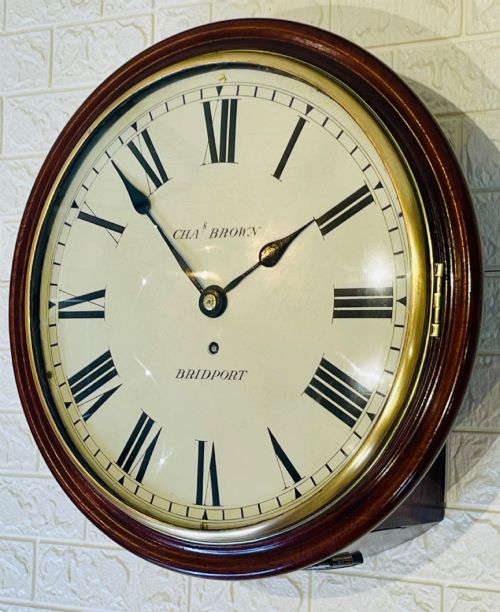
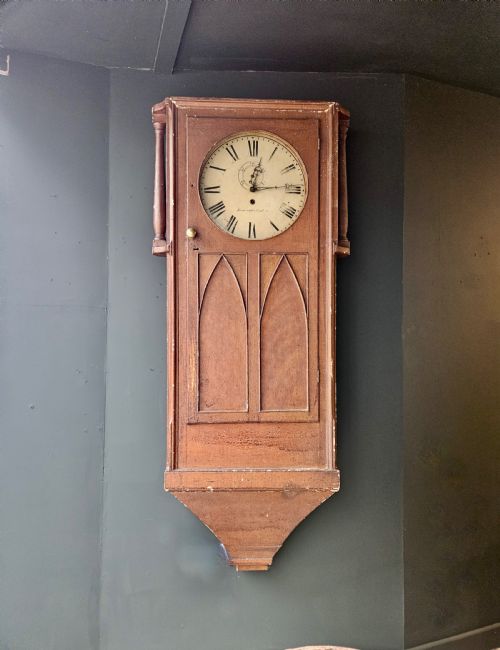
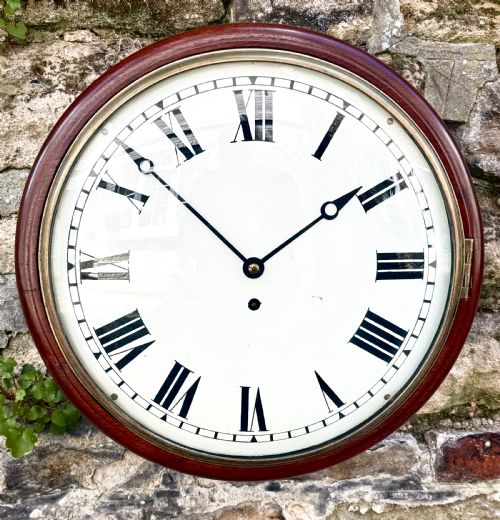

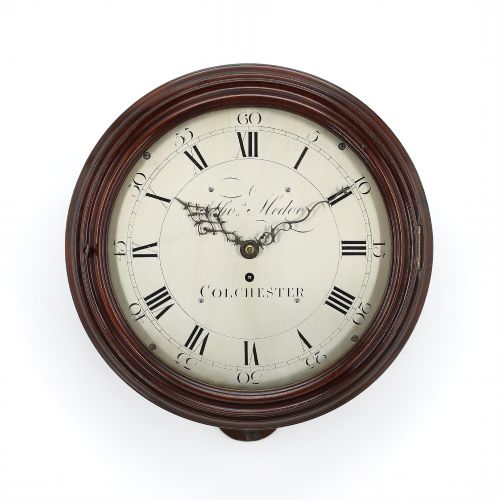


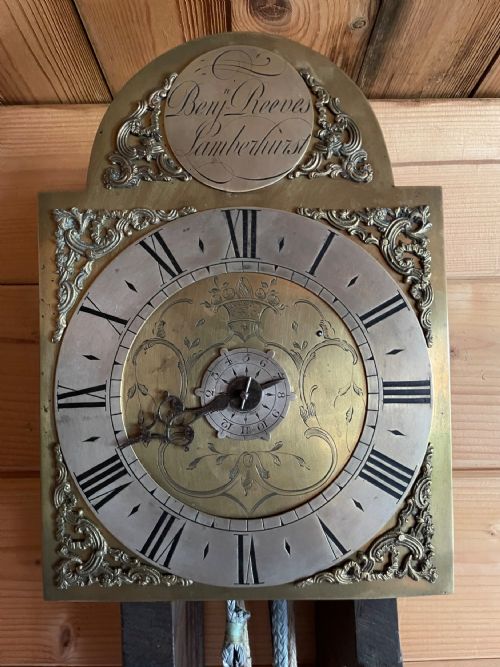


Georgian Dial Wall Clock
A georgian dial wall clock brings architectural presence and reliable timekeeping to a room through traditional English craftsmanship.
Georgian Dial Wall Clock
A georgian dial wall clock serves as a practical timepiece designed for domestic or public spaces, utilising a clear face for distance reading. The selection spans the eighteenth century, the Georgian era, and the Regency period, encompassing straightforward circular dials as well as drop-dial and tavern clock variants.
Mahogany cases dominate the selection, often paired with brass bezels and glass covers protecting painted metal, silvered metal, or wooden dials. Pieces frequently incorporate fusee movements designed to maintain even tension on the gear train as the mainspring unwinds.
Buyers encounter regional examples alongside London-made pieces, showing variations from simple hook and spike wall clocks to sophisticated drop-dial variations with convex faces.
Materials and movement construction
Clockmakers utilised solid mahogany for the protective cases, shaping timber housings to enclose the brass gear trains securely. Dials were constructed from sheet metal, wood, or convex iron, then painted or silvered for legibility.
Movements rely on fusee mechanisms or verge escapements, driven by steel springs and controlled by pendulum regulation. Brass components were cast and hand-finished, while iron and steel formed the structural arbors and springs.
A few energetic models carry alarm functions alongside timekeeping, ready to rouse eighteenth-century household sleepers from across the hall.
Craftsmanship and proportion
The distinction between tiers rests upon the crispness of the case timber, the neatness of the dial script, and the original state of the brass movement. Superior examples exhibit finely figured mahogany grain, robust brass plates, and well-proportioned bezels that close flush against the wall-box.
The integrity of the dial face influences worth, particularly where original painted numerals or maker signatures survive without heavy restoration. Movement components that retain their original finishing marks and unblemished teeth separate standard timepieces from masterwork productions.
Richard Jones of Hereford·Joseph Bird of Stroud·Thomas Hedge of Colchester·Benj Reeves Lamberhurst·Henry Deykin Worcester·Ganthony of London·John Seddon of London·Francis Perigal London·Osborn of Kingsbridge·Haley Milner London·Robert Salmon·Valiant Paris·John Thwaites·William Webster London·Atkins of Warwick·Borrell of London·Condliff of Liverpool·Birch of London·James Delasalle Gosport·S B Gaze London·Charles Shapland London·Samuel White Bideford·Heap London·Gaze of London·Daniels Liverpool
The Georgian Dial Wall Clock Glossary
- Fusee
- A conical pulley used in spring-driven clocks to equalise the torque of the mainspring as it unwinds. This mechanism ensures consistent force is delivered to the escapement throughout the running period.
- Drop dial
- A clock case featuring an extended lower wooden trunk beneath the circular dial, often housing a pendulum. The drop shape accommodates the swing while adding architectural weight to the wall mounting.
- Verge escapement
- An early type of escapement mechanism that controls the release of the gear train via a crown wheel and pallet impulses. It represents traditional horological construction found in older English wall pieces.
- Convex dial
- A clock face curved outward toward the viewer to reduce glare and improve visibility from various angles in a room. This curved form appears frequently on regional and London-made dials.
- Tavern clock
- A large, long-case wall clock featuring a prominent circular dial and a distinctively shaped wooden trunk. These pieces were historically utilised in public houses and large institutional spaces.
Georgian Dial Wall Clock: Frequently Asked Questions
How do I wind a fusee wall clock?
Winding requires inserting the key into the dial aperture and turning it gently until resistance indicates the spring is fully tensioned.
Care must be taken not to overwind the movement, ensuring the chain or cord on the fusee cone remains properly seated.
Where were these clocks originally hung?
These timepieces were traditionally placed in hallways, kitchens, parlours, and commercial establishments where accurate time visibility mattered.
Their secure wall-mounting design kept them safe from household foot traffic while remaining accessible for daily operation.
How do I date an English dial clock?
Dating relies on examining the case timber, the shape of the dial surround, the style of the hand-painted numerals, and the construction of the brass movement inside.
Maker signatures recorded on the dial face often cross-reference with historical trade directories to narrow down the decade of production.
Do wooden dials indicate a specific period?
Wooden dials appear frequently on Regency period and early nineteenth-century examples, often fashioned from solid mahogany or other native hardwoods.
These timber faces provide a distinct aesthetic alternative to the standard painted iron or convex metal dials of the era.