
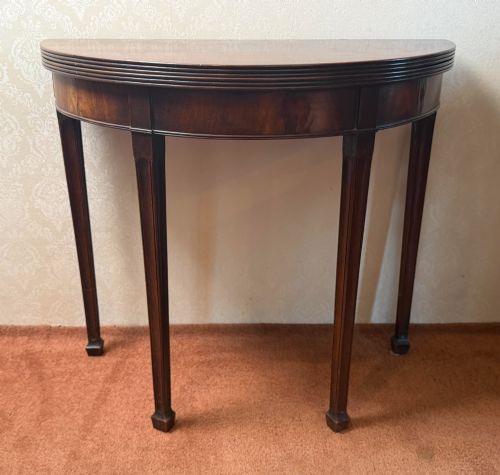
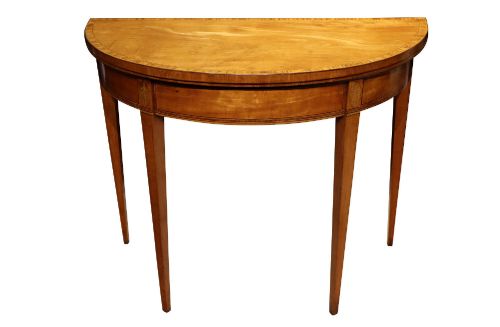

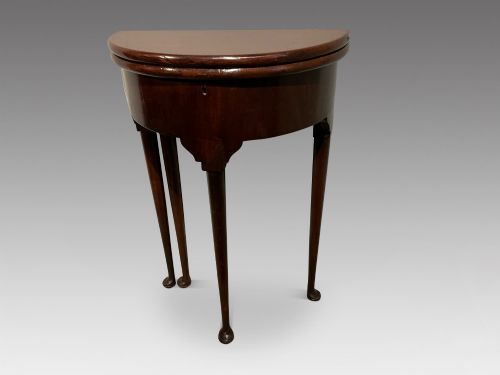
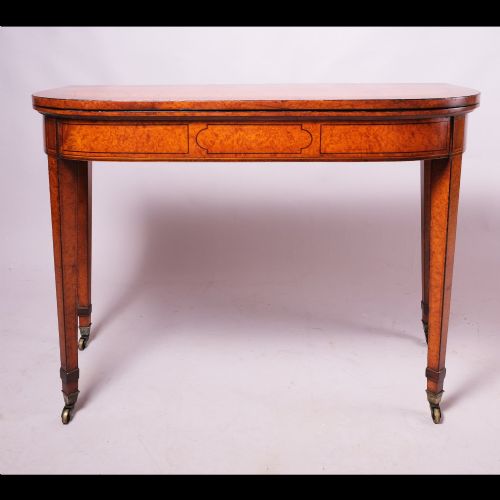
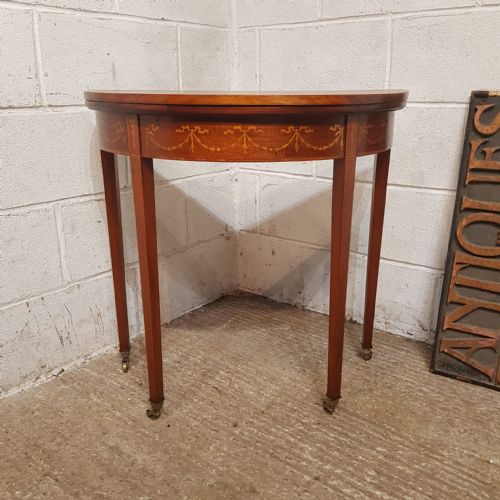
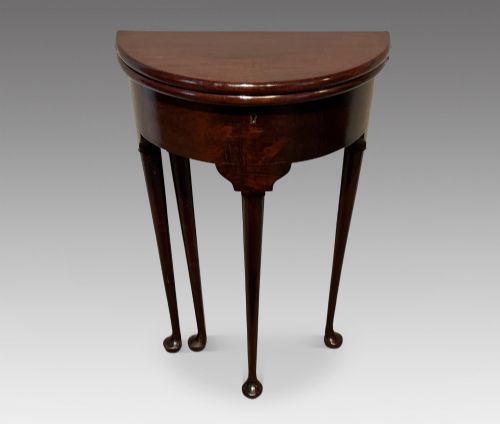
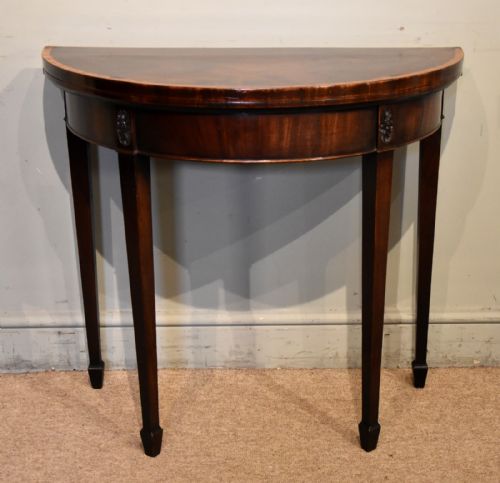

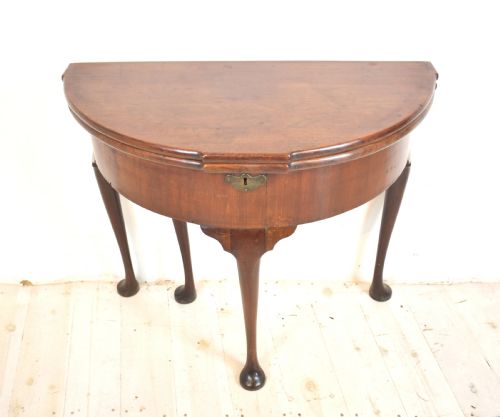
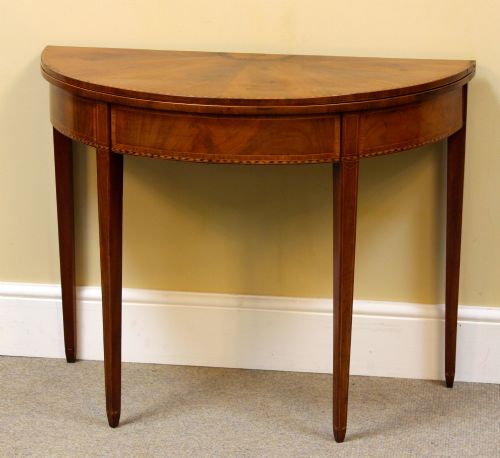


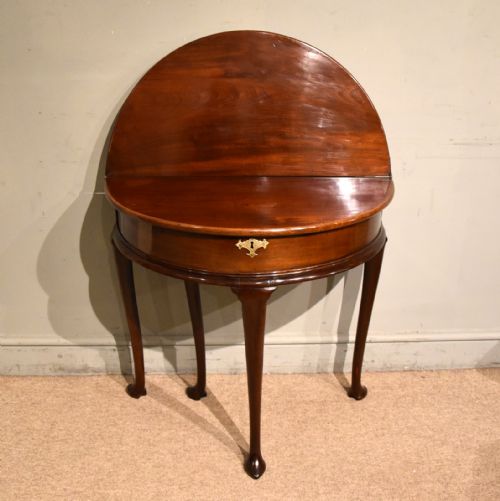

Georgian Demi Lune Card Table
A georgian demi lune card table brings neoclassical symmetry to a room, offering a semicircular console that opens to a green baize surface for evening gaming.
Georgian Demi Lune Card Table
A georgian demi lune card table combines the wall-hugging utility of a console with the folding top required for card play during the eighteenth century.
Makers designed these pieces to sit flat against a drawing room wall when closed, serving as pier tables until needed for evening entertainment.
How they were made
Cabinet makers built these frames primarily in mahogany, employing solid timber for structural rails and figured veneers for the semicircular tops.
Workshops utilised contrasting timber elements such as satinwood, kingwood, and boxwood inlay to create delicate banded borders and neoclassical paterae motifs.
Some tables conceal clever corner wells designed to catch stray gaming guineas before they rolled onto the carpet.
What varies in quality
The choice of timber grain fundamentally dictates the distinction between standard workshops and high-end cabinet makers, with figured flame mahogany and crisp kingwood crossbanding sitting at the upper end.
Precision in the hinge mechanism and the stability of the swing leg ensure the fold-over top remains level and true under daily use.
The Georgian Demi Lune Card Table Glossary
- Demi-lune
- A half-moon shape used to describe furniture with a curved front and flat back designed to stand against a wall.
- Crossbanding
- A narrow strip of veneer laid perpendicular to the main grain along the border of a tabletop to create a framed effect.
- Inlay
- A technique where pieces of contrasting timber or boxwood are inserted into recesses in the wood base to form decorative patterns.
- Fold-over
- A hinged tabletop construction that doubles the surface area when opened and supported by a pivoting leg.
- Baize
- A coarse woollen fabric traditionally used to line the playing surface of gaming tables.
Georgian Demi Lune Card Table: Frequently Asked Questions
How were these tables used originally?
Households placed these semicircular pieces against drawing room walls as decorative side or console tables during the day. When evening arrived, hosts unfolded the top to accommodate card games like whist or quadrille.
After play finished, the top folded back down to save floor space, keeping the room tidy.
Where should I place one at home?
These tables suit narrow hallways, entrance spaces, or living room walls where standard rectangular furniture projects too far into the floor plan. Because the flat back sits flush against vertical surfaces, they function well beneath mirrors or artwork.
Opening the top requires clearance on all sides, so position the piece where the leaf can swing freely.
How do I spot a later revival piece?
Revival pieces from the Edwardian period or the twentieth century often utilise machine-sawn internal timbers and modern brass hinges rather than hand-cut joinery. Examining the underside and the interior gate leg reveals the construction methods typical of later workshops.
Satinwood and mahogany finishes on nineteenth or twentieth-century examples also display different ageing characteristics compared to eighteenth-century originals.
What is the difference between tea and card tables?
While both utilise a folding semicircular top, card tables frequently feature internal wooden wells for storing counters and candles, alongside green baize playing surfaces. Tea tables typically present a polished polished wood interior designed to hold porcelain without gaming markings.
Both forms share the same demi lune silhouette and wall-console proportions.