



Georgian Brassware Pair
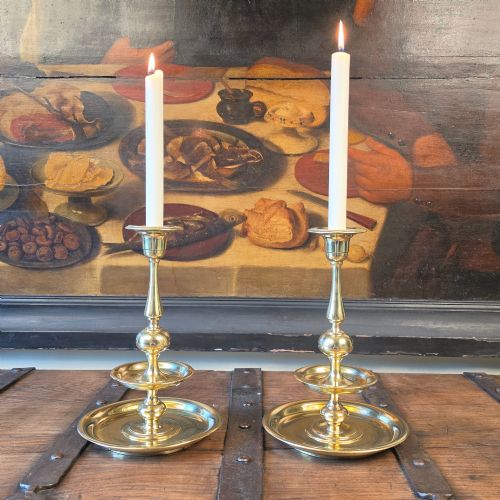
These georgian brassware pair pieces are dual hearth and table lights that bring heavy, warm metal to any room.
Georgian Brassware Pair
A georgian brassware pair consists exclusively of matching candlesticks formed in matched sets during the eighteenth and nineteenth centuries. These lighting pairs range from tall, large examples down to domestic chamber models.
The dominant form on this page is the candlestick, appearing across several decades of the eighteenth century and into the nineteenth. Makers shaped these pairs for functional illumination before electricity reached domestic interiors.
Examples span the reigns of George II and Queen Anne alongside later nineteenth century interpretations. Buyers find both seamed construction and solid cast bodies among the listed items.
How they were made
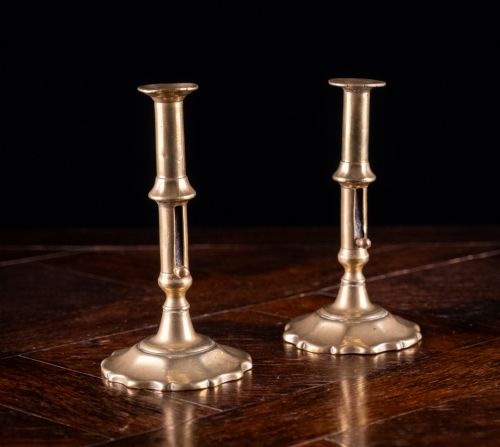
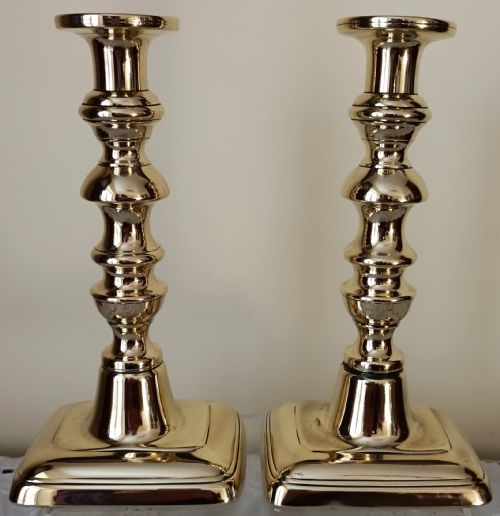
Foundries utilised brass and bell metal to cast these candlesticks in sections before joining them. Molten alloy filled sand moulds or bipartite metal flasks to create the basic sockets, stems, and heavy square or scalloped bases.
Makers formed many eighteenth century pieces from rolled sheet brass joined with a vertical seam down the stem. Telescopic varieties incorporated internal mechanisms like the Harrison patent for adjusting height.
Some eighteenth-century sticks include internal ejector blades so servants could literally shoot old wax stubs out of the bottom.
What varies in quality
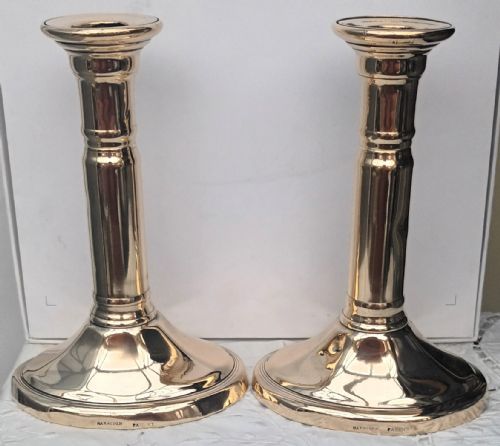
The weight of the casting and the crispness of the turned details distinguish superior pairs from simpler output. Cast brass pieces with thick walls and well defined drip pans demonstrate a higher standard of workshop production.
Patination and original surface survival set finer examples apart from heavily polished or altered pieces. The presence of functional ejector mechanisms and clear maker marks adds technical interest to individual pairs.
J.T. & Co·Harrison Patent
The Georgian Brassware Pair Glossary
- Ejector candlestick
- A lighting device featuring an internal sliding mechanism that pushes out the remnant candle stub. This mechanical addition helped domestic staff clear burned wax without damaging the socket.
- Bell metal
- An alloy of copper and tin that produces a resonant sound when struck. It was frequently utilised for robust domestic candlesticks.
- Seamed brass
- Sheet metal bent into a tubular shape and joined along a visible line to form the stem. This technique preceded advanced hollow casting methods.
- Telescopic
- An adjustable stem design allowing the candlestick to extend upward. Patented versions like the Harrison design allowed users to alter the height of the flame.
Georgian Brassware Pair: Frequently Asked Questions
What are georgian brassware pair pieces used for?
These matching sticks held tallow or beeswax candles to light dining tables, mantelpieces, and bedrooms during the eighteenth and nineteenth centuries.
Today, collectors place them on sideboards or mantelpieces to display period metalwork and provide ambient candle illumination.
How do I tell cast brass from seamed brass?
Cast brass pieces are poured in solid sections and lack vertical join lines along the shaft. They generally feel heavier and show smoother curves.
Seamed examples display a distinct vertical line where rolled sheet metal was joined together before being attached to the base and socket.
How do I clean antique brass candlesticks?
Most collectors prefer to leave a dark, undisturbed patination rather than polishing the metal to a bright shine. Gentle dusting with a soft cloth preserves the historic surface.
Avoid abrasive cleaners that strip away the centuries of oxidation which give these items their character.