



Georgian Pistol
A georgian antique pistol brings the tactile mechanics of eighteenth and nineteenth century personal defence directly to your cabinet.
Georgian Pistol
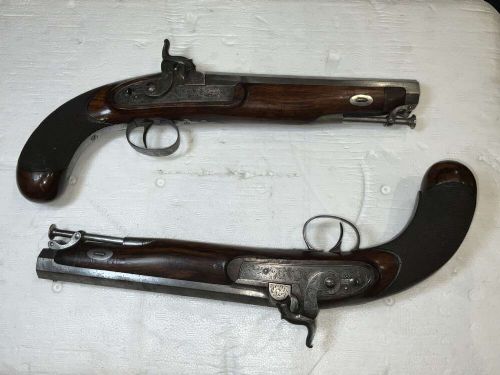
A georgian antique pistol encompasses muzzle-loading firearms produced primarily during the eighteenth and early nineteenth centuries, covering flintlock and percussion ignition systems. These arms span civilian pocket variants, military service pieces, and specialised duelling or target instruments.
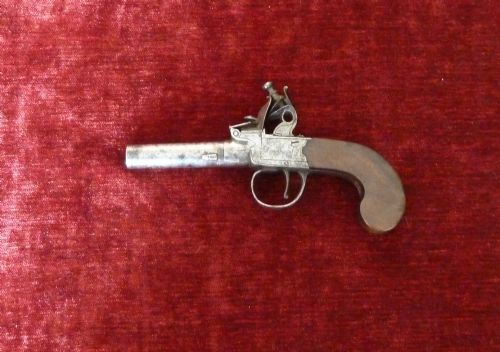
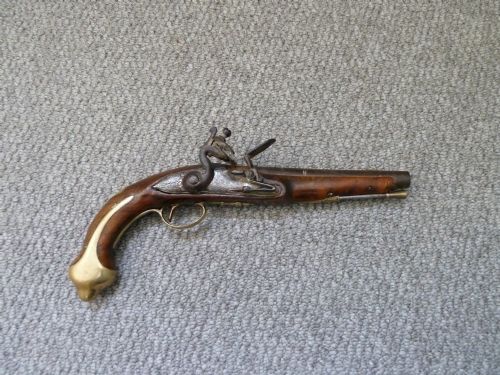
The most frequent examples encountered on this page originate from English workshops operating in London, Birmingham, and provincial centres. They range from compact turn-off pocket pieces designed for concealment to heavy dragoon and holster weapons utilised by military officers and travellers.
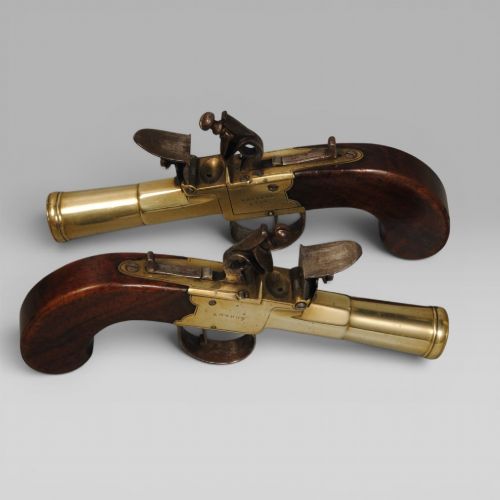
Stylistic influences reflect periods such as Queen Anne, Regency, and Georgian Military, incorporating brass, iron, or steel barrels paired with wooden stocks. Many items demonstrate regional characteristics, including Scottish Highland scroll-butts or Irish silver mounts.
Materials and Construction
Makers utilised forged steel and iron for barrels and lock mechanisms, often pairing them with cast brass for furniture, trigger guards, and butt caps. Barrels were frequently turned or cannon-moulded, occasionally featuring decorative engraving or gilt inlay.
Stocks were predominantly fashioned from dense, durable hardwoods such as walnut and mahogany, chosen for their ability to withstand the shock of discharge. Finer civilian pocket models frequently incorporated intricate silver-wire inlay or cast silver grotesque masks.
Lockplates were hand-fitted to individual stocks and engraved with maker signatures, inspection stamps, or crown motifs. Mechanisms relied on precise spring tension to release the flint against a frizzen or to drop the hammer on a percussion nipple.
Georgian Pistol Retail Price Guide 2026
Typical asking prices for georgian pistol among the pieces listed under this phrase on Sellingantiques today, from the lower quarter to the upper quarter. They describe what is for sale here now, not the wider market.
The inventory records pocket, duelling, dragoon, and sea service forms bearing proof marks from London and Birmingham.
Evaluating Quality and Execution
Quality rests upon the crispness of the maker's signature engraving, the precision of the metal-to-wood fit, and the overall balance of the piece in the hand. Master gunsmiths demonstrated superior discipline through clean lines, delicate scrollwork, and integrated spring-bayonet mechanisms.
The choice of secondary materials heavily influences the tier of manufacture, distinguishing utilitarian military contractors from bespoke cabinet pieces. Heavy brass furniture and plain iron denote service utility, whereas select figured walnut, silver wirework, and cast silver butt caps indicate high-status commissions.
Harrison of London·John Campbell of Doune·T. Potts·Twigg·Joseph Egg·Henry Nock·James Barber·Thomas Henshaw·Timothy Hughes·H.W. Mortimer & Son·Thomas Anelli·R. Willoughby·I Parr·John Rimes·Meyer & Mortimer·J. Robinson·Barber of Newark·Dutton·Wilson
The Georgian Pistol Glossary
- Flintlock
- An ignition mechanism utilising a piece of flint held in a cock to strike a steel frizzen, producing sparks to ignite the priming powder. This system dominated firearms production throughout the eighteenth century before the advent of percussion caps.
- Percussion
- A later ignition system where a hammer strikes a small fulminate-filled cap placed on a nipple, channelling fire to the main charge. It largely superseded the flintlock method during the early nineteenth century.
- Turn-off barrel
- A barrel designed to unscrew completely from the breech to facilitate powder and ball loading. This design allowed for tighter sealing and compact pocket pistol construction without a ramrod.
- Boxlock
- A firearm design where the breech and lock action are forged as a single unified housing, frequently featuring under-pan priming. It provided a streamlined profile common in blunderbuss and pocket pistols.
- Proof marks
- Official stamps struck onto barrels and actions indicating they successfully passed government or guild testing for pressure and safety. London and Birmingham proof houses applied distinct stamps used today for dating and attribution.
Georgian Pistol: Frequently Asked Questions
How do I identify a flintlock?
A flintlock operates through an external mechanism where a flint strikes a vertical steel plate to create sparks. Look for the distinctive cock holding the stone and the priming pan situated alongside the barrel.
This system was standard across military and civilian arms until the nineteenth century. Later variations transitioned to percussion systems which utilised an external hammer and a small nipple instead of a flint.
Were these pistols used for duels?
Certain examples were manufactured specifically as duelling arms, featuring long rifled or smoothbore barrels and sensitive set triggers. These were paired in fitted wooden cases alongside matching accessories.
Many other pieces listed are pocket, overcoat, or military service pistols intended for personal self-defence during travel rather than formal gentlemanly disputes.
Can these pistols still be fired?
While the mechanisms on many pieces remain in working order, modern firing is generally discouraged by collectors and dealers due to material fatigue and historical preservation. Historic proof standards do not align with modern smokeless powder pressures.
They are intended for display, study, and collection as historical artefacts of eighteenth and nineteenth-century metalwork and gunsmithing.
What is a Queen Anne pistol?
A Queen Anne pistol refers to a specific eighteenth-century design featuring a breech and action forged as a single piece with the trigger plate. They almost universally utilise a turn-off barrel and a distinct bulbous butt cap.
These pieces often lack sideplates, relying on clean lines and occasionally cast silver grotesque ornamentation for visual distinction.