


George II Style Armchair
A george ii style armchair brings substantial eighteenth-century proportion and rich carved timber into a room.
George II Style Armchair
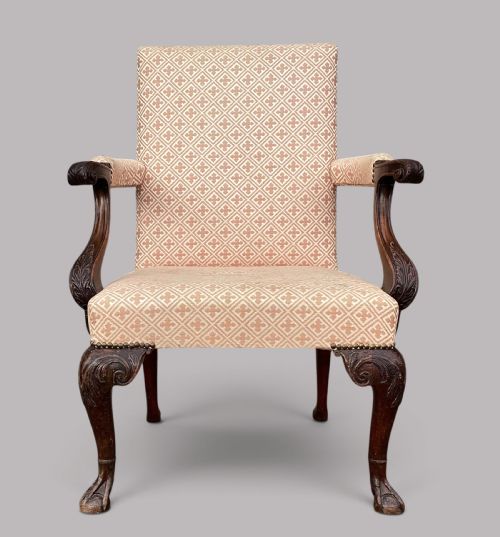
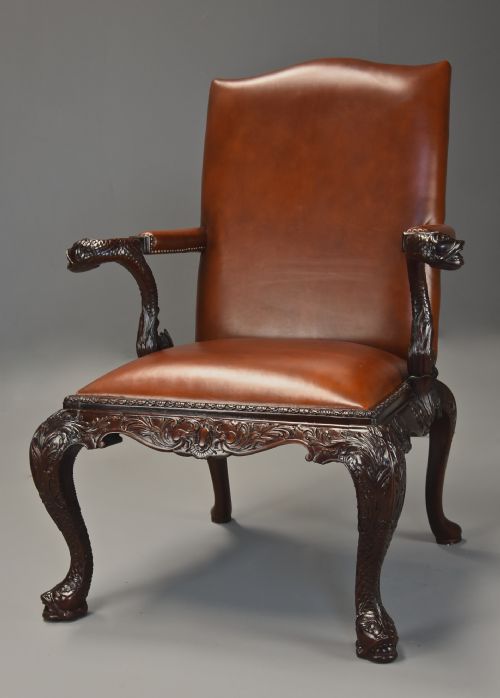
A george ii style armchair refers to seating inspired by the robust forms of the mid eighteenth century, constructed primarily during the nineteenth and early twentieth centuries. These pieces replicate the sweeping arms, scrolling knuckles and substantial cabriole legs characteristic of the original period.
The version most commonly met on this page is the mahogany or walnut Gainsborough chair, featuring an upholstered seat and back with open arms. Wing chairs and dining chairs built in this aesthetic also appear frequently among the listings.
Makers working in the Victorian and Edwardian eras revisited these designs to satisfy a demand for historic gravitas, producing library chairs and desk chairs that borrow heavily from Chippendale influences and Irish regional motifs.
How they were made
Timber selection centres on dense mahogany and figured walnut, chosen for structural strength and deep grain patterns. Carvers shaped solid sections of wood by hand to form shell motifs on knees and ball-and-claw feet.
Upholstery techniques rely on traditional webbing and stuffing secured beneath leather, velvet, tapestry or woven fabric. Brass tacks often edge the leather panels on Gainsborough and library chairs.
Joinery employs traditional mortise and tenon methods, ensuring the heavy frames support active use while retaining strict geometric alignment.
Listings feature mahogany and walnut as the primary woods, frequently paired with leather, velvet, and tapestry upholstery across nineteenth and early twentieth-century pieces.
What varies in quality
Depth and crispness of the hand carving distinguish the finer examples from routine workshop production. Crisp edges on acanthus leaves and well-defined talons on ball-and-claw feet indicate a skilled hand at the bench.
Proportion and stance dictate visual success, as lesser pieces often appear pinched or heavy in the arm supports. The sweep of the cabriole leg must balance the weight of the upholstered back without looking clumsy.
Material selection for secondary elements, such as the choice of solid mahogany over softer woods for structural rails, separates standard commercial items from bespoke commissions.
Robert Strahan Dublin
The George II Style Armchair Glossary
- Gainsborough armchair
- An open-armed, upholstered library chair with a wide seat and low arms designed to accommodate eighteenth-century court dress. This form is common in nineteenth-century revivals.
- Cabriole leg
- A furniture leg that bends outward in a convex curve and tapers inward in a concave curve, ending in a foot. It mimics the shape of an animal's leg.
- Ball-and-claw foot
- A carved foot depicting a bird's talon grasping a spherical ball. It appears frequently on eighteenth-century and revival seating.
- Chippendale style
- A decorative vocabulary associated with Thomas Chippendale featuring rococo, gothic and Chinese motifs. Pieces often display intricate pierced splats and ornate carved rails.
- Wingback armchair
- An upholstered chair with high sides attached to the arms to shield the user from drafts. Revivals of this form incorporate deep padding and leather coverings.
George II Style Armchair: Frequently Asked Questions
Are these chairs genuine eighteenth century?
Most examples found here date from the nineteenth and early twentieth centuries, constructed during revival periods. Makers at that time deliberately copied mid-eighteenth-century proportions using period techniques.
While original eighteenth-century pieces exist, the majority on the market represent skilled later interpretations of the aesthetic.
How do I use a Gainsborough chair at a desk?
A Gainsborough chair works well at a partners desk or a library table due to its upholstered comfort and open arm design. The low arms slide easily beneath standard desk heights.
Ensure the seat height matches the writing surface before placing the chair into a daily workspace.
What is the difference between George II and Chippendale styles?
George II design typically emphasises heavy proportions, bold cabriole legs, and shell carvings. Chippendale style, evolving directly from this period, introduces lighter fretwork, ribbon backs, and stronger Gothic or Chinese influences.
In practice, revival pieces often blend both vocabularies into a single carved mahogany frame.
How should I care for leather upholstery?
Leather upholstery requires regular dusting with a soft cloth and occasional treatment with a suitable leather conditioner to prevent cracking. Keep the chair away from direct sunlight and heat sources to preserve the natural moisture of the hide.
Hand-dyed leathers particularly benefit from minimal moisture and gentle handling.